
Underkeep Guide | Combat Explained
This Underkeep Guide Explains The In-Game Combat
Game Guide by Amaya on Nov 16, 2026
Combat in Underkeep is turn-based, with each hero receiving one action per round. Winning battles depends on managing your party's positions, choosing the right attacks, exploiting enemy weaknesses, and understanding how accuracy, armor, and status effects work.
How Combat Rounds Work
Each hero gets one action per round. This can be a basic attack or their assigned active skill. However, some abilities are free actions and do not consume the hero's turn. Check the skill tooltip for the message "Does not consume an action" to identify these abilities.
Potions and inventory items can also be used without spending an action, making them useful when you need to heal or remove a status effect without sacrificing an attack.
A round ends when every hero has acted or when you press the hourglass button. Be careful with the hourglass, because any heroes who haven't acted will skip their turns.
Another important restriction: once any hero takes an action, your party cannot move until the round ends. This means you should arrange your formation before starting Combat and avoid wasting actions on unnecessary position changes.
Rows, Positioning, and Attack Range
Your party's formation affects which attacks you can use and how much damage your heroes receive.
-
Front Row: Most melee attacks require a hero to stand in the front row. Enemies also tend to target the front row, so place your tankiest characters here.
-
Back Row: This is generally safer from ordinary enemy attacks and allows ranged characters and spellcasters to attack without moving forward.
-
Reach Weapons: Weapons with the Reach property let you make melee attacks from positions that would normally be too far away.
-
Out of Reach: If an enemy is out of reach, move closer, equip a Reach weapon, or use a ranged attack or spell.
Changing a hero's position costs that hero's action. Plan your formation before entering a fight rather than spending valuable turns rearranging everyone.
Combat Tactics That Win Fights
Focus your damage and keep dangerous enemies from taking their turns.
Focus Fire: Concentrate your party's attacks on one enemy instead of spreading damage across several targets. Abilities such as Hunter's Prey, Mark the Dead, and Unholy Convergence can help mark a target so your heroes can focus on eliminating it.
Use Crowd Control: Stun, Freeze, and Blind can prevent enemies from attacking effectively. Skills such as Skull Rattle, Shield Bash, and Arcane Lock can stun enemies, while Ice Shard freezes targets and Smoke Bomb blinds them. Use these abilities against dangerous enemies before they can deal significant damage.
Check Enemy Immunities: Some enemies are immune to critical hits or specific status effects, including Stun, Bleed, Burn, Freeze, Poison, Blind, Paralysis, and Disease. Watch the combat log when an effect fails. If an enemy resists your usual strategy, switch to another damage type or ability.
Exploit Enemy Types: Undead, Demons, and Animals have different counters. Paladins are particularly effective against Undead and Demons, while Elks gain armor against Animals. Choosing the right hero for an encounter can make difficult fights easier.
Retreat When Necessary: If a battle goes badly, you can end the round and retreat. You can also leave, rest, and return when your party is better prepared.
Destroy Objects: Some objects in the world are destructible and can be attacked. Keep an eye out for these during exploration.
How Experience Is Shared
Experience points are divided between the heroes who are alive when an enemy dies. Each enemy's XP is split evenly among surviving party members, with fractions rounded down. Heroes who are dead when the enemy is defeated receive no experience from that kill.
The same rule applies to experience earned from quests and encounters. For example, if your party receives 400 XP and all four heroes are alive, each receives 100 XP. If only one hero is alive, that character receives the entire amount.
Individual XP bonuses are applied after the experience is divided. Humans receive a 10% bonus, while equipment with Experience bonuses can provide additional XP.
Kill experience also changes depending on difficulty:
-
Easy: 90% of the normal kill XP.
-
Normal: 95% of the normal kill XP.
-
Hard: 100% of the normal kill XP.
A hero who dies during a fight still keeps the experience earned from enemies defeated before they fell. You can also deliberately concentrate experience on one hero by keeping the others dead during kills, then reviving them at a statue for gold. This is a consequence of how the game's experience-sharing system works.
Hit Chance Explained
Every attack that can miss uses a hit chance roll between 1 and 100. If the result is equal to or lower than the attack's hit chance, the attack connects.
Hit chance is calculated using flat points rather than percentages that multiply. Dexterity, equipment bonuses, enemy Evasion, and Blind all add or subtract points from the final result.
The game does not display your final hit chance against an individual enemy, so you may need to calculate it yourself.
Melee Hit Chance
Your heroes' melee hit chance follows this formula:
Melee Hit Chance = 100 + Melee Hit Bonuses - Enemy Evasion - Enemy Melee Evasion
Melee attacks start at 100% accuracy, regardless of Dexterity. This makes melee particularly reliable against enemies with low Evasion.
Melee hit bonuses are extremely limited. The only source listed in the combat data is the Raven mutation Twisted Balance, which applies a -5 penalty.
Weapon skills such as Flurry Thrust, Cleave, Bleeding Dash, and Backstab the Weak use the same accuracy calculation as regular melee attacks.
Blind reduces a hero's melee hit chance by 50 points.
Ranged Hit Chance
Ranged attacks use Dexterity as their main accuracy stat.
Ranged Hit Chance = DEX × 10 + Ranged Hit Bonuses - Enemy Evasion - Enemy Ranged Evasion
This means a character with 5 Dexterity starts with 50 ranged accuracy, while a character with 10 Dexterity starts with 100 before enemy Evasion.
Several items and effects can increase ranged accuracy:
-
Cloak of Swiftness: Provides +5 ranged accuracy per level, up to +25.
-
Marksman Signet: Provides +5 ranged accuracy.
-
Ring of Ranger Guard: Provides +10 ranged accuracy.
-
Scoutwind Boots: Provide +10 ranged accuracy.
-
Helmet of Lucky Farsight: Provides +20 ranged accuracy and gives missed ranged shots a second roll.
Some effects reduce ranged accuracy. The Raven mutations Photosensitive Eyes and Twisted Balance apply -20 and -5 penalties, respectively. Blind also reduces ranged accuracy by 50 points.
Ranged weapon skills, including Aimed Shot, Barbed Arrows, and Execution Shot, use the same calculation.
Spell Accuracy
Spells never miss. Damaging spells skip the hit chance calculation entirely, meaning enemy Evasion and Blind do not reduce their accuracy.
This applies to spells such as Fire Spark, Static Shock, Ice Shard, Fireball, Ice Tower, Storm Chain, Arcane Lock, Void Lance, Unholy Convergence, Blood Lance, Bloodfall, Exsanguinate, Scarlet Shackles, Blood Pact, Mark the Dead, and Flame of Conviction. Spell attacks from staffs follow the same rule.
However, spells' secondary effects still have their own chances of applying. For example, the chance to Burn, Freeze, or Stun an enemy is calculated separately.
Smoke Bomb also skips the normal hit roll, but that enemy's Evasion reduces its chance to be Blinded.
Because spells cannot miss, they are particularly useful against enemies with high Evasion, such as snakes and spiders.
Thrown Items
Throwing an item at an enemy uses a separate accuracy formula:
Throw Hit Chance = 100 - Enemy Evasion - Enemy Melee Evasion
Your Dexterity, equipment bonuses, and Blind do not affect this calculation.
Enemy Accuracy and Evasion
Enemies use a different formula when attacking your heroes.
Enemy Hit Chance = 100 - Your Evasion
Ranged enemy attacks also account for your ranged-only Evasion.
Your Evasion is calculated using Dexterity and equipment bonuses:
Evasion = DEX × 2 + Gear and Buff Bonuses
Evasion is normally capped at 60. The Evasive Roll ability increases this cap by two per level, up to an additional 10 points. Ranged-only Evasion from effects such as Glimmerhide is added after the normal cap.
Some armor reduces Evasion. For example:
-
Plate Armor: -10 Evasion.
-
Plate Boots: -8 Evasion.
-
Plate Helmet: -6 Evasion.
-
Chain Armor: -8 Evasion.
Lighter equipment can provide small Evasion bonuses. Leather Boots provide +2, Monk Tunic provides +4, and quarterstaffs provide +5.
Blind is particularly effective against enemies because it reduces their hit chance by 50 points. This makes Smoke Bomb a powerful defensive ability, especially against enemies that rely on physical attacks.
However, enemy spell attacks cannot normally be dodged through Evasion. They skip the Evasion calculation entirely. The Raven mutation Phase-Slip Carapace is the only listed way to avoid these attacks.
How Armor Reduces Damage
Armor reduces incoming physical damage, but each point of Armor does not remove a full point of damage.
Armor calculation is:
Damage Taken = Enemy Damage Roll - (60% of Your Armor After Armor Pierce, Rounded Up)
Enemy Armor Pierce reduces the amount of Armor used in this calculation.
For example:
-
2Armorr: Reduces incoming damage by 2.
-
5 Armor: Reduces incoming damage by 3.
-
10 Armor: Reduces incoming damage by 6.
An enemy attack that normally deals 7 damage against a hero with 10 Armor will deal 1 damage. If the attack is a critical hit, it deals 2 damage instead.
Enemies do not have Sharpness, so they cannot add damage back after your Armor reduction. If Armor reduces an attack to zero or less, the Armor deals no damage, and additional effects such as Fire or Poison are also skipped.
Enemy critical hits deal double damage after Armor reduction. Your heroes' critical hits work differently, dealing 1.75 times their normal damage. Heroes immune to critical hits receive a normal hit instead.
Understanding Enemy Evasion
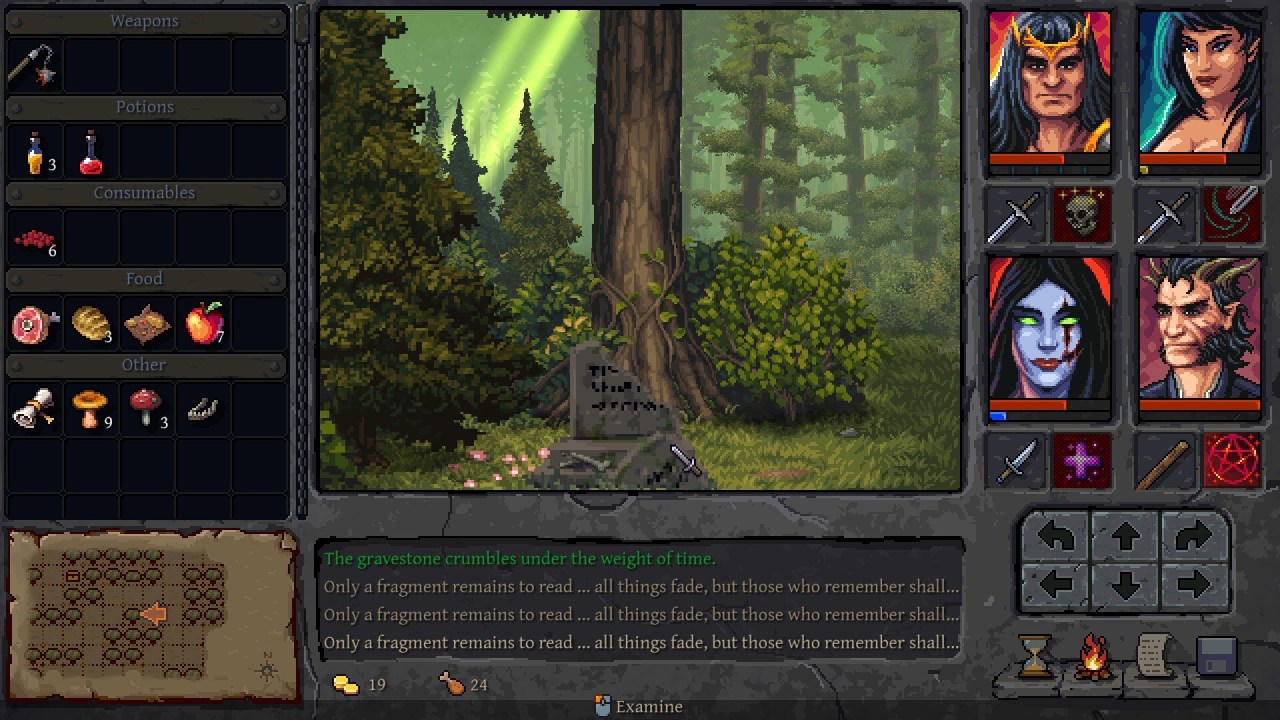
Different enemies have different Evasion values, and some receive additional Evasion against specific attack types. This is especially important when deciding whether to use melee or ranged attacks.
Some examples include:
-
Boneblade: 0 Evasion, with an additional +30 against ranged attacks.
-
Boneblade Archer: 5 Evasion, with an additional +30 against ranged attacks.
-
Fallen Swordsman, Ooze Cube, and The Faded: 0 Evasion.
-
Giant Rat: 15 Evasion.
-
Orc Fighter: 16 Evasion.
-
Underfang, Swampling, and Cinderling: 20 Evasion.
-
Wrathclaw: 25 Evasion.
-
Stormspinner, Duskwither, and Shadow Beast: 30 Evasion.
-
Wrathspinner and Grimapple: 40 Evasion.
-
Voidbiter: 40 Evasion, with an additional +50 against ranged attacks.
-
Grassfang: 50 Evasion, with an additional +10 against melee and +20 against ranged attacks.
These values explain why certain enemies are harder to hit with particular weapons. Skeletons, for example, have additional Evasion against ranged attacks, making melee a more reliable option. Grassfangs are difficult targets for both melee and ranged characters, while spells remain reliable because they never miss.
Worked Accuracy Examples
Consider a Ranger with 7 Dexterity and a level 2 Cloak of Swiftness. The Ranger has 70 base ranged accuracy and receives another 10 points from the cloak.
This gives the Ranger 80 ranged accuracy before enemy Evasion.
-
Against a Wrathclaw: 80 - 25 = 55% hit chance.
-
Against a Boneblade: 80 - 30 = 50% hit chance.
-
Against a Grassfang: 80 - 50 - 20 = 10% hit chance.
A Warrior attacking the same enemies has 75%, 100%, and 40% melee hit chances, respectively. A Wizard using spells has 100% accuracy against all three.
The main takeaway is that ranged attacks are not automatically more accurate than melee. Melee starts at 100% accuracy, while ranged attacks need sufficient Dexterity and bonuses to reach the same value. Ranged attacks are still useful because they can hit enemies from the back row.
If your archer has 125 ranged accuracy but still misses, remember that this value is calculated before enemy Evasion. For example, against a Grimapple with 40 Evasion, the final hit chance is 85%. This means roughly one in seven shots can miss.
If your accuracy seems lower than expected, check whether the archer is Blinded, affected by Raven mutations, or suffering from Backseat Parasite. The latter sends half of your attacks toward a random enemy, which may have higher Evasion. Each shot also makes its own accuracy roll, so multiple misses can happen even when your hit chance is high.
Status Effects and Their Cures
Status effects can change a fight's outcome by dealing damage over time, preventing actions, or reducing a character's effectiveness.
The following effects are particularly important to understand:
-
Poison: Deals damage every round, with a minimum of 1 damage. Its duration is affected by Endurance. Use a Potion of Cure Poison or Void Mend Level 4.
-
Burn: Deals Fire damage every round. Use Frostvein Draft or Void Mend Level 3.
-
Freeze: Causes the affected character to skip their turn. Use Frostvein Draft.
-
Bleed: Removes HP every round. Use Void Mend Level 2.
-
Stun: Prevents the affected character from acting. Stun does not stack. Use Thunderwake Draught or Void Mend Level 5.
-
Paralyze: Prevents movement and locks the entire party in place, although characters can still attack. Use Thunderwake Draught.
-
Blind: Reduces melee and ranged accuracy by 50 points. It does not affect spells. This effect eventually wears off.
-
Disease: Prevents recovery while resting. Cure it before resting to avoid wasting food without restoring health.
-
Mental Fog: Prevents the affected character from using skills for several rounds. Wait for it to wear off.
-
Slime Corrosion: Reduces Armor. Wait for it to wear off.
Disease is especially dangerous outside Combat. If you rest while a hero is diseased, you will consume food without receiving the usual recovery benefits.
How Status Effects Stack
Applying the same status effect multiple times does not always increase its damage. Most effects follow a fixed stacking rule.
For Poison, Burn, Bleed, Freeze, Blind, Paralysis, Disease, and Slime Corrosion, the game keeps the stronger effect and adds the new duration to the remaining rounds.
For example, imagine an enemy is already Bleeding for 2 damage per round with 2 rounds remaining. You then apply a stronger Bleed that deals 4 damage per round for 3 rounds. The enemy will now take 4 damage per round for 5 rounds.
Applying a weaker version afterward will extend the duration without lowering the damage.
Stun works differently. If you apply Stun again, the game keeps whichever duration is longer instead of adding the two durations together.
This means repeatedly applying Poison, Burn, or Bleed helps extend the effect, but you need a stronger version to increase its damage. The Blood Mage's Exsanguinate is an exception because it can directly add damage to an existing Bleed.
Endurance and Poison Duration
Endurance determines how long Poison lasts on your heroes. Characters with low Endurance suffer from Poison for more rounds, while those with high Endurance recover from it faster.
The duration changes depending on your Endurance:
-
1 Endurance: Poison lasts 3 additional rounds.
-
2–3 Endurance: Poison lasts 2 additional rounds.
-
4–5 Endurance: Poison lasts 1 additional round.
-
6–7 Endurance: Poison duration is unchanged.
-
8–9 Endurance: Poison lasts 1 fewer round.
-
10–11 Endurance: Poison lasts 2 fewer rounds.
-
12–13 Endurance: Poison lasts 3 fewer rounds.
-
14–15 Endurance: Poison lasts 4 fewer rounds.
-
16–17 Endurance: Poison lasts 5 fewer rounds.
-
18 or higher Endurance: Poison lasts 6 fewer rounds.
Equipment bonuses to Endurance also count toward this calculation. If your Endurance reduces Poison's duration to zero, the effect will not apply.
Keep in mind that Endurance does not reduce the chance of Poison being inflicted. It only changes how long the effect lasts.
Some equipment and abilities provide complete immunity:
-
Stun: Champion's Grip while active, Rubbery Body mutation, Helm of Dominance, Shield of Protection, Ranger's Guard, and Shaman Wrap.
-
Freeze: Helm of Dominance and Shaman Wrap.
-
Blind and Paralysis: Ring of True Sight. It appears in the item list but may not currently be obtainable.
-
Critical Hits: Slugman (Eye Stalks), Vein Sense mutation, Ironveil Armor, Cloak of Ironveil, and Echo Charm.
Heroes have no listed immunity to Poison, Burn, or Bleed, so carry the appropriate cures.

Final Thoughts
Underkeep's combat system rewards careful positioning and smart ability use. Keep durable heroes in the front row, focus your attacks, and use crowd control against dangerous enemies. Spells are especially useful against high-Evasion targets, while Armor and Evasion help your party survive physical attacks. Always carry status cures and remove Disease before resting.
FAQ
Q. Does Dexterity increase melee accuracy?
A. No. Melee starts at 100% accuracy. Dexterity affects ranged accuracy and Evasion instead.
Q. Do spells ever miss?
A. No. Spells skip the hit chance calculation, although their secondary status effects can still fail.
Q. Is ranged Combat more accurate than melee?
A. No. Melee starts at 100% accuracy, while ranged attacks depend on Dexterity and bonuses. Ranged attacks can reach enemies from the back row.
Q. Does Armor completely block damage?
A. Armor reduces Armor damage by 60% of its effective value after Armor Pierce. If the reduction brings damage to zero or less, the attack deals no damage.
Q. Does Endurance prevent Poison?
A. No. Endurance only changes how long Poison lasts. It does not reduce the chance of Poison being applied.
Q. What happens if I rest while Diseased?
A. You consume food but receive no recovery. Cure Disease before resting.
Q. Do dead heroes receive experience?
A. Dead heroes do not receive XP from kills made while they are dead, but they keep any experience earned before falling.
Q. What is the best way to hit enemies with high Evasion?
A. Use spells because they never miss. Melee can also be effective against enemies without additional melee Evasion.
Editor, NoobFeed
Latest Articles
No Data.