
AMD’s New Approach to Ray Tracing Massive Geometry
AMD explores tetrahedral cages to reduce ray tracing costs across scenes containing massive amounts of animated geometry.
Hardware by Nahe Yan on Sep 08, 2026
Ray tracing has become more common in modern graphics, but processing large amounts of animated geometry remains costly. As graphics hardware improves and games move toward path tracing and more detailed scenes, the amount of geometry to process can grow quickly. AMD is researching a method called tetrahedral cages to reduce animation costs.
AMD’s research focuses on ray tracing massive amounts of animated geometry using tetrahedral cages. The work, originally posted a few months ago and updated on September 2, examines the animation scaling problem that arises when scenes contain large amounts of detailed geometry.
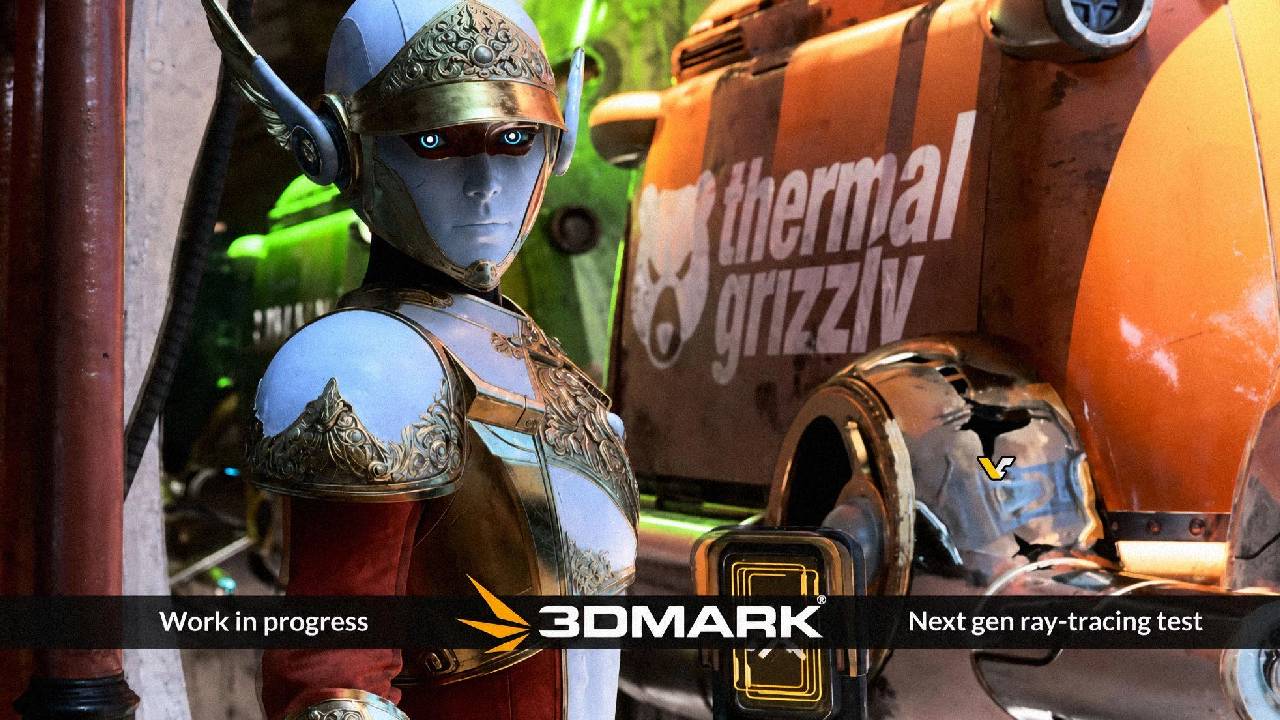
AMD’s Next-Generation Ray Tracing Research
The goal is to tackle how expensive ray tracing can become. AMD wants to decouple animation and triangles. When rendering a scene, the underlying geometry is combined with textures, lighting, and other elements to produce the final image. The problem is that animating every triangle directly becomes expensive as the triangle count increases.
During preprocessing, the mesh is split into smaller disjointed pieces associated with the tetrahedra. The method then builds many BLAS structures for those pieces. At runtime, only the cage is animated. The animation is essentially performed on these cages. A useful way to think about them is as a stand-in for the underlying geometry.
The cage provides a simpler representation that can be animated while the more detailed geometry remains associated with it. Each unique deformation needs its own animated cage, though it can share the same rest-pose mesh. The paper demonstrates the technique on trees, grass patches, frogs, and combined scenes containing just under 600 million animated triangles, rendered at 60 fps on an RX 9070 XT.
The demonstration is at 1080p, and the technology is still in its early stages. Most of the work happens offline. During preprocessing, empty tetrahedra are removed, and for every animation frame, the tetrahedral cage is animated. The cage is then computed per instance, the top-level animation acceleration structure is updated, and the scene can be traced.
Ray Tracing Scenes With Massive Amounts of Geometry
This approach matters for scenes filled with trees, grass, plants, and other detailed objects. When these objects animate independently, ray tracing must account for their changing geometry as lighting interacts with the scene. Imagine coming over a ridge and seeing a large body of water with sunlight coming in from the east.
The water could reflect the surrounding plants and other details in the scene. All of that interaction needs to be calculated, which is part of why ray tracing can be so costly. AMD's demonstration shows how it can handle animation across a complex world containing 25,000 plants. Each plant is animated independently through the tetrahedral cages.
That means the trees and other objects can have their own animation rather than simply reusing the same animation cycle. This type of scene was possible in real time with rasterization, but it was never easy with ray tracing. At the highest levels of detail, the plants alone contain 2.8 billion triangles.
Reducing GPU Memory and Update Costs
The difference between the traditional approach and AMD's method becomes clearer when looking at the resource requirements. According to AMD, classic BLAS updates for independent animated LODs would consume more than 80GB of GPU memory and take more than 300ms to update on an RX 9070 XT.
A 300ms update time would result in roughly 3.3 fps. With the traditional methodology, the result is therefore around 3fps. AMD's demonstration, meanwhile, reaches more than 60fps on an RX 9070 XT while handling around 500 million animated triangles per frame after LOD selection.
The memory difference is also significant. An RX 9070 XT has 16GB of memory, while an RTX 5090 has 32GB and an RTX 4090 has 24GB. An 80GB requirement is beyond what these consumer graphics cards provide. The tetrahedral cage approach is intended to reduce that overhead by moving the animation work onto a much smaller representation of the geometry.
The tetrahedral cage research is part of a broader set of work AMD is developing through GPUOpen.
AMD is also developing other graphics-pipeline projects. One of them is Mini-DXNN, which focuses on interactive neural texture compression for DirectX 12. Another project is lightweight attention-based indirect illumination.
These projects cover different parts of rendering, including geometry, textures, ray tracing, compute, and illumination. Depending on how the research develops, some of the technology could eventually become part of AMD's FSR ecosystem and potentially reach future hardware platforms.
The tetrahedral cage approach remains research for now. Still, the results show that reducing the amount of geometry that needs to be directly animated could reduce the cost of ray-tracing scenes with extremely high geometric complexity.
Editor, NoobFeed
Gaming Hardware Updates
No Data.