
ROG Ally X20 vs. MSI Claw 8 EX AI+: Intel Arc Beats AMD in Gaming
Intel's Arc G3 Extreme delivers a substantial gaming advantage over AMD's Radeon 890M in several demanding handheld gaming benchmarks.
Hardware by Masaru Hoshino on Oct 23, 2026
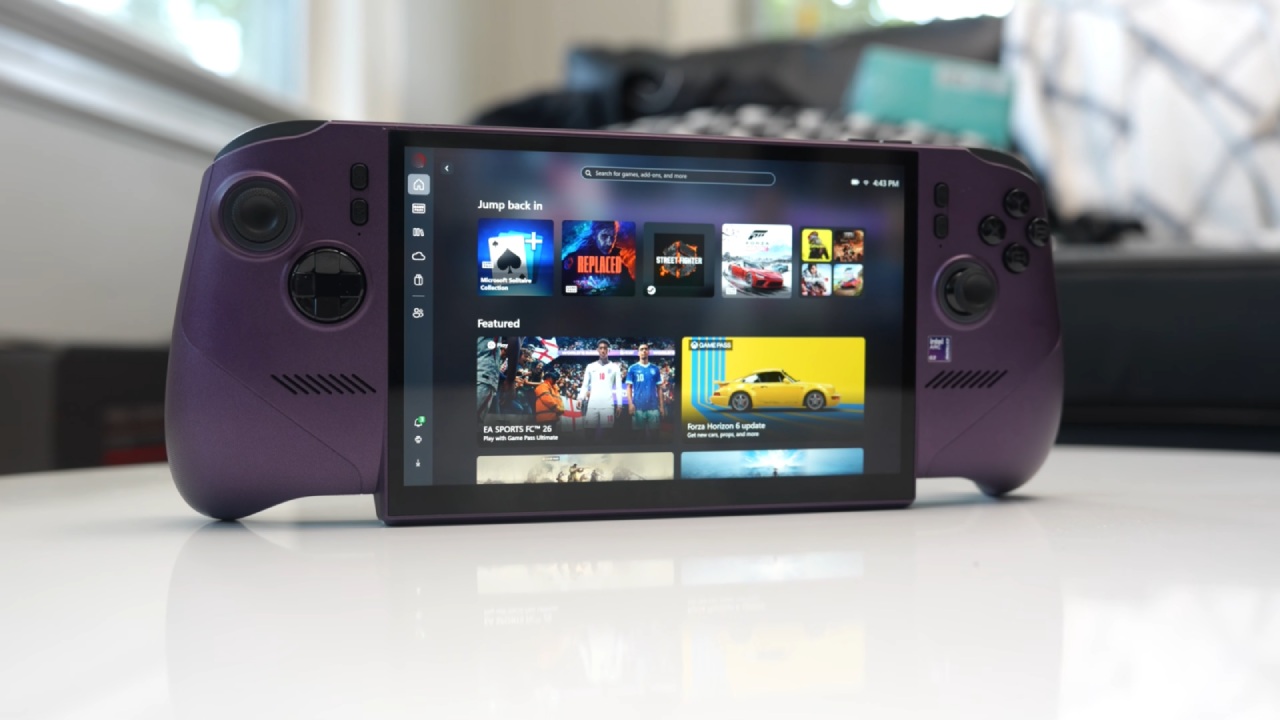
The premium handheld gaming PC market continues to evolve as AMD and Intel compete to deliver powerful gaming experiences in portable devices. The AMD-powered ROG Ally X20 and the Intel Arc G3 Extreme-equipped MSI Claw 8 EX AI+ both bring high-performance processors, integrated graphics, and 80Wh batteries to the same category. But game benchmarks show massive performance gaps between these two pricey handhelds.
Design and Specifications Separate the Two Handhelds
The ROG Ally X20 has a 7.4-inch 1080p OLED screen with a customizable refresh rate of up to 120hz. The MSI Claw 8 EX AI+ has an 8-inch IPS display with a 120hz refresh rate and variable refresh rate capabilities. Both devices include 80Wh batteries, but they differ in memory configuration.

The MSI Claw features an Intel G3 Extreme processor with 14 cores and 14 threads and an Intel Arc B390 integrated GPU with 12 Xe3 cores. It includes 32GB of RAM running at 8533MT/s. Meanwhile, the ROG Ally X20 uses AMD's Ryzen AI Z2 Extreme, featuring eight cores and 16 threads. Its Radeon 890M graphics processor includes 16 RDNA 3.5 compute units. The device comes with 24GB of RAM running at 8000MT/s.
Synthetic Benchmarks Reveal Intel's Graphics Advantage
We tested both handhelds at 35W, 25W, and 17W to compare performance under different power limits. We adjusted their power-management settings to keep the comparison as fair as possible. Geekbench 7 showed that the ROG Ally X20 performed approximately 16% better in single-core testing at 35W.
However, the MSI Claw delivered around 18% higher multi-core performance. At 17W, Intel led in both single-core and multi-core results. The GPU benchmarks were even more impressive. In 3DMark Time Spy, the MSI Claw scored 7,139 points, compared with 4,178 points for the Ally X20 at 35W. Intel achieved approximately 71% higher total performance and a 76% advantage in the graphics score.
Gaming Benchmarks Demonstrate Intel's Lead
Cyberpunk 2077 showed the disparity between the two systems. At native 1080p resolution and High settings, the MSI Claw averaged 53 fps at 35W, while the Ally X20 managed 33 fps. At 25W with resolution scaling, Intel averaged 80 fps, while AMD averaged 51 fps. At 17W, they averaged 81 fps and 53 fps, respectively.
Shadow of the Tomb Raider fared similarly. At 35W, native 1080p on Highest settings, the Claw hit 76 fps, and the Ally X20 hit 47 fps. At 17W, with identical Medium settings and resolution scaling, Intel averaged 71 fps, while AMD averaged 56 fps.
Red Dead Redemption 2 also favored Intel. The Claw delivered 67 fps at 35W, compared with 44 fps on the Ally X20. At 17W, however, the difference narrowed to 64 fps versus 58 fps. Forza Horizon 6 followed the same pattern, with Intel maintaining higher average frame rates across all three power configurations. Horizon Zero Dawn Remastered was more competitive, with the Ally X20 reaching 41fps at 25W compared with the Claw's 42 fps.
Battery Life and Pricing Complicate the Decision
Despite their performance differences, both handhelds delivered remarkably similar battery life. At 6–8W, the MSI Claw lasted 8 hours and 16 minutes, while the Ally X20 reached 8 hours and 12 minutes.
At 17W, they delivered 3 hours and 5 minutes versus 3 hours and 9 minutes. Another major issue is price. The ROG Ally X20 costs $1,299, and the MSI Claw 8 EX AI+ costs $1,799.
Final Thoughts
Overall, in the games tested, the MSI Claw 8 EX AI+ was around 51% faster at 35W, 33% faster at 25W, and 24% faster at 17W. Intel clearly leads in gaming performance, but AMD offers a nice OLED screen and a $500 discount.
If you are a performance-focused gamer, the MSI Claw is made for you. The ROG Ally X20 is a more budget-friendly option with the same battery life.
Editor, NoobFeed
Gaming Hardware Updates
No Data.