
RTX 5090 vs. Two RTX 5080s: Dual-GPU Setup Delivers 50% Higher Performance
Dual RTX 5080 graphics cards challenge NVIDIA's flagship RTX 5090 with significantly higher rendering performance at a lower combined price.
Hardware by Tanvir Kabbo on Nov 24, 2026
NVIDIA GeForce RTX 5090 is one of the most powerful consumer graphics cards today. However, as its price tag rises, it's becoming difficult for most PC aficionados to afford. If the RTX 5090 costs much more than the RTX 5080, it may be better to buy two RTX 5080 graphics cards. Recent testing shows that two GPUs used together can beat the top-end single GPU on a range of rendering tasks, for a substantially lower cost.
Two RTX 5080s vs. One RTX 5090
This setup becomes more viable with the arrival of the PNY RTX 5080 Slim OC. Its true dual-slot design lets it accommodate two graphics cards in compatible PC systems. Two RTX 5080s also give you 32GB of VRAM total, the same amount as the RTX 5090.
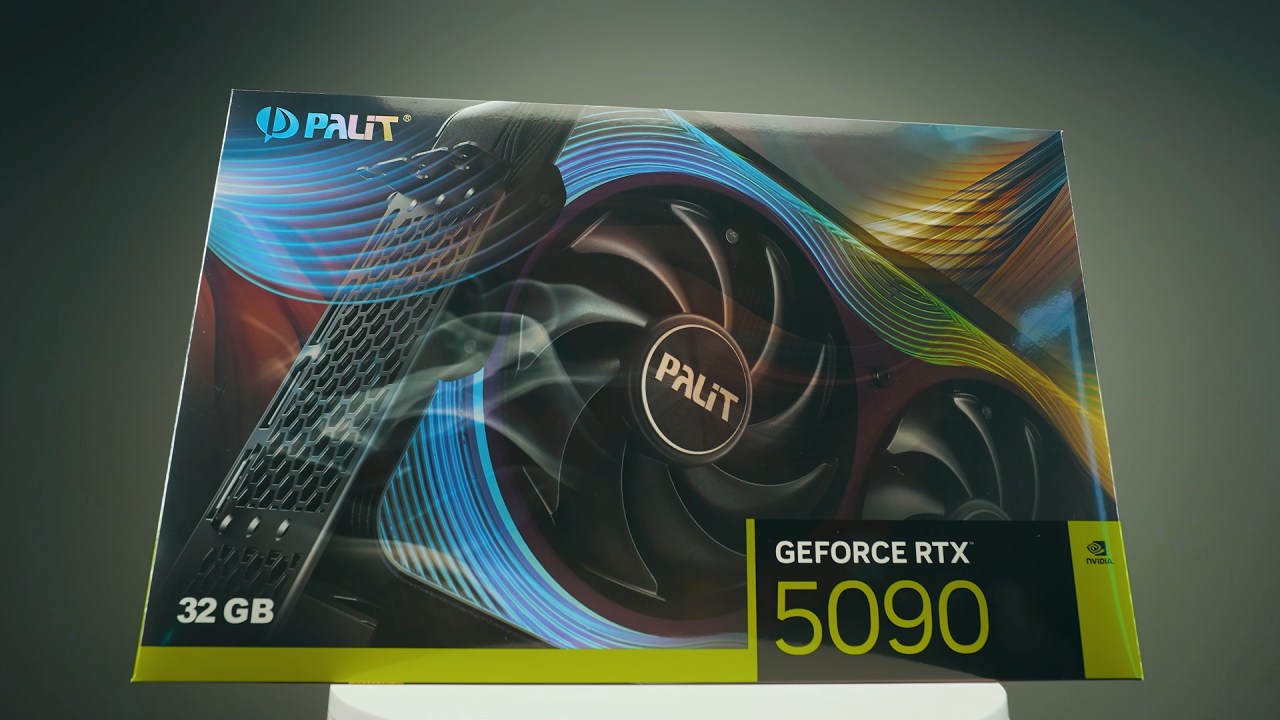
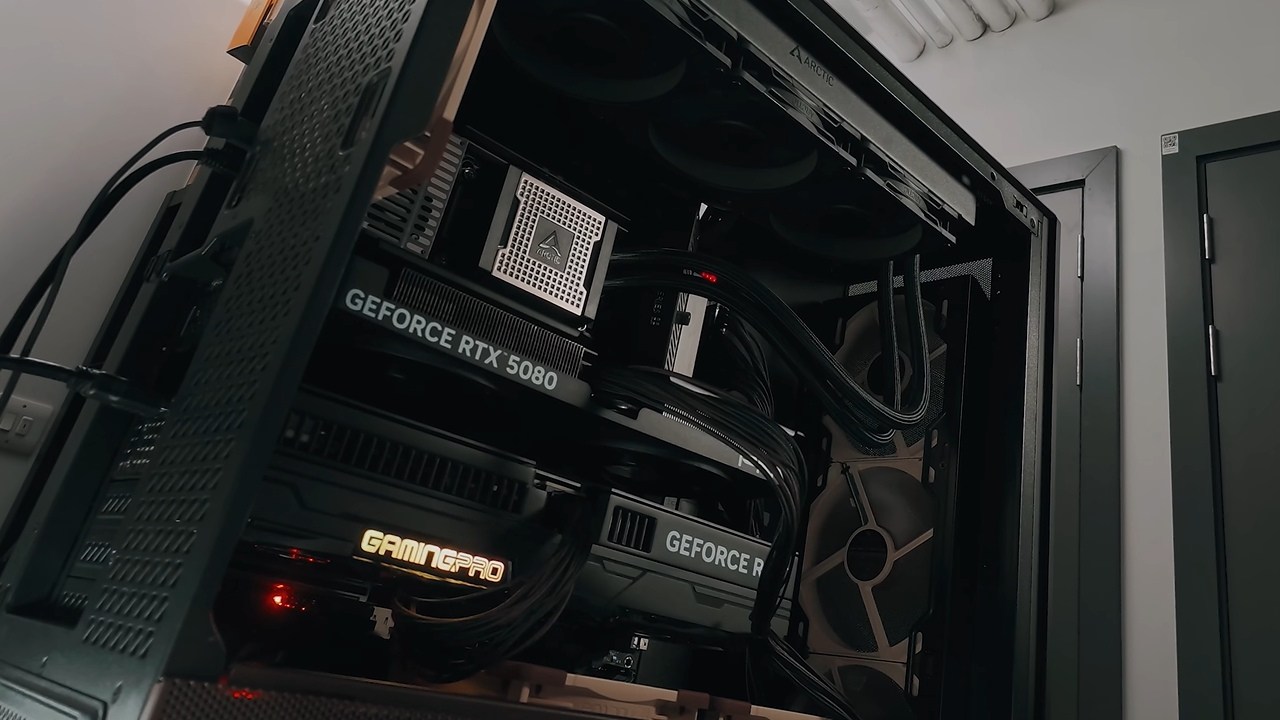
We tested them in an Intel Xeon 696X system with 128GB of DDR5 RDIMM memory and a custom Noctua PC enclosure. We started by testing the Palit RTX 5090, then swapped it for two RTX 5080s: the PNY RTX 5080 Slim OC and Palit Gaming Pro OC.
Cinebench R26 Shows 50% Higher Performance
The first benchmark was Redshift Render (Cinebench R26), which supports multiple GPUs. The RTX 5090 scored over 126,000 points, and the two RTX 5080s scored around 190,000 points. That's an improvement of almost 50% in performance.
But not all applications can take advantage of numerous graphics cards. Initial testing with Adobe Photoshop, After Effects, Premiere Pro, Lightroom Classic, and DaVinci Resolve ran into several snags. After I closed OBS, several apps had issues with the dual-GPU setup. That's why software optimization matters.
OctaneBench and V-Ray Deliver Impressive Results
OctaneBench worked fine with both RTX 5080 graphics cards and split the VRAM usage between the two, not surpassing their 16GB capacity. The RTX 5090 managed 1,457.06, while the twin RTX 5080 setup scored 1,842.75, which is a 26.5% increase.
V-Ray did much better. In the CUDA benchmark, the RTX 5090 scored 4,477 points while two RTX 5080s managed 6,114 points, an increase of 36.5%. The RTX 5080 also outperformed the RTX 5090, with scores of 6,327 and 9,113, respectively. That's a 44% performance boost.
RTX 5090 Remains Faster for Local LLMs
The following test was with LM Studio and local LLMs. Both RTX 5080s could load the model, with about 11.7GB and 12GB of VRAM used between them. But the dual-GPU setup managed around 171 tokens per second, while the RTX 5090 got to roughly 222 tokens per second. The RTX 5090 also led on longer generation workloads.
Memory bandwidth is the key factor. LM Studio can spread models across several GPUs; however, two RTX 5080s can't match the RTX 5090's higher memory bandwidth. This led to roughly 30% better inference performance for the RTX 5090.
Premiere Pro Export Favors Two RTX 5080s
Another interesting outcome was exporting a Premiere Pro project. The RTX 5090 finished in 10 minutes 25 seconds, and two RTX 5080s completed the task in 9 minutes 7 seconds. This implies the dual-GPU advantage isn't confined to synthetic benchmarks. As long as software enables it, multiple graphics cards can also help real-world rendering workloads.
Final Thoughts
The results indicate that two RTX 5080s can outperform a single RTX 5090 in several rendering tasks, delivering up to 50% more performance in Cinebench R26 and 44% better results in V-Ray. But for local LLM inference, the RTX 5090 is still faster because of its higher memory bandwidth. Other variables include software compatibility, cooling, power consumption, and physical placement.
Two RTX 5080s will cost about as much as a single RTX 5090 and deliver much better rendering performance in compatible apps. The arrangement is an unexpectedly convincing alternative to NVIDIA's flagship GPU for fans who care most about multi-GPU applications.
FAQ
Q. Are two RTX 5080 graphics cards faster than one RTX 5090?
A. Yes. Two RTX 5080 graphics cards deliver up to 50% higher performance in Cinebench R26 and 44% better results in the V-Ray RTX benchmark compared to a single RTX 5090.
Q. Do two RTX 5080 GPUs provide the same VRAM capacity as an RTX 5090?
A. Yes. Two RTX 5080 graphics cards provide 32GB of combined VRAM, matching the RTX 5090's 32GB capacity. However, the memory is split across two GPUs rather than forming a single unified memory pool.
Q. Is the RTX 5090 better than two RTX 5080s for local LLMs?
A. Yes. The RTX 5090 delivers approximately 30% higher local LLM inference performance in LM Studio because of its superior memory bandwidth, achieving around 222 tokens per second compared to approximately 171 tokens per second on two RTX 5080s.
Q. Can two RTX 5080 graphics cards improve Premiere Pro rendering performance?
A. Yes. In the tested Premiere Pro project, two RTX 5080 graphics cards completed the export in 9 minutes and 7 seconds, compared to 10 minutes and 25 seconds on a single RTX 5090.
Senior Editor, NoobFeed
Gaming Hardware Updates
No Data.