
Avatar Legends: The Fighting Game Review
PC
Fluid movement, creative combat, and faithful Avatar-inspired mechanics make every match exciting, even if the overall package leaves room for improvement.
Reviewed by Tahmid Mahi on Jul 25, 2026
Avatar has inspired games for years, but very few have managed to capture what makes bending so exciting. Rather than building another action-adventure title, Avatar Legends: The Fighting Game takes a different route by bringing the series into the traditional one-on-one fighting genre.
It leans into fast movement, technical mechanics, and expressive combat instead of cinematic storytelling, giving you a game that feels designed with fighting game fans in mind while remaining recognizable to longtime Avatar followers.
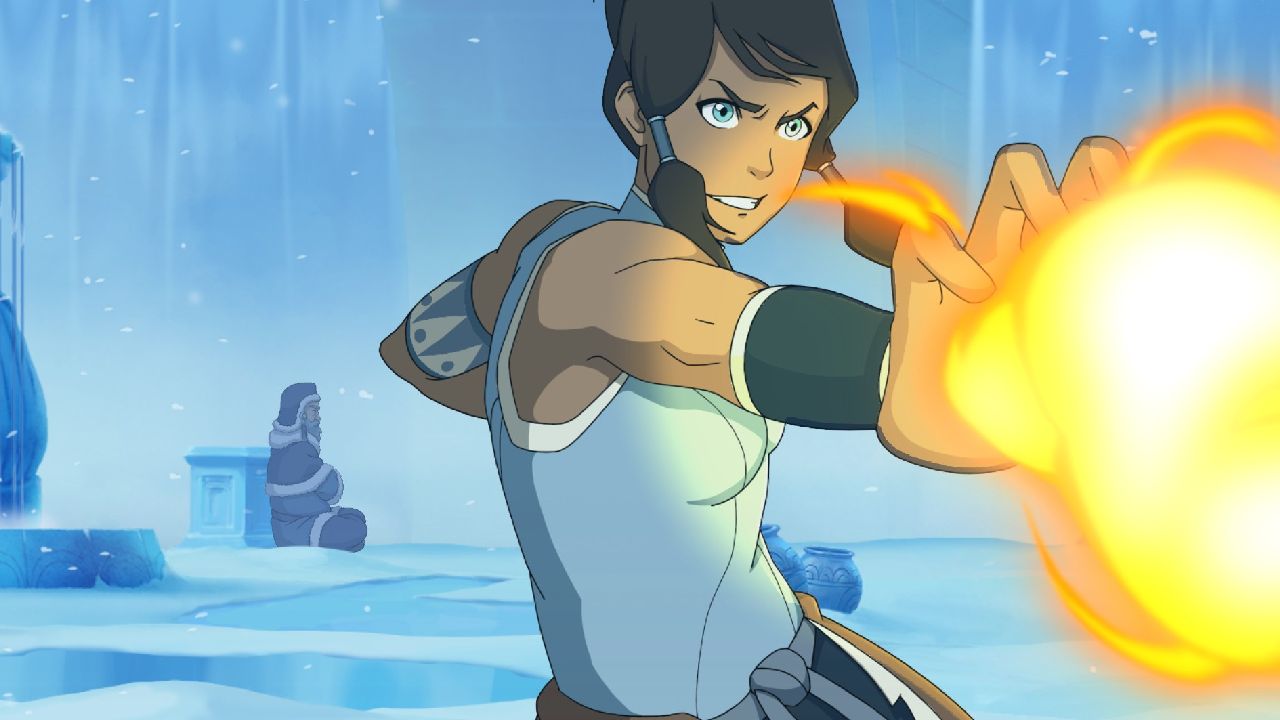
Gameplay Group International approaches the series with a surprisingly focused vision.
The developers don’t try to replicate every memorable moment from the shows; instead, they focus on translating each character’s personality and bending style directly into gameplay. Each fighter is built around mechanics that are reflective of who they are, instead of just throwing different visual effects on everyone.
Despite launching at a budget-friendly price, Avatar Legends: The Fighting Game doesn't feel like a scaled-down experience where combat is concerned. Instead, most of its effort clearly went into building an intricate fighting system that rewards practice and experimentation. At the same time, some surrounding features don't receive the same attention, creating a package that's both impressive and occasionally frustrating depending on what you're looking for.
The main story is an original adventure outlined by Avatar creator Michael Dante DiMartino and written by Tim Hedrick, who previously worked on both Avatar: The Last Airbender and The Legend of Korra. Rather than continuing existing events, the campaign places familiar faces inside an alternate reality created during Harmonic Convergence.
This unusual setup creates plenty of entertaining interactions throughout the campaign. Katara has forgotten Aang, Korra makes some surprising friendships, Azula’s role is completely altered, and even characters like Sokka are written with personalities that feel entirely different from what fans remember. Everyone’s in a temporary timeline, so the story is less about big consequences and more about character interactions.
The writing has some particularly strong moments, but the overall plot struggles to keep the player interested during the long campaign. The story is 27 chapters long, and the alternate-universe idea starts off strong but starts to read more like light fan fiction than a memorable Avatar adventure.
Outside the story mode, every character also receives an arcade storyline that offers smaller, lower-stakes adventures. These aren't particularly lengthy, but they provide additional interactions between the cast while rewarding you with gallery unlocks such as concept art inspired by the animated series.
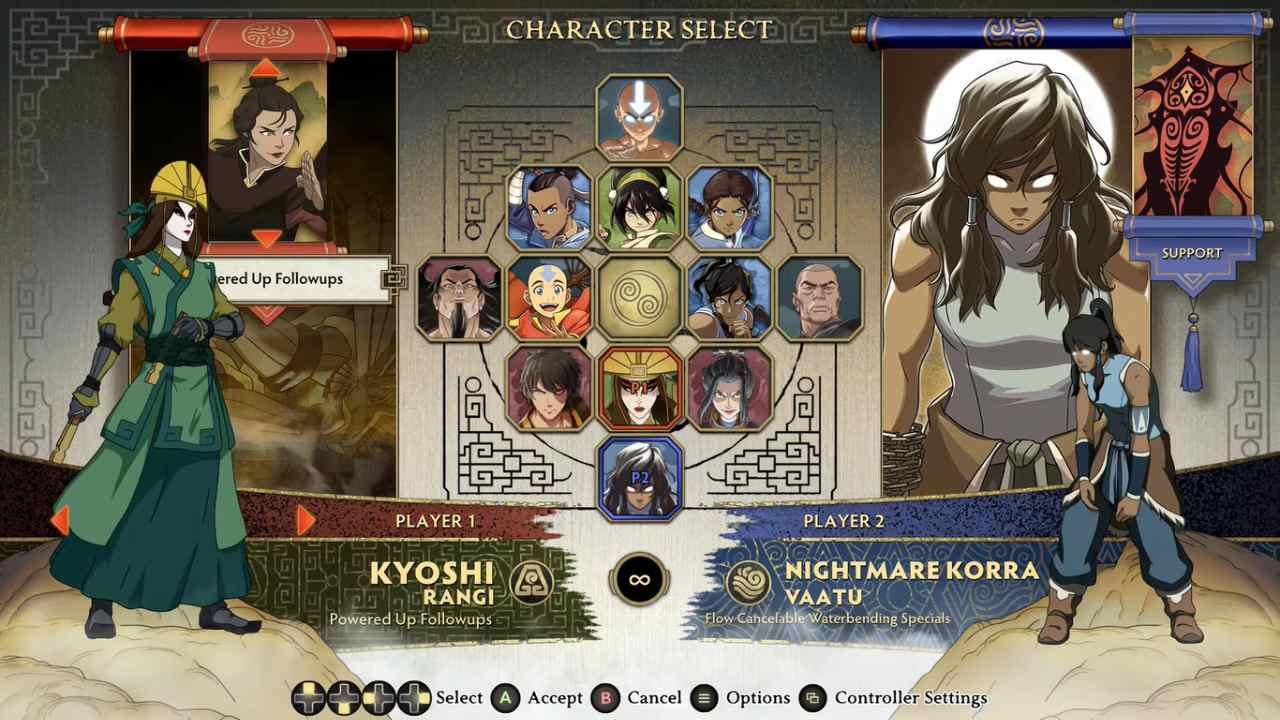
Auto combos let you repeatedly press the light attack button to create stylish chains.
Thus, your first matches are approachable even if you've never touched a traditional fighting game before. Holding different directions while using auto combos even changes the sequence, giving you multiple variations without forcing you to memorize long button strings immediately.
Once you're ready to move beyond the basics, Avatar Legends: The Fighting Game reveals its true complexity. The typical manual combos have a simple structure that chains light, medium, and heavy attacks into special moves, with most special attacks using familiar quarter-circle motions. The inputs are still there, but running them requires considerable effort.
Timing windows are very tight, bread-and-butter combos are simple but require accuracy, and small errors can cause long combo routes to break down. It’s not about the difficult inputs; it’s about the speed, timing, spacing, and execution that constantly challenge you to be consistent.
The flow system is at the heart of every fight, making movement the key to success.
Each character has their own flow actions that drastically change their approach to combat. Aang uses the glider to control his aerial momentum, attack from awkward angles, and glide across the arena by manipulating the wind.
Azula has amazing freedom in the air; Toph uses the ground to set up positioning; Katara pairs movement with powered-up attacks; and Zaheer gets free flying, which changes how matches are played entirely. Flow actions are something experienced players can use to cancel into one another, creating movement patterns that seem almost limitless.
You’ll need to spend your resources as much as you need to land your attacks. Flow uses up its meter, so all movement options come at a cost. The flow button allows you to dodge incoming punches but leaves you open to throws, which are devastating critical hits.
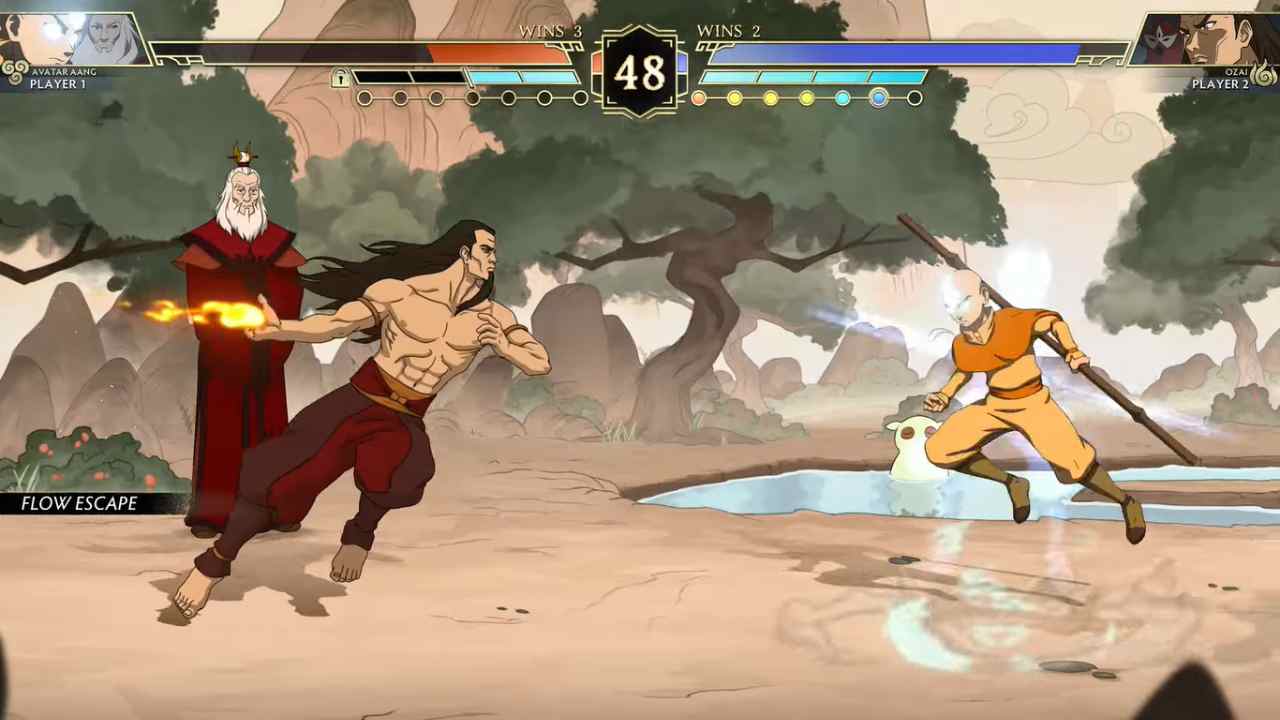
When you empty your flow meter, your character becomes unbalanced, losing access to your defensive options and leaving you vulnerable to damaging follow-up combos from your opponents. You're always trading off mobility, defense, and offensive pressure instead of wasting resources.
Energy is the second major resource in the game, working alongside Flow Landing throws, chaining your first special move in a combo, and pressure-specific critical hits, all of which build energy points to fuel EX attacks and supers. Lose a round, and you increase your max Energy capacity, eventually getting to each character's strongest super attack.
Each of the twelve characters has his philosophy. Korra feels the most like a traditional fighting game protagonist while secretly ticking up her Avatar Cycle mechanic. Toph rules the ground with armored movement and space control. Kyoshi trades speed for power and, surprisingly, aerial movement.
Sokka gives up on bending altogether and starts using weapons, confusion, and technical setups.
Azula is precise and methodical or wildly aggressive, depending on her form, while Aang focuses almost entirely on movement. Rather than sharing identical mechanics with different animations, each fighter asks you to rethink how you approach every match.
The support system expands each character even further. Before every battle, you choose one of three support characters that modify specific abilities. Some make existing special attacks stronger; others improve movement, add new attacks, or unlock different combo opportunities.
Some supports, for example, will improve Kyoshi’s air mobility, open up combo routes, or enhance her mix-up potential. Aang’s support can also entirely change how fluidly he can move between attacks and flow actions. This system effectively multiplies each character's playstyle, making the roster feel much larger than its twelve fighters suggest.
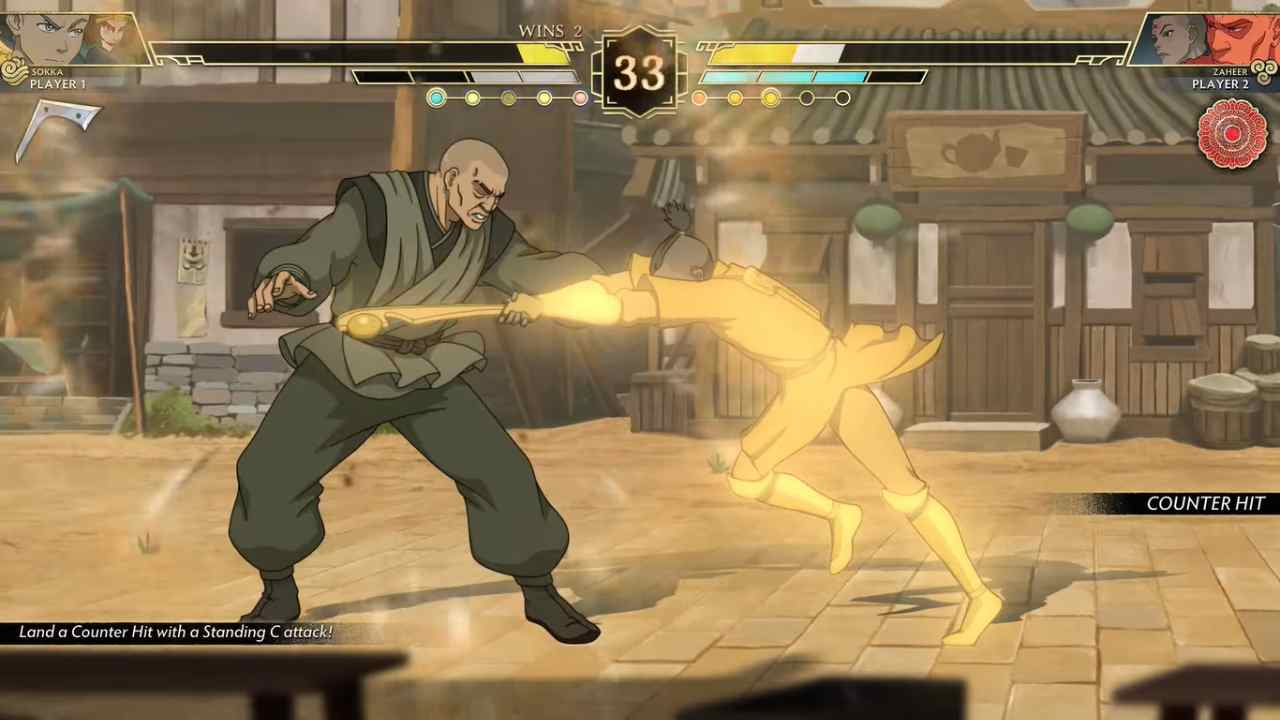
Combat is unquestionably the heart of Avatar Legends. Every system revolves around encouraging creativity without overwhelming you through complicated controls. Auto combos make your opening hours accessible, but Avatar Legends: The Fighting Game steadily pushes you toward manual execution, advanced movement, critical hits, resource management, and character-specific mechanics.
Every fighter possesses unique critical hit conditions tied directly to their personality, rewarding specific actions with bonus damage, energy, or extended combo opportunities. These mechanics really help each victory feel earned, as you’re always adapting to your chosen character rather than using universal strategies.
The fighting also leaves plenty of room for player expression. Combo routes rarely seem predetermined, as movement, support choices, critical hits, resource management, and flow cancels all combine to create a wide range of possibilities. You’re always figuring out where to stand, what meter to burn, what to move, if it’s worth going for extra damage or saving stuff for later
That depth does come with drawbacks.
Tight timing windows make even familiar combos surprisingly easy to drop. Hit confirming often becomes difficult because the pace moves so quickly, and improvising after an unexpected hit isn't always possible unless execution has already become second nature. Several reviewers also noted that certain buffer windows feel unnecessarily strict, meaning slightly more input leniency could have reduced frustration without lowering the game's skill ceiling.
Training tools partially help solve that problem. Character tutorials explain useful attacks, pressure options, mix-ups, and practical strategies rather than only listing moves. Combo trials range from simple auto combos to demanding advanced sequences, while a breakdown feature pauses each input to help you build muscle memory step by step.
Frame data, hitboxes, input displays, recording functions, and practice settings provide plenty of useful information. Yet some anticipated options are still lacking. Practicing hit confirms doesn’t have random blocking, setting up specific dummy behaviors feels needlessly cumbersome, and the tutorials expect you to already have some fighting game experience.
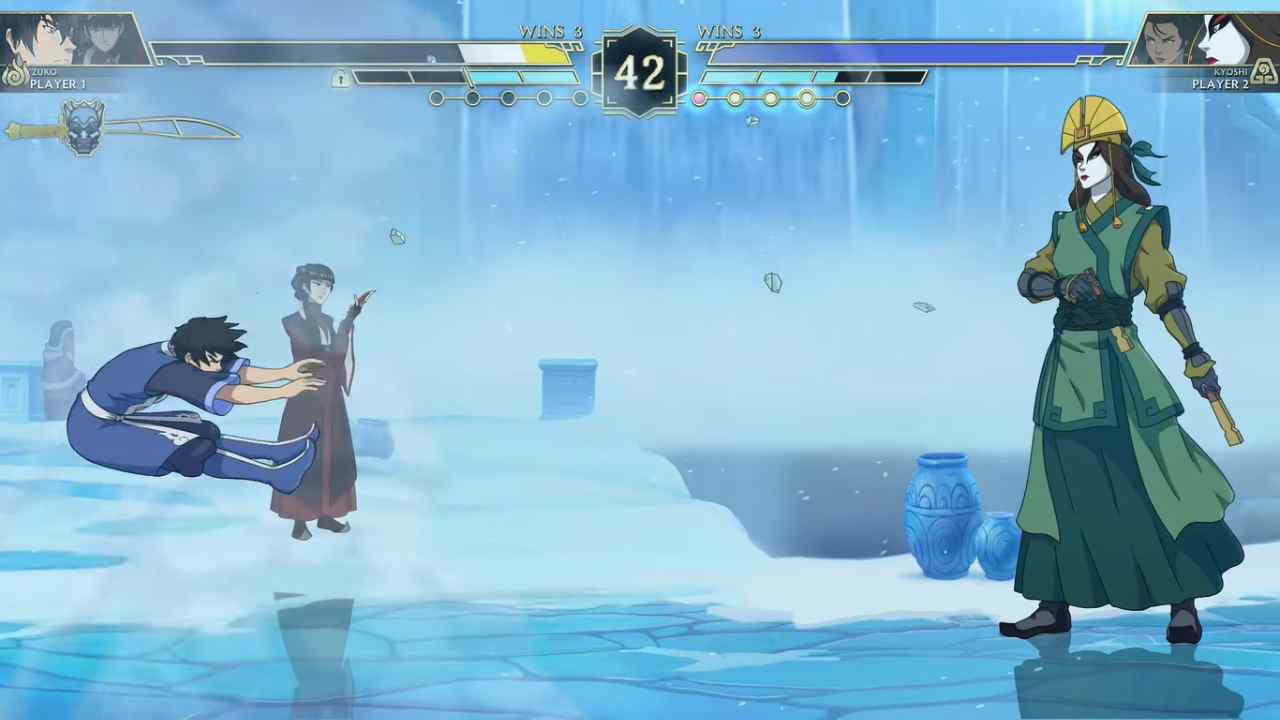
Progression is still pretty light. There are simple RPG mechanics in Story Mode, where repeated battles slowly increase a character’s health and available Energy. You get currency for completing encounters, and you can spend it at Momo's Bazaar to bolster support characters for upcoming missions.
The rollback netcode for online play is a blessing, and full cross-play support lets players enjoy matches across regions with generally stable performance. Fast rematches, quick load times, and immediate returns to training mode after disconnects keep downtime to a minimum.
The online package still lacks several standard features, including larger spectator lobbies, replay search tools, replay takeover, and multiplayer lobby support for more than two players. Many of these additions are supposedly for post-launch updates, but their absence is noticeable at launch.
You can tell Avatar Legends is special from the start because of its hand-drawn sprites.
The character animations are lively, expressive, and full of character. Each form of bending has a unique movement, and attacks flow smoothly from one animation to another. The movement and sign are true to the animated series, but they don’t just copy it. Every fighter feels authentic, whether they have fire, water, earth, air, or just weapons.
The combat effects also beautifully reinforce the gameplay. You can still read wind currents, fire explosions, earth manipulation, and water attacks, and Avatar Legends: The Fighting Game is so well designed that even when attacks are happening, you can still tell what’s going on. Transitions between stages are clean, menus are responsive, and the overall presentation rarely gets in the way of the fighting itself.
The sound design is convincing and impacts every hit. Punches, bending attacks, and weapon strikes all carry a weight and satisfaction, and the energetic response keeps pace with the fast-paced action on screen. Story Mode is fully voice-acted, bringing personality to character interactions even if there are very few original television cast members.

Avatar Legends: The Fighting Game succeeds because it knows what it wants to be. Rather than trying to force accessibility at every turn, it has friendly foundations before gradually revealing one of the deepest and most expressive combat systems in any fighting game in recent memory.
The surrounding package doesn't always reach the same standard. Story Mode eventually loses momentum, several training options feel incomplete, and online features still lack conveniences that have become common across the genre. These are flaws that keep Avatar Legends: The Fighting Game from feeling fully polished, but they never get in the way of the quality of the fighting itself.
If you're willing to put in the time, you'll get a fighter with exceptional movement, meaningful character variety, rewarding execution, and mechanics that keep opening up new possibilities long after you've learned the ropes. It might not be the most accessible fighter, but every little improvement feels rewarding, and Avatar Legends is one of the more satisfying modern 2D brawlers for those who enjoy technical, expressive combat.
Editor, NoobFeed
Verdict
Avatar Legends: The Fighting Game is a fighting game where players will find a rewarding experience with impressive long-term depth, but missing features and an uneven story hold it back.
84
Related News
No Data.