
Big Ambitions Review
PC
Build your business empire from scratch; every purchase, trip, and hire happens in a living city around you.
Reviewed by Maisie Scott on Aug 29, 2026
Big Ambitions starts with a simple idea: you arrive in New York with very little and have to figure out how to turn that into something bigger. The game first appeared in early access in 2023, and the full 1.0 version arrives after three and a half years of development.
It comes from Hovgaard Games, the Danish studio behind Startup Company, and its final release keeps the focus on building a business from the ground up rather than handing you a ready-made empire. You begin in story mode with guidance from Uncle Fred, a successful family member who pushes you toward becoming an entrepreneur.
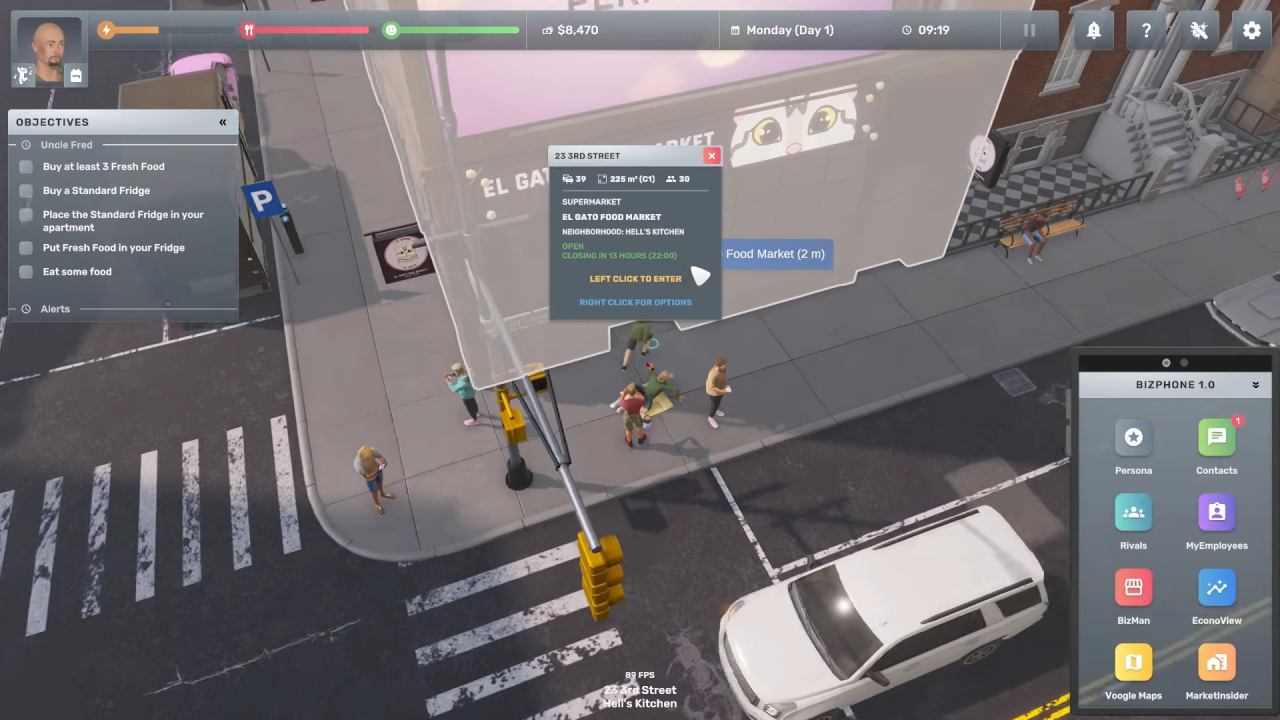
The opening is deliberately small.
You have an apartment to claim, basic needs to deal with, and very little money. In Big Ambitions, the tutorial gradually introduces the systems instead of throwing every business option at you immediately. You are encouraged to follow Fred's instructions because the interconnected mechanics are deep enough that skipping the early guidance could leave you unsure what to do next.
No complicated personal backstory drives the whole experience. Your character is essentially a blank slate, so the main story becomes the business journey you create. You start with almost nothing, take a small job, get a loan, open a shop, and decide how far to take it.
You can move toward a florist, supermarket, coffee shop, hairdresser, gym, clothing store, liquor store, law firm, gift shop, takeaway business, or even a website development operation. Later, you can scale into warehouses, offices, headquarters, and larger networks.
Big Ambitions is at its most interesting when you stop thinking of it as a menu-driven business simulator and start treating the city as part of the management system. You do not simply click a button to buy a refrigerator, truck, or other equipment and have it appear where you need it. You physically travel to stores and dealerships, buy the item, load it into your vehicle or carry it with a trolley, and take it back.
That turns distance into something you have to account for.
A cheaper building across the city may not actually be the better choice if every restocking trip becomes a long drive. Your first apartment teaches you this immediately. You need food, so you go to the supermarket, buy fresh items, and bring them home. You need a refrigerator, so you visit the appliance store, pay for one, transport it back, and place it yourself. Furniture works in much the same way.
A shopping trolley lets you move several objects at once, while the amount it can carry depends on its size. If you have only one item in your hands, you are limited to that until you find a better way to move things. The apartment is more than decoration because you have to manage food, energy, sleep, and happiness. Food protects your energy, while running out of energy makes movement painfully slow.
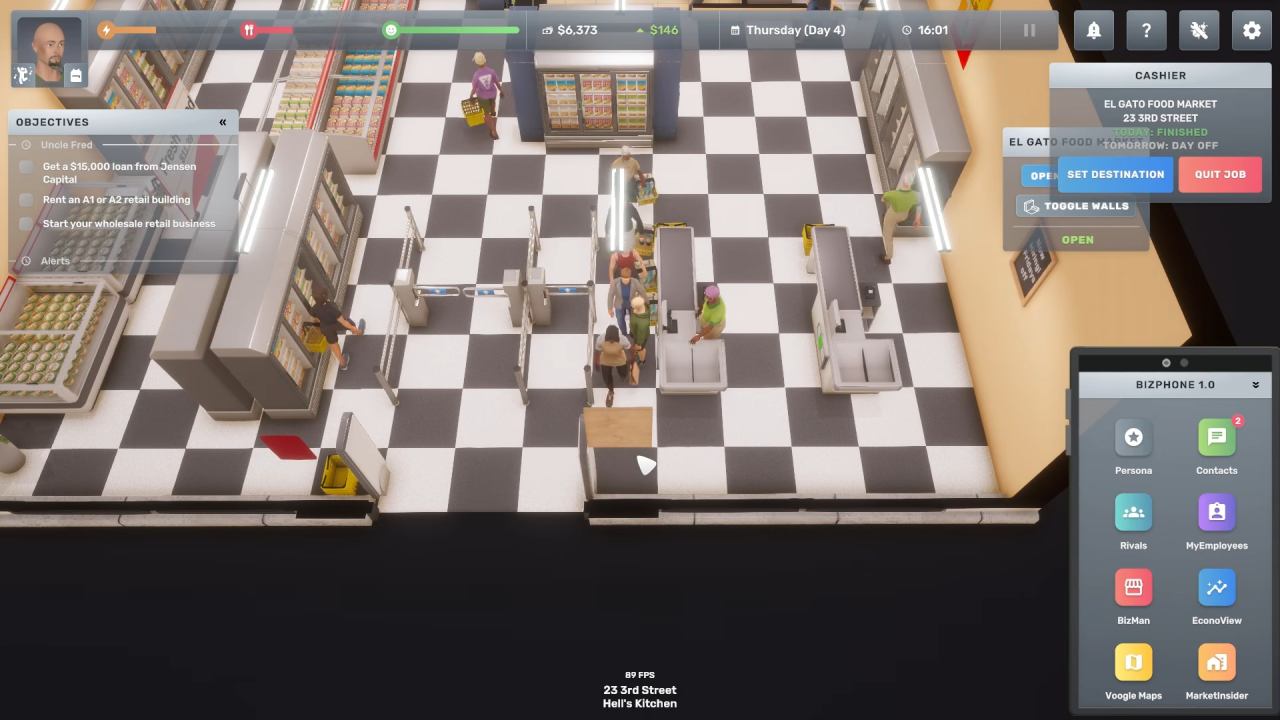
Sleep restores it, and activities such as exercise can improve happiness. As your finances improve, a better home also becomes part of your progression. In Big Ambitions, transportation adds another layer of everyday management. You receive a free car early on, even if it isn't exactly impressive, and you soon discover that driving isn't just a convenience. Cars use fuel and take damage.
Bad driving can damage the vehicle, and parking can become its own small problem. Illegal parking can result in fines, while reckless driving can damage the vehicle. You can later use better vehicles, and you can introduce a private driver service that lets you leave a vehicle at a garage and summon the driver when you need one. That gives you a way to reduce constant parking and driving once your business becomes large enough to justify it.
Your first real business follows a similar hands-on process.
You borrow money from a bank, find a suitable retail building, compare its type, rent, traffic, and potential customer numbers, and then decide what kind of business fits the location. The choice is not purely about finding the cheapest rent. You also need to consider nearby competitors and what customers in the area are likely to buy. Even after choosing a business, you still need to provide the necessary furniture to ensure it starts operations successfully.
For example, to set up a hairdresser, you need certain furniture. These include a cash register, cabinet, hairdresser chairs, a shelf, and head-washing station. You then need inventory, such as hair-care products and paper bags, which you collect from a wholesaler and bring to the shop. The process sounds simple, but several small tasks can pile up quickly.
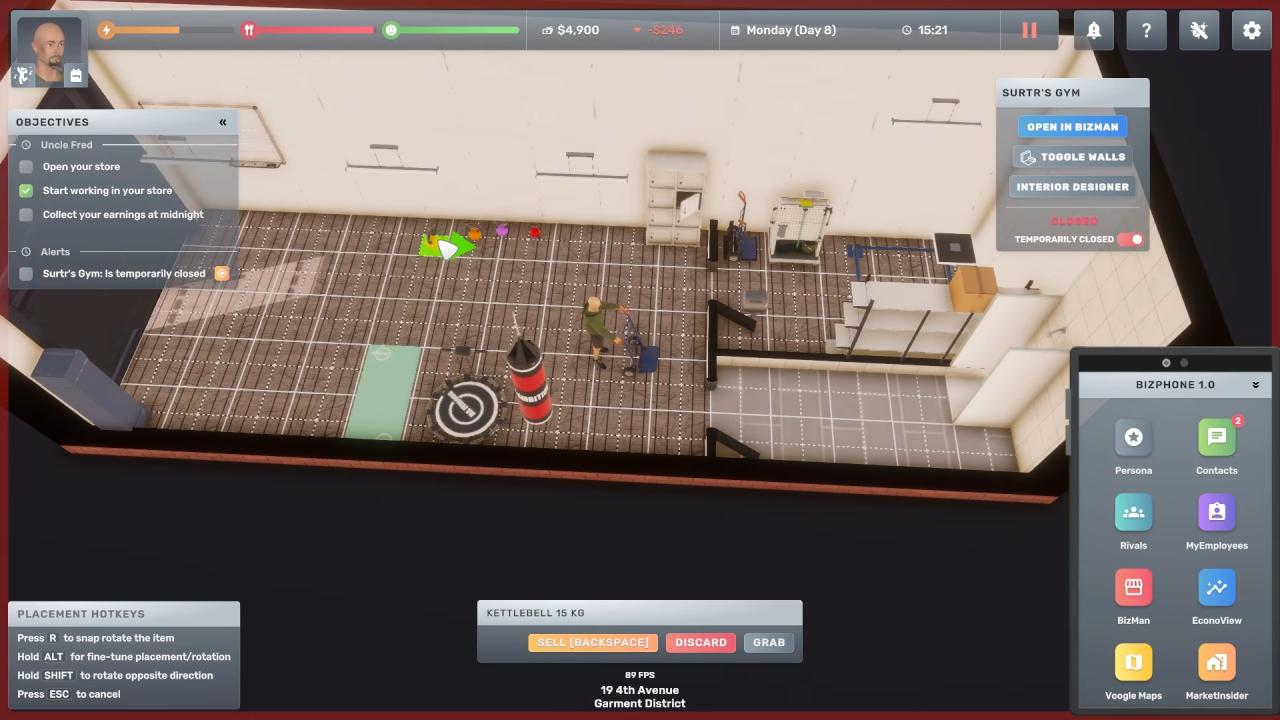
A gym shows this clearly. The business screen tells you what is limiting customers; you might have enough lockers but not enough machines. Customers can complain about missing trainers, equipment, or a dirty space, so cleaning becomes another job you either handle yourself or assign to staff.
In Big Ambitions, employees change the game substantially because running the business yourself only works for so long. Hiring is not an instant transaction. You need access to a recruiting agency, and before you can hire your first employee, you have to complete a basic management course at the business school. The course takes time and costs money, which means even a simple hiring decision can force you to rearrange your schedule.
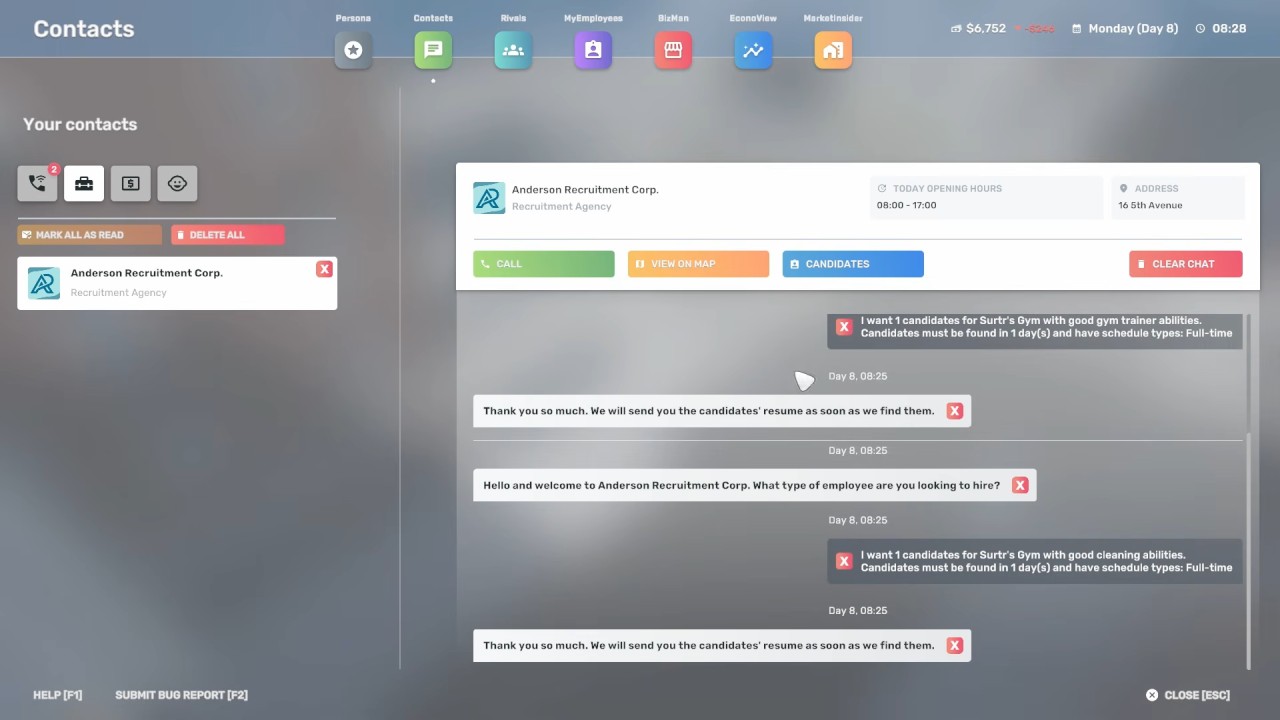
Once we have candidates, their availability and expertise become important.
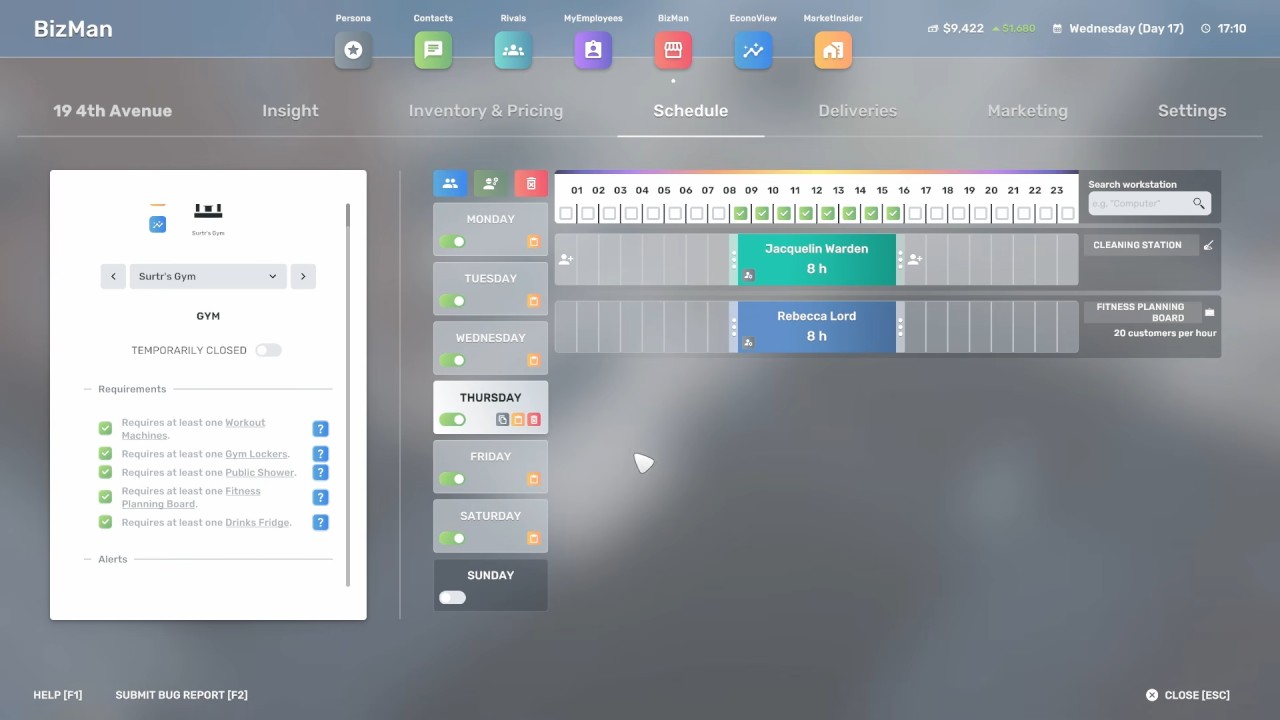
A candidate may only be available part-time, or they may have scheduling conflicts with the required hours. We can assign our staff to our businesses and assign roles and schedules. The hairdresser can be assigned a schedule, while the other person can handle customer service at the counter. You can copy schedules across several days, but the system still makes you pay attention to who is doing what and when.
Training adds another layer. Employees may need particular skills, and sometimes you have to remove them from a business before training them. This means your staffing plan is not just about hiring the highest-rated candidate. You are balancing cost, availability, skills, training, and the hours your business needs covered.
The early game can feel surprisingly busy. You may need to buy stock, repair your car, study management, hire staff, eat, sleep, refuel, clean, and handle whatever problem appears next. The individual tasks are simple, but together they create a real workload. You can also fast-forward time when you do not need to watch something happen.
As your company grows in Big Ambitions, the business side becomes much deeper. You can bring goods through the harbor, use warehouses to distribute supplies, and eventually create a logistics network that connects different stores. At that stage, the game starts to make you think of your company as a system rather than a single shop.
You can hire managers for areas such as HR, logistics, and purchasing, but those employees need the infrastructure to do their jobs.
Managers need desks and computers, which may mean you need a headquarters. The headquarters then becomes another property to rent, furnish, and maintain. Expansion isn't simply watching a number get bigger. More money brings more responsibilities, more buildings, more employees, more equipment, and more logistics.
Your organization physically takes up space in the city. Growth therefore creates its own problems, and solving them becomes part of the reward. The market system in Big Ambitions gives you the information you need to make those decisions. Different districts have different social compositions, and the game provides data about working-, middle-, and upper-class populations.
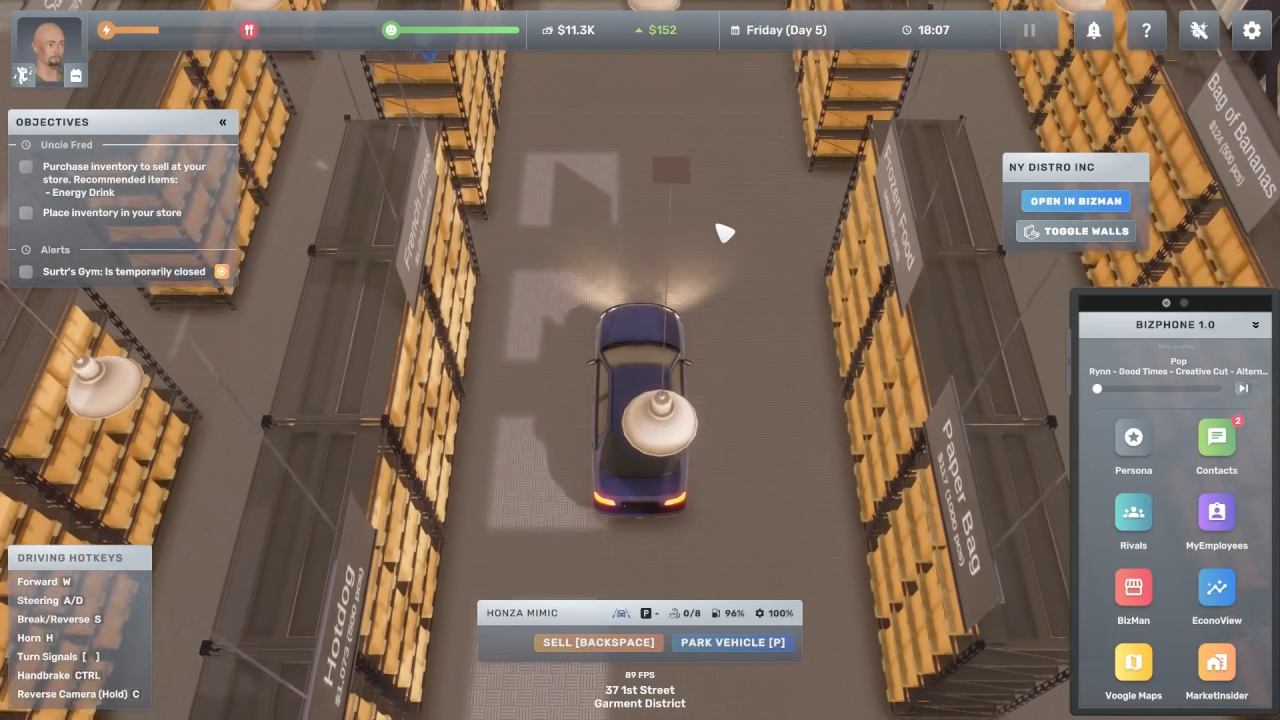
It also shows property information for different building types, including retail, office, warehouse, and residential space. Product demand is another major factor. You can compare unmet demand, market prices, import costs, and the number of competitors selling a product. That gives you a reason to study an area before committing to a business.
Competition is supported by rival systems and by changing events. You can see information about competing businesses and track their financial performance. Events can also affect the market. A lack of a product like apples can matter for some companies but have no impact on others.
Suppliers' issues, orders, and shortages are things that can affect your planning, and so you can't assume that everything at your firm will stay the same.
No combat tactics are used in Big Ambitions, and there are no typical puzzles to solve here. Something similar to a puzzle can be considered your company. It takes solving various problems when choosing a building, products to sell, equipment arrangement, employees' schedule, etc. The challenge comes from putting the systems together, not solving a separate minigame.
A bad location can hurt you. A poor staffing decision can leave a shop unable to operate properly. Buying too much equipment can force extra trips across the city. Taking on an expensive loan can make daily repayments difficult. Even parking in the wrong place can cost money. These are small consequences, but together they keep your decisions meaningful.
There is also no conventional experience-point grinding system at the center of the game. Progress comes through money, business growth, education, skills, employees, properties, and better infrastructure. Your own education matters because courses unlock the ability to manage certain parts of the company, while employee training improves what your staff can do.
Instead of repeatedly fighting enemies for XP, you build capacity by learning and investing. That makes progression feel tied to the business rather than a separate reward system. Visually, the game uses a top-down, tilted view of New York.
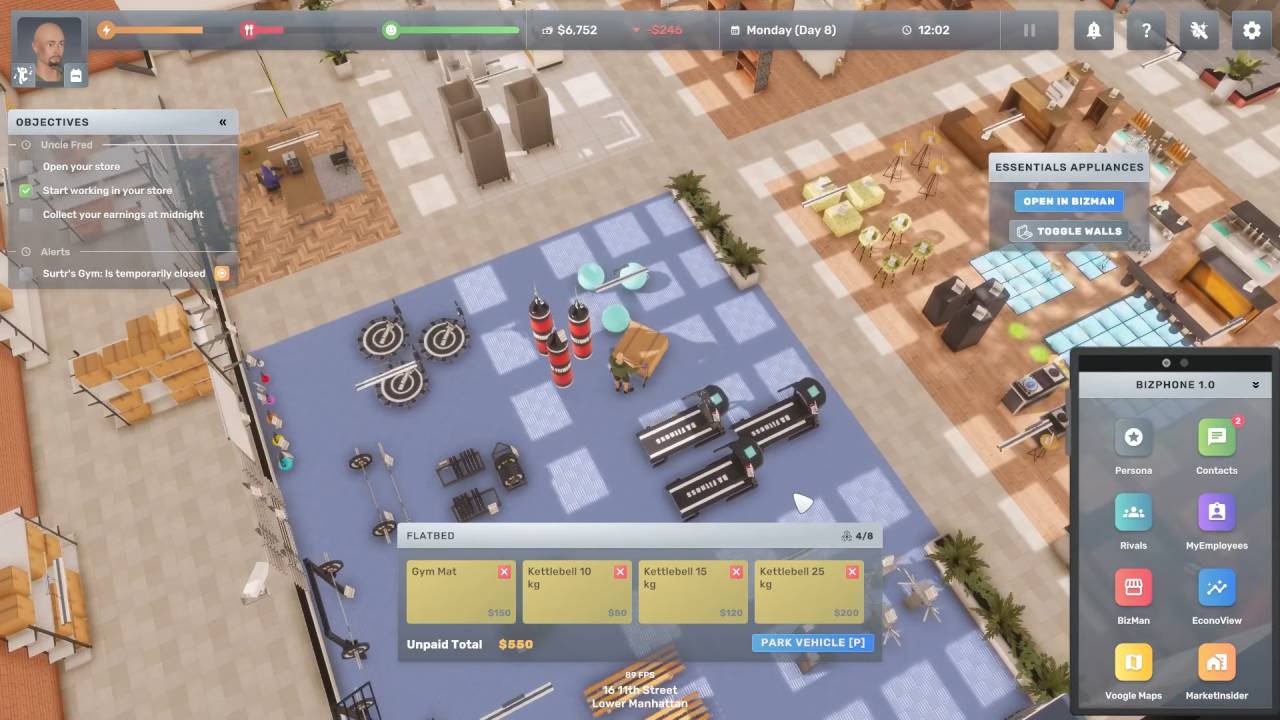
Big Ambitions isn't trying to look photorealistic, and the character models and animations have a slightly janky quality.
That can be noticeable, especially during ordinary movement, but it also suits the scale of the simulation. You can see your character moving through streets, entering stores, driving around, furnishing rooms, and interacting with the physical city. Interiors are practical and easy to understand, which matters more here than visual spectacle.
It is a vital visual element, since you are always moving around within it. The streets, stores, parking areas, warehouses, houses, offices, and other buildings make the map functional. The development stage further incorporates the Hamptons, with larger houses, luxury housing, and retail stores.
Sound design is simple. The soundtrack uses upbeat, Creative Commons-style pop music, and the variety helps during long drives and routine work. You can turn the radio down or off. Traffic and police sirens also add some life to the streets.
The 1.0 release of Big Ambitions also adds several useful systems. The Hamptons expands the city with a more residential, luxury-focused area, including expensive mansions, gated communities, private docks, and homes tied to characters in the game. The private driver service offers another way to deal with transportation once you can afford it.
Food delivery through Speedy Bites gives you another way to manage meals.
It can also provide a small source of early income if you choose to deliver food yourself. The banking system in Big Ambitions has also been revised. Negative interest is removed, while loans become stricter, with higher income requirements, higher rates, and minimum daily payments.
At the same time, the borrowing ceiling is higher and partial repayment is possible. Investments also improve with daily automatic investing and partial withdrawals. These changes make money management more important as your operation becomes larger.
One of Big Ambitions' biggest strengths is how naturally these systems overlap. You are not just running a shop from a spreadsheet. You have to live in the same world as the business. You need to sleep before working, eat before your energy runs out, drive to suppliers, bring equipment back, keep the car running, hire people, study management, and make sure the business can cover its costs.
That breadth is also its main weakness. Driving and parking can take a lot of time, and an equipment mistake can cost you an entire day of extra trips. Once the businesses are making plenty of money and the system runs smoothly, the endgame can also become repetitive.
Still, those slower moments are part of what makes the simulation work.
The game includes mundane tasks instead of skipping them, and that gives the larger progression more weight. Starting with a tiny apartment and a small business makes the later possibility of warehouses, managers, headquarters, multiple stores, investments, and expensive properties feel earned.
There is no official multiplayer mode, so the experience remains single-player. Steam Workshop mod support gives it room to expand, but cooperative play isn't part of the official experience. In the end, Big Ambitions succeeds because it treats business growth as a full process instead of reducing it to a few menus.
You begin as an inexperienced character with almost no resources, and you gradually learn how the city, market, employees, property, transport, and finances fit together. The game gives you a lot of freedom in deciding what kind of company you want to build, while the systems constantly remind you that growth has a cost.
You can stay small for a while, but the design clearly encourages you to build toward something larger. The satisfaction comes from solving the problems that appear along the way. A shop needs staff; staff need schedules; managers need offices; products need suppliers; suppliers need logistics; and logistics need infrastructure.
Every new level of success creates another layer to manage.
When you have to drive across New York to pick up a refrigerator, haul equipment back to your gym, or visit a wholesaler for inventory, the numbers on the business screen connect to a real place. The spreadsheet has consequences in the world around you.
Big Ambitions is not perfect. Its presentation can feel rough, its driving and parking can become tedious, and the late game can lose some of the excitement that comes from building your first business. But the ambition behind the design is clear, and the systems work together well enough to make the overall journey compelling.
For a game about starting with almost nothing and building something larger, that is exactly what you need. You get a city full of opportunities and enough freedom to choose your route, while progress comes from managing the ordinary decisions between a tiny operation and a real company.
Editor, NoobFeed
Verdict
Big Ambitions is an ambitious business sim that succeeds through its interconnected systems and grounded city, even if rough visuals, repetitive late-game stretches, and time-consuming driving hold it back from greatness.
70
Related News
No Data.