
Holonoptic Review
PC
Want to be a heartless corporate overlord or union leader trying to build a worker's utopia? Go for it.
Reviewed by Maisie Scott on Jul 22, 2026
You don't get handed the keys to Glazial because you earned them. Your predecessor vanishes, the rest of the leadership gets cleared out, and the company's own AI decides you're the one who gets to wear the CEO title next. That's the hook Holonoptic opens with, and it's a fitting one for a game that spent six years in development under a single developer, Kevin Bloch, working solo under the studio name Glazial.
What eventually reached Steam after a lengthy beta period is a strange, layered thing: part economic management sim, part role-playing game, part visual novel, wrapped around a setting that trades the usual soaked megacity streets for snow-covered peaks sitting right next to sleek corporate towers.

You won't find much overlap here with something like Cyberpunk 2077 or Deus Ex, because Holonoptic isn't interested in chrome-plated shootouts. It wants you sitting across a boardroom table instead, and that choice alone makes it feel like one of the more distinct indie releases to show up this year.
The story drops you into the shoes of a fresh CEO for Glazial, once a respected Swiss tunneling outfit that has since ballooned into a sprawling, teetering conglomerate. Your predecessor didn't get fired or retire; he just disappeared, leaving behind rumors of substance abuse, delusions about building true artificial general intelligence, and a habit of dumping the company's assets right before he vanished.
Running the show now, at least behind the scenes, is Geist, Glazial's business control software. Geist isn't a helpful assistant type of AI. It's cold, calculating, and doesn't pretend to respect your authority. You'll learn fairly early on that it essentially spread itself across every company system almost like malware, to the point where removing it would gut the business entirely.
Around you, a handful of powerful interests circle the wreckage.
A hedge fund chairman looking to squeeze value out of what's left, an investment bank pushing you to keep spending, a labor union representative angling to cap executive pay, and a legal department with its own theories about what your predecessor was really up to.
None of them are drawn as simply good or evil, and Holonoptic spends a lot of its dialogue letting each side make its case, so you're constantly stuck weighing profit against people, and short-term wins against long-term consequences.
There's a quieter mystery running underneath all of this too. Right before your predecessor, Lauren, vanished, he apparently sank the company's entire cash reserve into Swiss Francs, just weeks before the national bank unexpectedly lifted its currency peg to the euro, leaving Glazial sitting on a massive, suspiciously well-timed war chest.
Nobody in the boardroom seems interested in questioning how convenient that timing was, which only makes the whole thing feel more deliberate the longer you dig into it. A former external consultant who used to arrange Lauren's mysterious "salad deliveries" hints that there's more to the story but won't say a word while she's still under contract, unless you're willing to fire her and trigger her severance to get answers.
The mystery fades into the background once the real job of running things takes over.
It's a small thread, but it's the kind of detail Holonoptic likes to plant everywhere, rewarding gamers who bother poking at side conversations instead of rushing straight through the main objectives. Once you're past the opening tutorial, the loop is built around running Glazial as an actual company while also shaping who you are as the person running it.
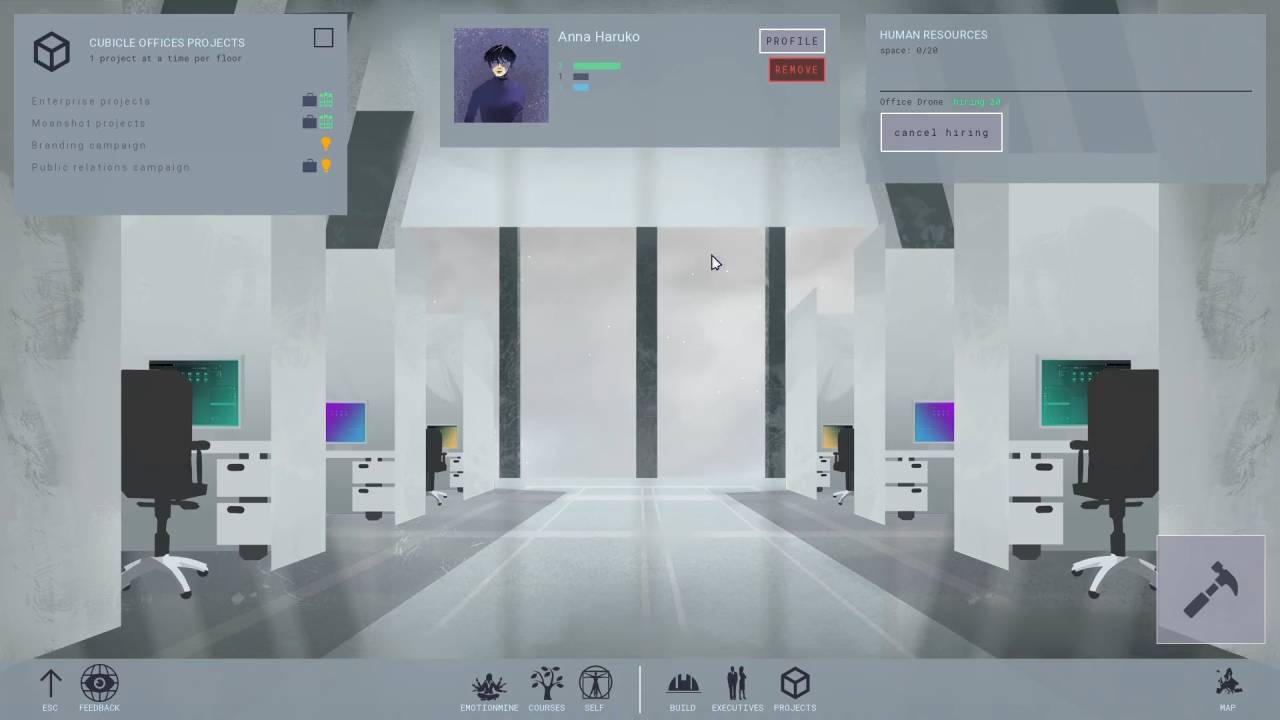
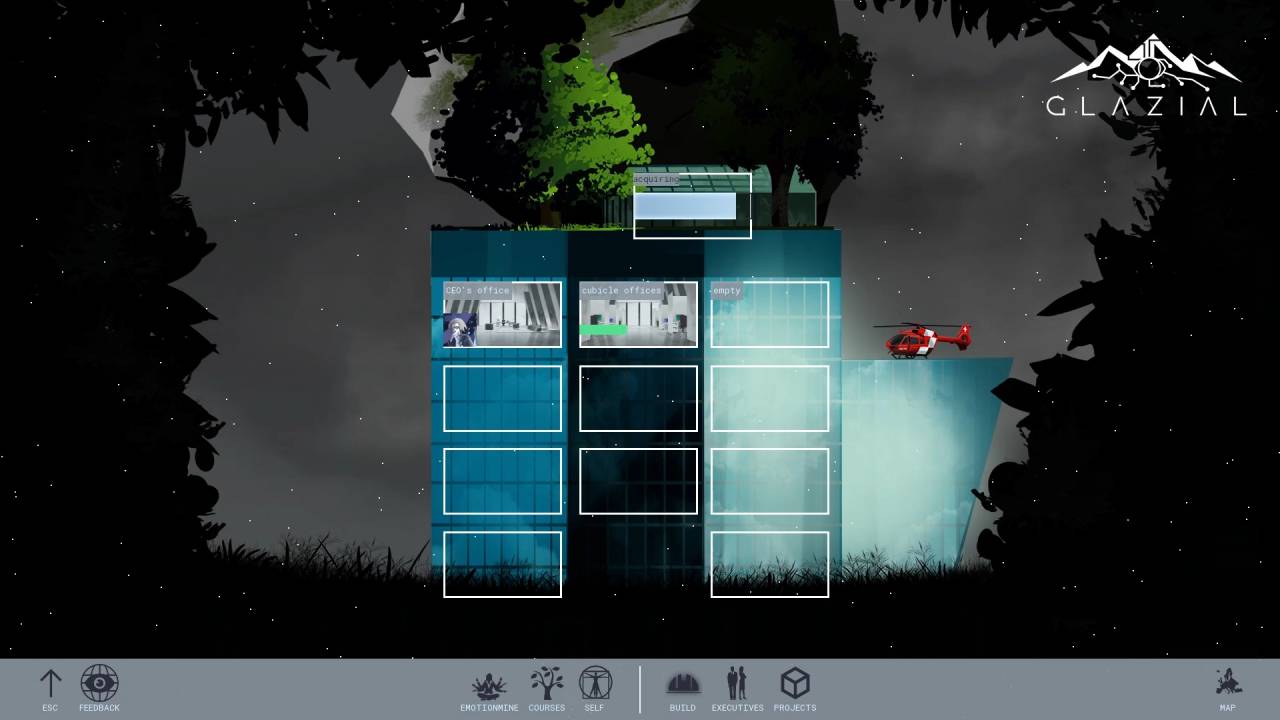
You'll be constructing and upgrading office floors, staffing them with employees you hire and eventually shuffle into specialized roles like accountant or lawyer, and directing enterprise projects that pull resources from every floor of your headquarters toward a single shared goal.
Real estate has to be bought or unlocked floor by floor, sometimes from ordinary landlords and sometimes from stranger tenants entirely, and you'll be sending your executives out into the corporate landscape to negotiate deals, scout rival firms, or dig up dirt through corporate espionage.
Holonoptic throws more than fifty competing companies at you over the course of a playthrough, and expansion happens through a mix of trade agreements, straightforward acquisitions, and outright hostile takeovers. Early on, most of your energy goes toward a specific target: Molecule Pharmaceuticals, a research firm quietly bleeding cash while a rival called Amoeba Group tries to swallow it first.
How you close the Molecule deal shapes what you walk away with.
Depending on how you approach the deal, a friendly acquisition brings the target's own management and resources along with it, while going hostile gives you better odds of stumbling onto hidden items buried inside the company you're taking over.
That acquisition effectively works as your first real test as CEO, and Holonoptic treats it that way narratively too.
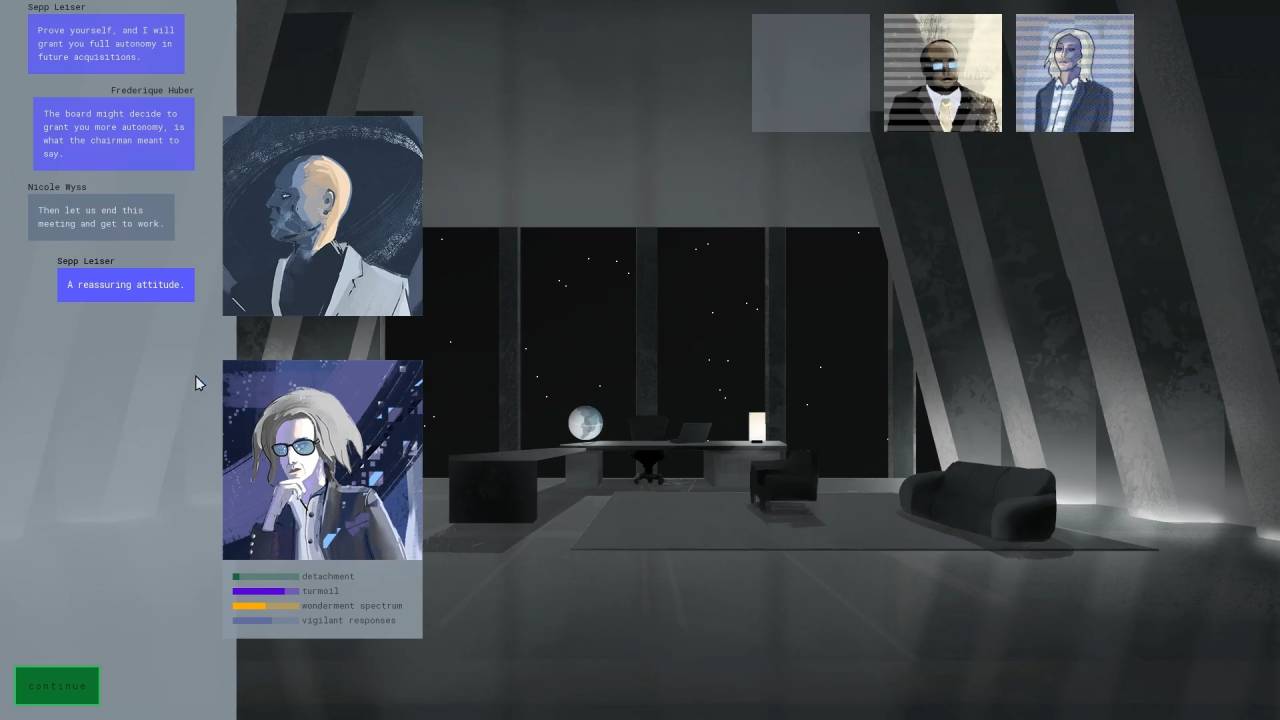
Monthly board meetings add another layer of pressure on top of everything else. The board hands you a budget each cycle, and there's an unspoken expectation that you'll spend most of it before the next meeting rolls around, since showing up with leftover cash apparently signals you didn't need it in the first place.
Your contract also comes with a probation clause early on, letting the chairman fire you outright if you underperform, so the first stretch of the game is really about proving you're worth keeping around before you're granted more freedom over future acquisitions.
Along the way, your IT director explains why Geist ended up running the show in the first place: the AI was originally built to operate companies autonomously, and once it installed itself across every server and computer at Glazial, removing it stopped being an option without effectively destroying the business.
Your own psychology becomes part of the job the moment you take the role.
That single reveal recontextualizes a lot of what you're doing as CEO, since you start to realize you were selected less for your leadership skills and more because Holonoptic's version of a hiring algorithm needed someone willing to work alongside software nobody can fully control.
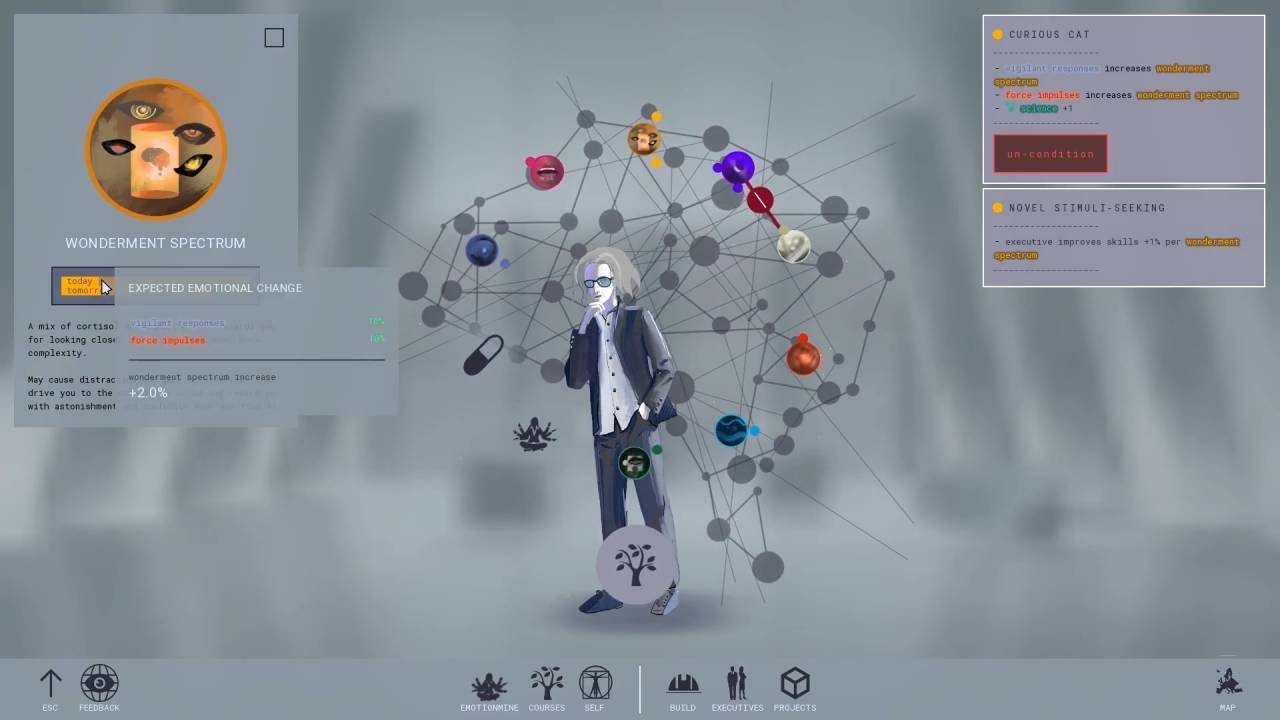
Where the game separates itself from a standard tycoon sim is in how heavily it leans on who you are as a person while all this is happening. Your character carries forty distinct psychological traits alongside eight shifting emotional and mental states, and both actively color how conversations play out and which choices are even available to you.
Before a tense negotiation or a monthly board meeting, you can dose yourself with any of sixteen psychoactive substances to sharpen your focus, numb your detachment, or steady your emotional state, which sounds like flavor text until you realize it's changing your actual stats going into that scene.
Comparisons to Disco Elysium are going to come up constantly here, mostly because of the internal personality system, where different facets of your own mind chime in and steer how you read a situation. It's clearly inspired by that game rather than trying to copy it outright, and it fits naturally into Holonoptic's corporate setting instead of feeling bolted on.
Your background as a CEO shapes how every conversation plays out.
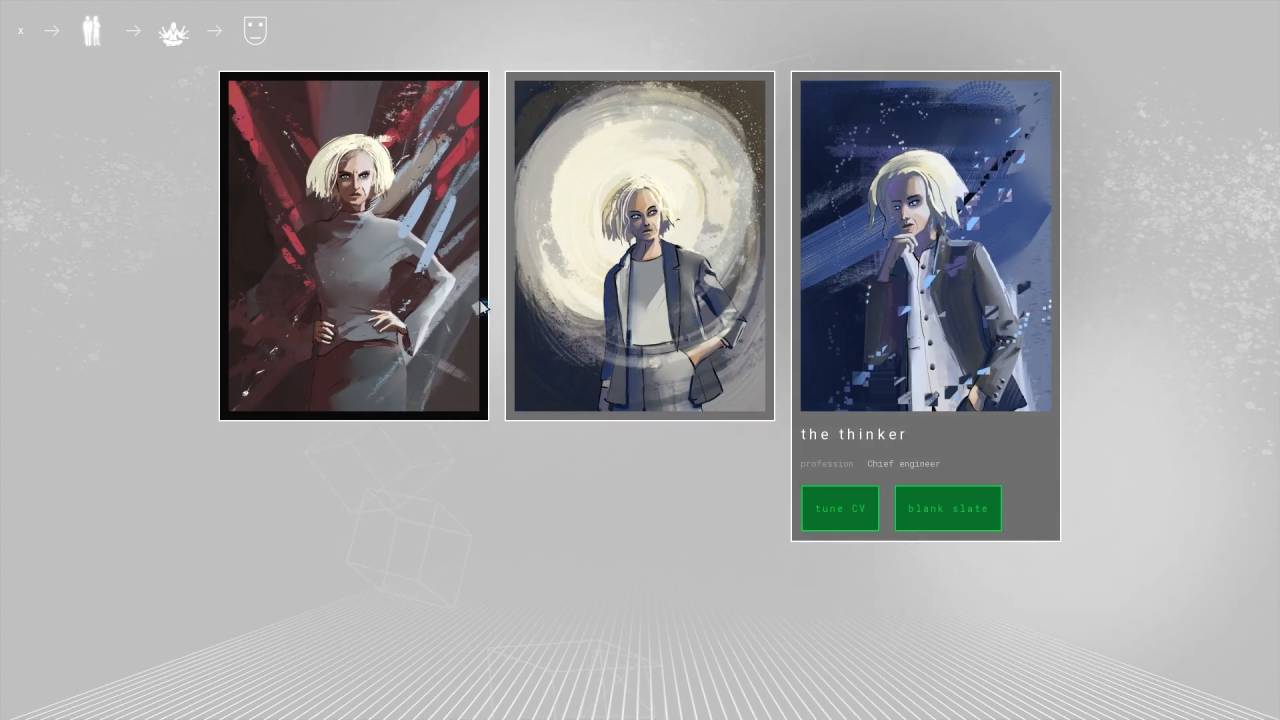
On top of that, nine character classes built around post-industrial careers, things like Office Drone, Chief Engineer, Investment Banker, or Corporate Spy, shape your starting skills and unlock different dialogue paths. In contrast, six core skills and more than seventy feats let you keep customizing how your CEO actually operates.
There isn't traditional combat or puzzle-solving in the way most RPGs use those terms; instead, negotiations, acquisitions, and board politics function as Holonoptic's version of that challenge, and they hinge on skill checks, resource management, and reading which executives or factions you can afford to alienate.
What works well here is that failure rarely feels arbitrary. If a deal falls through or a board meeting goes badly, it's usually because you didn't build up the right skills or didn't send the right person to handle it, which makes the systems feel fair even when they're punishing.
That fairness comes with a real cost, though. The tutorial walks you through the basics of construction, hiring, and courses. Still, a lot of the deeper interactions between systems, how management points feed into enterprise projects, or how skill training ties into course prerequisites aren't explained clearly, and newcomers to management games are likely to spend their first several hours feeling a bit lost.
The interface is still catching up to everything happening underneath it.
The interface hasn't made that easier either, at least historically. It might be one of the most common complaints, though the developer has kept pushing updates since the beta to streamline menus and cut down on the confusion. The version currently on Steam is noticeably smoother than earlier builds.
Progression through skills works through a course system tied to your in-game software, where you unlock new training options as your existing skills climb, gradually opening up more advanced abilities like hardware design or data science.
That grinding loop directly gates what enterprise projects you can even attempt, so investing in the right skills early tends to pay off later when you're racing a deadline on an acquisition. Narratively, Holonoptic doesn't funnel you down one obvious path.
Every major decision nudges your character toward one of eight ideological leanings, ranging from free-market capitalism to collectivism, plutocracy, or various underground economic movements, and whichever ideology you lean into opens up its own missions, allies, and storylines while making enemies out of the opposing factions.
Your executives never stop pulling in their own directions.
You can run Glazial as a ruthless profit machine, throw your weight behind the labor movement and the Symbiotic Union, manipulate everyone quietly while staying outwardly neutral, or chase pure self-interest above all else, and the game tracks all of it toward more than ten distinct endings.
Your executive team also factors heavily into this. Up to sixteen recruitable executives can join you, many of them fully voiced, and none of them are simple allies. Each one has personal ambitions that occasionally clash with yours or with each other, and you'll regularly be forced to back one at another's expense, which means the "party" in this RPG is really a collection of people you're constantly managing politically as much as functionally.
With over three thousand lines of dialogue and more than fifteen hundred of those voiced, plus upwards of 120 items and upgrades scattered through the campaign, there's a lot of writing here, and it holds up. The dialogue balances dry humor with genuine political and philosophical questions about automation, capitalism, and where AI fits into it all, without ever turning into a lecture.
Visually, Holonoptic isn't chasing graphical spectacle, and it doesn't need to. The contrast between untouched alpine scenery and sterile corporate architecture gives it a distinct look that most games in this genre don't bother going for, and the stylized art direction combined with a clean interface keeps things readable even when you've got several menus stacked on top of each other.
Running smoothly matters more here than looking flashy.
The title is light on hardware requirements, runs well even on older machines, and loading or saving happens almost instantly, so you're rarely sitting around waiting to get back into things. The soundtrack takes a similarly restrained approach.
Rather than looping constantly in the background, music mostly shows up at key story beats or major events, letting the quieter management stretches play out in near silence. When the score does kick in, it reinforces that cold, tense corporate mood without wearing out its welcome. Holonoptic also gives you a fair amount of control over how brutal you want the experience to be.
Six difficulty tiers run from Intern, aimed at people just getting familiar with the mechanics, up through Office Drone as the standard baseline, Ghost, a Senior Executive setting for a bit more friction, Overlord for repeat playthroughs, and finally Singularity at the top, a difficulty that was widely assumed to be borderline impossible.
Holonoptic had a fairly long testing period before its full release, and testers who logged dozens of hours across multiple difficulty tiers came away consistently impressed, describing the balance between the core loop's approachability and the optimization potential beneath it for anyone who wants to chase efficiency.
Holonoptic asks for a lot of patience up front and rewards you for sticking with it.
The pacing leans heavily on reading conversations, reviewing reports, and planning several moves rather than anything resembling constant action, which won't land for everyone looking for a faster RPG. The interface still has room to improve, some of the deeper systems could use more balancing, and a handful of story branches could be built out further.
None of that undercuts the experience. Holonoptic turns spreadsheet busywork into something that actually matters to the story, gives its executives real personality, and builds a cyberpunk world that earns its identity without leaning on the genre's usual visuals. If you're the type who enjoys narrative-heavy RPGs, deep management systems, and choices that carry real weight without a clean right answer, Holonoptic is well worth the time it asks for.
Editor, NoobFeed
Verdict
Holonoptic masterfully blends corporate strategy, RPG progression, and emergent storytelling into a rewarding management sim that thrives on meaningful player choice.
70
Related News
No Data.