
Intel Arc Pro B50 16GB GPU Delivers Mixed Results in Modern Games
Gaming benchmarks reveal how Intel Arc Pro B50 handles modern 1440p titles despite its workstation-focused design and limited power requirements.
Hardware by Tanvir Kabbo on Nov 01, 2026
Professional graphics cards aren't typically designed for gaming, but that doesn't mean they cannot deliver a decent experience outside workstation applications. Intel's Arc Pro B50 is an interesting example. Its low-profile design, 16GB of GDDR6 memory, and modest power requirements make it an appealing option for compact systems. It does not need an external power connector, which also simplifies installation in smaller workstation builds.
However, its professional positioning raises an important question: how well can this relatively compact GPU handle modern games at 1440p? A series of gaming tests provides a clearer picture of its strengths, limitations, and when its extra VRAM could help.
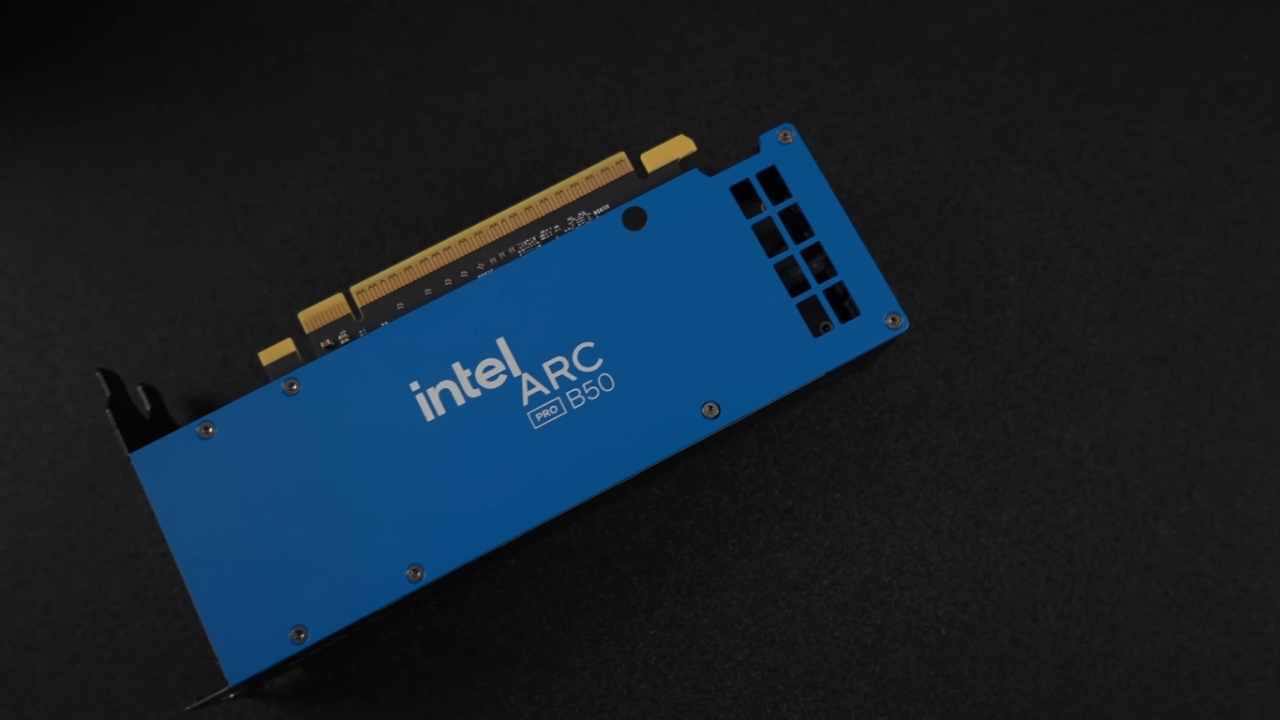
Intel Arc Pro B50 Specifications and Test System
The Arc Pro B50 features 16 Xe cores, 16 ray tracing units, and 128 XMX engines. Its listed base frequency is 1700MHz, while boost clocks can reach 2600MHz. Intel also equips the card with 16GB of GDDR6 memory, giving it more capacity than many mainstream gaming graphics cards in a similar compact category. The tested unit originally cost approximately $370, although its price has since climbed beyond $400.
The test platform used an AMD Ryzen 9 7945HX, a Zen 4 processor with 16 cores and 32 threads. Its base clock is 2.5GHz, with boost frequencies reaching 5.4GHz. The system also included 96GB of memory operating at 5600MT/s. Faster system memory might have improved the platform further, but the available capacity was sufficient for the gaming tests.
1440p Gaming Results Reveal Uneven Performance
Testing at 1440p placed additional pressure on the GPU and its memory subsystem. Higher-resolution gaming can expose VRAM limitations, making this a useful environment for evaluating the B50's 16GB configuration.
Forza Horizon 6 averaged 30fps with the Ultra Ray Tracing preset. That result isn't particularly impressive for a dedicated gaming GPU, but it shows the Arc Pro B50 can run demanding visual settings without immediately exhausting its available memory. The benchmark also reflected the performance experienced during regular driving.
BeamNG produced a more encouraging result. At 1440p using the Low preset, the graphics card averaged 52fps on the tested map. Memory consumption remained between 6GB and 7GB, leaving considerable capacity unused. Higher settings were also within reach, with performance estimated at approximately 30–40fps on the Ultra preset. Among the tested titles, BeamNG provided one of the more comfortable experiences.
ARC Raiders was less impressive. At 1440p on the Epic preset, the B50 averaged 35fps. GPU frequencies hovered around 1900MHz, suggesting the card wasn't consistently reaching its potential boost range. Enabling Resizable BAR helped address a common performance-related issue, although it did not completely eliminate the inconsistent clock behavior.

VRAM Capacity Becomes More Important in Recent Games
LEGO Batman offered another useful look at memory consumption. At 1440p on the High preset, the game used about 7.5GB to 8GB of VRAM. GPU frequencies generally stayed between 2GHz and 2.2GHz, providing a more consistent operating range than ARC Raiders. The result also shows why memory capacity matters when choosing a graphics card for newer releases.
The difference becomes particularly relevant when considering an RTX 5060 configuration with only 8GB of VRAM. Although memory capacity alone does not determine gaming performance, demanding titles can increasingly make limited VRAM a constraint at higher resolutions.
Mount & Blade II: Bannerlord performed well on the Very High preset at 1440p, averaging 61fps. Larger battles and late-game sieges could reduce frame rates to approximately 40–50fps, but the overall experience remained reasonably smooth. This is a strong result considering the card's compact design and workstation-oriented positioning.
Arma Reforger placed a heavier burden on the GPU. At 1440p with the Medium preset, memory usage reached approximately 6.6GB to 7GB, while operating frequencies stayed near 2200MHz. The average frame rate was 30fps, making the experience playable but far from ideal for users seeking consistently high refresh rates.
Low Temperatures and Compact Design Remain Major Advantages
We tested Counter-Strike 2 at 1280x960 with minimum graphics settings. GPU utilization remained around 50%, while the card reached higher clock frequencies than in several other games. Temperatures stayed between 60°C and 70°C, which is an encouraging result for a low-profile graphics card with limited cooling space.
These results also highlight the importance of the rest of the system. A processor with additional gaming-focused cache could improve performance in CPU-sensitive situations, although the GPU itself would remain the primary limitation in more demanding graphics workloads.
Intel Arc Pro B50 Offers More Than Its Gaming Results Suggest
The Intel Arc Pro B50 occupies an unusual position between professional workstation hardware and entry-level gaming graphics. Its 16GB of VRAM, compact dimensions, and lack of an external power connector make it particularly interesting for small systems that also handle productivity or AI workloads. Gaming performance is inconsistent, but several titles delivered acceptable results at 1440p.
Its limitations become clearer in demanding games, where averages around 30fps leave little room for higher settings or smoother gameplay. Lowering the resolution to 1080p should provide more performance headroom, although the exact improvement will depend on each game's workload and system configuration.
For anyone primarily interested in gaming, conventional gaming GPUs will generally offer a more suitable experience. However, users who need a compact professional card with 16GB of memory and occasional gaming capability may find the Arc Pro B50 worth considering. Its value ultimately depends on the price available, the software workload, and whether its workstation features justify choosing it over a dedicated gaming alternative.
Senior Editor, NoobFeed
Gaming Hardware Updates
No Data.