
Microsoft Project Zenith Arrives on AMD Ryzen AI Halo With 192GB Unified Memory
Microsoft's Project Zenith combines AMD's powerful Ryzen AI hardware with massive unified memory to simplify demanding local AI development.
Hardware by Tanvir Kabbo on Nov 11, 2026
The growing demand for artificial intelligence is pushing developers beyond traditional cloud infrastructure and toward powerful local computing platforms. As LLMs grow more demanding, memory capacity and inference costs are becoming key concerns. Microsoft and AMD are addressing these issues with Project Zenith, a ready-to-code development environment for AMD's enhanced Ryzen AI Halo small PCs.
The platform features the Ryzen AI Max+ PRO 495 and 192GB of LPDDR5X unified memory, targeting developers who wish to experiment with huge AI models without relying on cloud-based GPU resources all the time; however, with a reported price of $7,299.99 for the flagship configuration, its future worth hinges on whether local AI processing can justify such a large upfront investment.
Microsoft Project Zenith Simplifies AI Development
One major enhancement to the Ryzen AI Halo platform is Microsoft's Project Zenith, a pre-configured Windows 11 environment for AI development. Developers don't have to spend hours setting up development tools; they get a workstation with the needed applications already installed rather than starting with a traditional OS installation.
The environment consists of Azure CLI, Python, Visual Studio Code, Git, Node.js, GitHub Copilot CLI, and Windows Subsystem for Linux (WSL). These technologies cover much of the basic infrastructure needed for software development, AI experimentation, and cloud integration.
This means developers won't have to suffer the unpleasant process of setting up a new workstation. Setting up runtimes, installing dependencies, and resolving compatibility issues can eat up valuable development time. Project Zenith aims to remove much of the early labor, letting users start building applications and experimenting with AI models right away.
Including Azure CLI and GitHub Copilot CLI also ties the platform into Microsoft's broader development environment, making local testing easier to integrate with cloud-based workflows.
Ryzen AI Max+ PRO 495 Brings Powerful Hardware
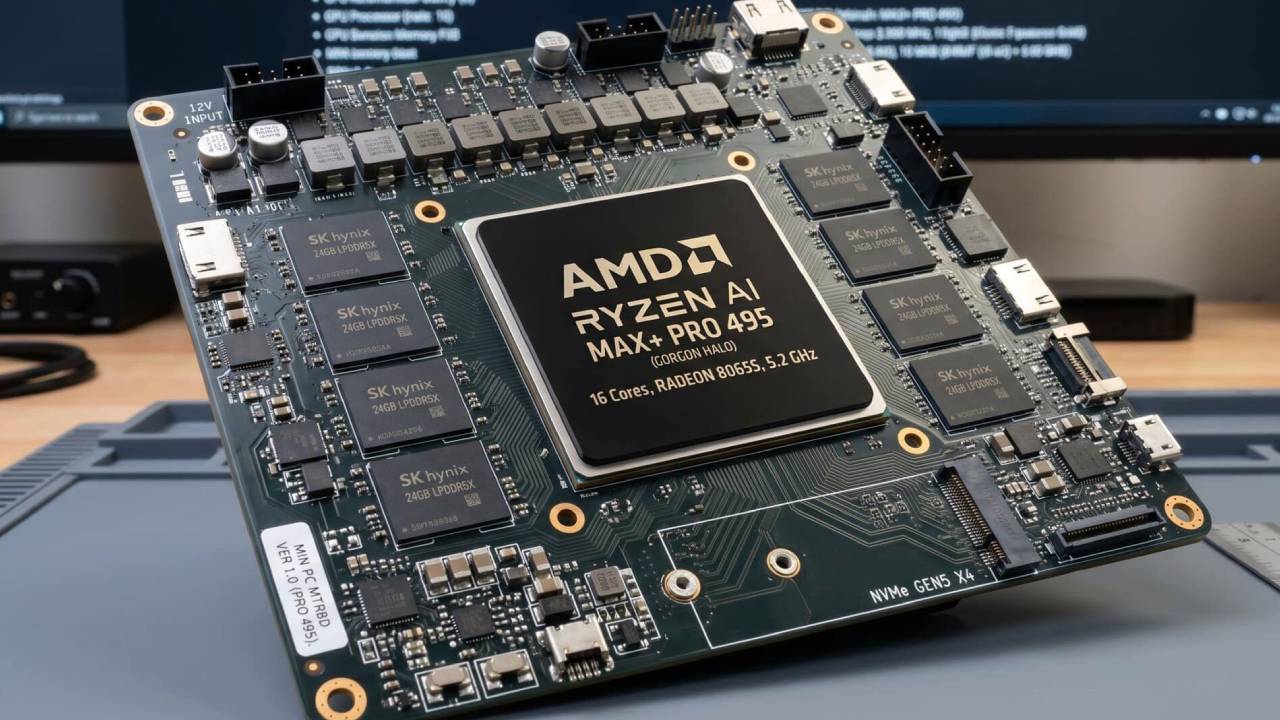
Central to the upgrade is AMD's Ryzen AI Max+ PRO 495, part of the Gorgon Halo processor family. The flagship APU will include 16 Zen 5 CPU cores, with boost rates reaching up to 5.2GHz, offering ample processing power for development workloads and multitasking.
The graphics are powered by the built-in Radeon 8065S GPU with 40 RDNA 3.5 compute units. The processor also incorporates an XDNA 2 NPU rated at 55 TOPS, providing dedicated acceleration for supported AI workloads.
However, the GPU is particularly important because it can access the system's unusually large unified memory pool. Unlike conventional desktop configurations with separate system RAM and dedicated VRAM, AMD's architecture allows developers to allocate substantial system memory directly to graphics processing.
192GB Unified Memory Targets 300B-Parameter Models
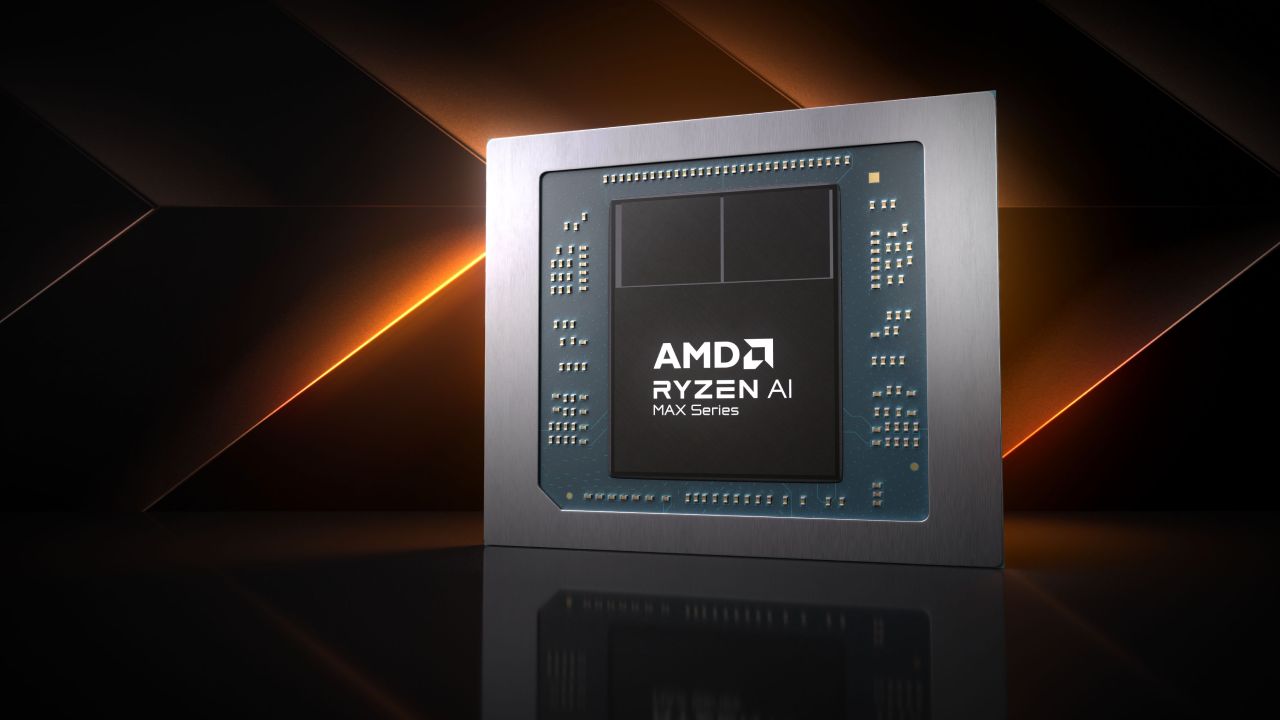
The headline specification is undoubtedly the 192GB LPDDR5X unified memory. Developers can allocate up to 160GB directly to the integrated GPU, with memory bandwidth reaching 273GB/s.
This capacity addresses one of the biggest limitations of conventional consumer GPUs: insufficient VRAM for large language models. Even expensive graphics cards will struggle to handle models with hundreds of billions of parameters without splitting the work across multiple GPUs.
Reported specs say Ryzen AI Halo can handle models up to 300 billion parameters with aggressive quantization. Quantization reduces model-weight precision and memory requirements, allowing larger models to fit within available hardware resources.
However, fitting a model into memory does not automatically guarantee high inference performance. The 273GB/s bandwidth is considerably lower than the high-bandwidth memory available on dedicated AI accelerators. Context length, runtime overhead, and quantization settings will also influence practical performance.
Nevertheless, having up to 160GB of GPU-accessible memory in a compact workstation creates opportunities for local AI experimentation that would otherwise require expensive multi-GPU configurations.
Is the $7,300 Price Tag Justified?
The biggest challenge is the price. Micro Center lists the 192GB configuration at $7,299.99, compared with about $3,999 for the original 128GB version. For developers who regularly rent A100 or H100 cloud instances, buying local hardware could eventually reduce recurring costs. A dedicated workstation eliminates the hourly GPU rental fees and offers access to local computing resources at all times.
But the cost trade-off is not so simple. Cloud infrastructure provides access to far more powerful accelerators without the high upfront cost. Electricity, maintenance, depreciation, and the workstation's relatively limited memory bandwidth must also be considered.
Thus, the Ryzen AI Halo is not a straight replacement for enterprise AI servers. Developers training massive models or requiring high-throughput inference will still benefit from dedicated accelerators.
FAQ
Q. What is Microsoft Project Zenith?
A. Microsoft Project Zenith is a preconfigured Windows 11 development environment designed for AI developers. It includes tools such as Python, VS Code, Git, Node.js, Azure CLI, GitHub Copilot CLI, and WSL.
Q. How much unified memory does the AMD Ryzen AI Halo offer?
A. The upgraded AMD Ryzen AI Halo features 192GB of LPDDR5X unified memory, with up to 160GB allocatable directly to its integrated Radeon GPU.
Q. Can the Ryzen AI Max+ PRO 495 run 300-billion-parameter AI models?
A. Yes. The platform can accommodate models up to 300 billion parameters with aggressive quantization, though actual performance depends on memory requirements, context length, and runtime configuration.
Q. How much does the 192GB AMD Ryzen AI Halo configuration cost?
A. The 192GB configuration is listed at $7,299.99 at Micro Center, making it a premium option for developers interested in local AI inference and development.
Senior Editor, NoobFeed
Gaming Hardware Updates
No Data.