
33 Immortals Review
PC
33 rebellious souls team up, fight their way through Inferno, Purgatorio, and Paradiso, and take their shot at God.
Reviewed by Adeela Tas on Jun 11, 2026
33 Immortals comes from Thunder Lotus, the Canadian studio behind Spiritfarer, and you can feel that pedigree the moment you load in. Where their earlier work was a quiet, narrative-driven experience about a single character, 33 Immortals flips the formula entirely. It throws you into a chaotic, online-only co-op roguelike built around one wild premise: you and 32 other damned souls just decided to rebel against God, together, right now.
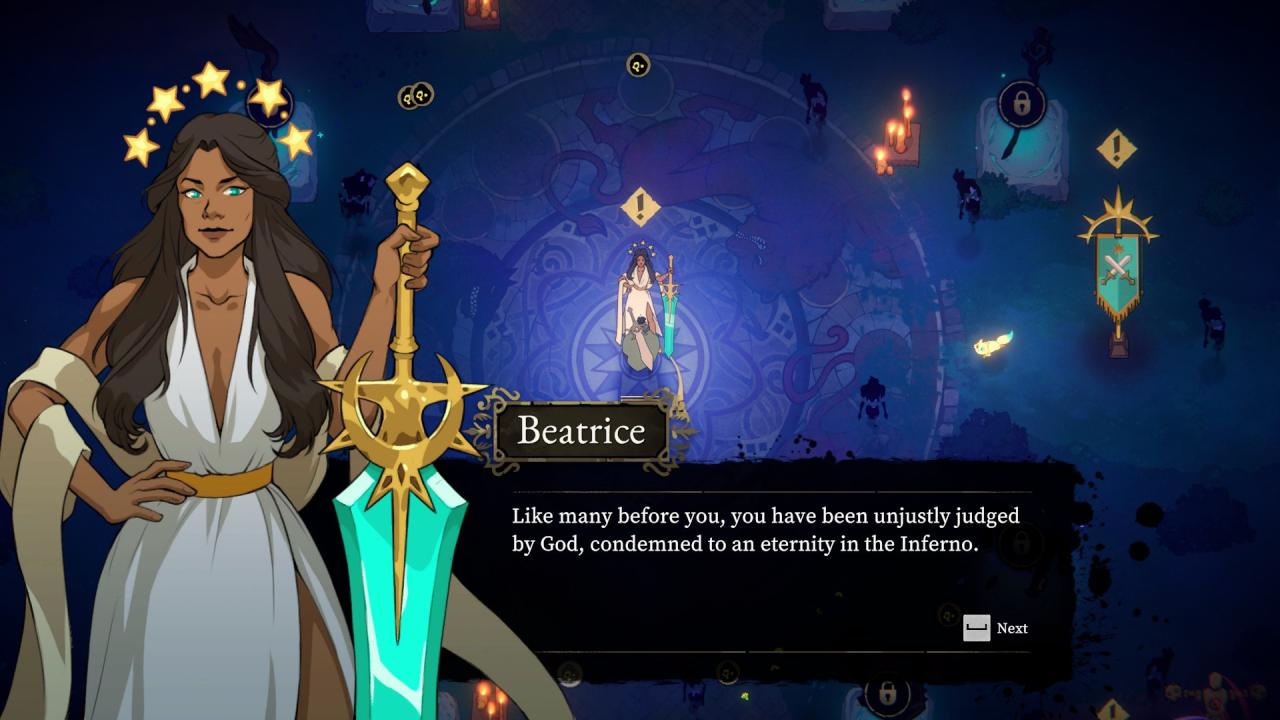
The whole game is built on top of Dante's Divine Comedy. Inferno, Purgatorio, and Paradiso all show up as the three major worlds, and a handful of familiar names from the poem are folded into the story too. Beatrice acts as your guide and leads the rebellion, Dante runs the perk system back at camp, Virgil keeps the bestiary, and Charon and others show up in reimagined forms.

None of it is heavy-handed lore. Beatrice fills you in gradually as you progress, and if you want to dig into the Christian iconography and the Catholic-meets-alien art direction, there's plenty there, but the game never forces you to care about the story to enjoy 33 Immortals.
The number in the title isn't just branding either.
Each canto of the Divine Comedy comes in sets of 33, and the developers actually experimented with 100-player lobbies before settling on 33 as the sweet spot. So every Inferno run drops you and 32 strangers onto a big map, scattered across different starting points, and from there it's up to all of you to fight your way through.
The story in 33 Immortals is intentionally light. Your soul has been judged and condemned, but in the Dark Woods, the hub between worlds, a rebellion is brewing. Beatrice leads that rebellion, and your job alongside the other 32 players is simple on paper: punch through Hell, then Purgatory, then Paradise, and confront God directly. As you complete more feats, Beatrice opens up more, explaining mechanics and filling in the world a bit more.
It's the kind of narrative that's there if you want it, but it never gets in the way of the actual gameplay loop, which is really where 33 Immortals wants your attention. Visually, the journey through the three realms changes quite a bit. The Inferno and Purgatorio areas look more grounded, with human-like monsters and Catholic motifs everywhere.
The closer you get to Paradiso and to God, the more abstract everything becomes, with enemies turning into these geometric, almost alien shapes. It's a nice way of visually reinforcing the idea that you're moving further from the world you know. At the start, you pick one of four classes- Sword of Justice, Bow of Hope, Daggers of Greed, Staff of Sloth- which Thunder Lotus also frames as your starting weapon: Tank, Shooter, Fighter, or Specialist.
Each of these comes with its own playstyle.
The Tank staggers enemies and can summon shields to protect teammates. The Shooter fires from range and can recall arrows for extra hits. The Fighter uses fast, close-range dagger attacks and can leap in for bonus damage. The Specialist uses a staff to lob energy orbs from mid-range and can slow down groups of enemies. Eventually, though, 33 Immortals lets you unlock all available weapons regardless of which class you started as, so your initial pick isn't really a long-term commitment.
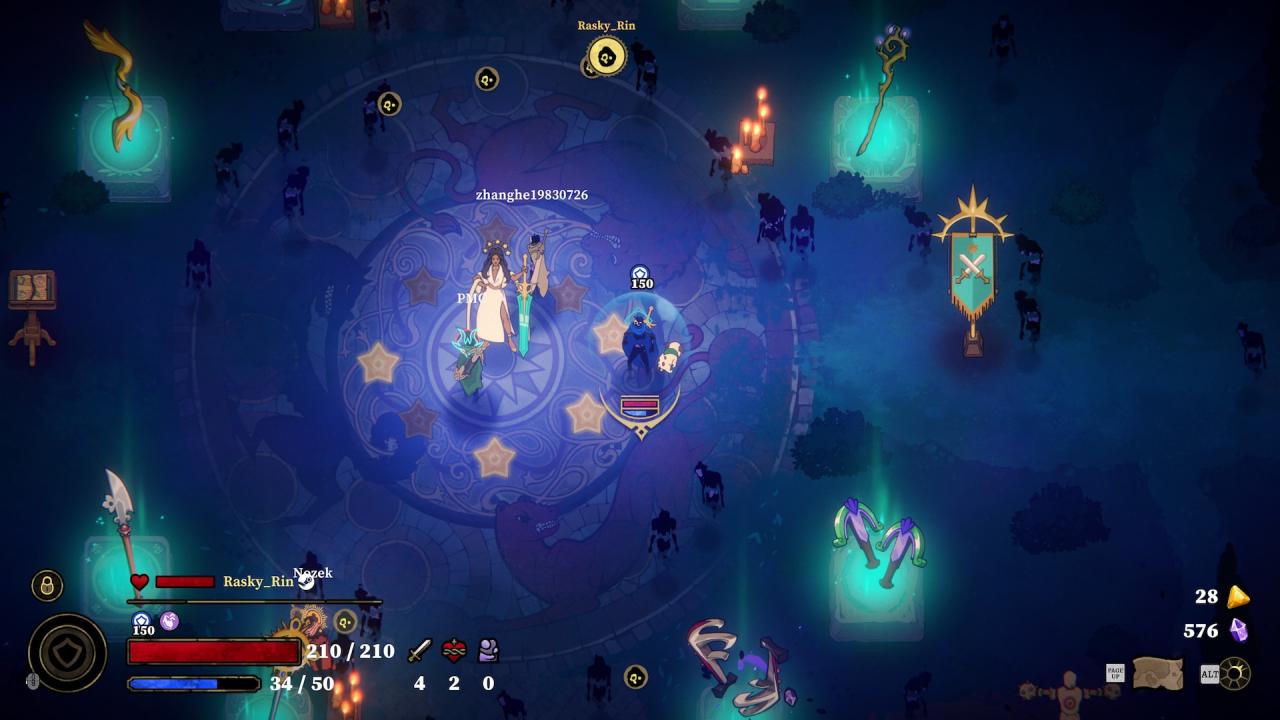
You're not locked into one identity forever. Between runs, you're hanging out in the Dark Woods, which functions a lot like the hub in Hades. There's a wardrobe for cosmetics, a training area where you can press a button near a dummy to learn your moveset, and a handful of NPCs who manage different systems. Dante is your perk guy; you bring him perk tokens, earned from completing runs, and he crafts new perks for you to slot in.
You've got six perk slots total, and each one can be leveled up using Eternal Shards, going from a modest bonus to something much stronger at tier three. Once you're ready to head out, a 33 Immortals run plays out in a few distinct phases. First, you're dropped onto a big map and start exploring, fighting mobs, opening chests, and picking up the run's two main currencies.
Bones are the in-run currency, used to heal at shrines or to buy keys for 100 bones a piece. Eternal Shards and Dust drop from enemies too, with Dust specifically being used at sanctuaries to boost one of three stats: Attack, Vitality, or Empathy. None of the Bones or Dust carry over once the run ends, so the idea is to spend everything you've got before you finish.
While you're out exploring, you'll come across Torture Chambers, sometimes called Chambers of Torment.
These are smaller, six-player challenge areas that pop up on a rotating cooldown, roughly every ten minutes. Some of these chambers want you to wipe out every enemy; others want you to destroy specific effigies. Each chamber gives you two chests, one that's free and one locked behind a key you'll need to buy with Bones. The map shows you if a chamber is already full, so you're not stuck waiting around for no reason, at least in theory.
All of the chambers across the map need to be cleared before the run moves into its next phase, which is the Ascension. This is where the map starts collapsing inward, similar to a battle royale's shrinking zone, except you're not fighting other players; you're just trying to survive the environment closing in while still getting in your last few level-ups. The game waits until every player has made it to the ascension point before moving everyone into the final boss fight, so if some players are lagging behind, you'll actually see them and have to wait for them to catch up.
Right before the boss, everyone gets handed random relic upgrades and a temporary co-strike buff that boosts everyone's damage. Then it's straight into the Inferno's final boss: Lucifer. The fight has multiple phases, crystal-based mechanics that kick in partway through, and big telegraphed attacks the game actually announces ahead of time, so you're not left guessing what's about to hit you.
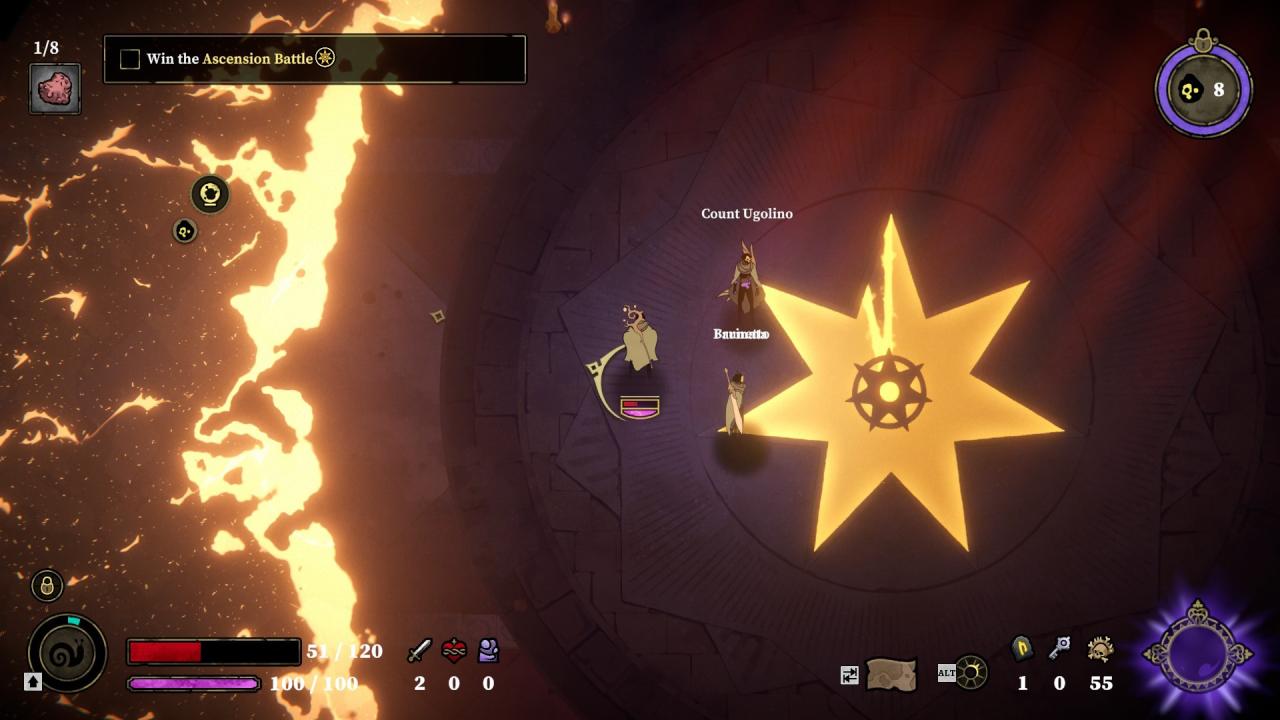
There are also stack mechanics where a set number of players need to group up to share incoming damage, and AOE effects that someone needs to physically carry away from the group and drop somewhere safe. If you go down during the fight, you become a kind of floating orb, and another player needs to revive you, though you'll only come back with a portion of your health. Get knocked out a second time, and that's it for you in that run.
Beat Lucifer, and you walk away with the key to Purgatorio, where the difficulty steps up noticeably, and the player count drops to 22.
There you'll eventually face Adam and Eve as the boss. Survive that, and Paradiso opens up with just 11 players remaining, culminating in a final fight against the Wrath of the Lord. So the structure of 33 Immortals is essentially a funnel: more players, easier difficulty at the start, fewer players and harder fights as you climb toward Paradiso.
After any run, win or lose, you keep your Eternal Shards, perks, halos, weapon skins, and emotes. Back at the Dark Woods, you can spend those shards at weapon shrines to unlock new weapons, and unlocking a weapon within your class actually gives you bonus shards while you're using it.
There's also a permanent leveling system tied to completing Feats; these are milestone-style objectives like killing a set number of monsters, opening chests, breaking urns, or doing a certain amount of damage through specific combos. Completing groups of these feats levels up your character permanently, unlocking more perk slots, more health, damage reduction, and other long-term bonuses.
Combat in 33 Immortals is built around a pretty simple toolkit: a light attack, a heavy attack, and a special co-op ability tied to whatever weapon you're using. On paper, that sounds limited, and to be fair, it kind of is. There's no deep combo system or technical mastery curve here. What 33 Immortals does instead is lean hard into the co-op side.
When multiple players hit the same enemy at the same time, you get a damage bonus, which actively encourages grouping up rather than spreading out. Each weapon also has a unique co-op ability that only triggers when other players are standing on nearby glowing tiles: swords throw up a team shield, bows unleash an arrow barrage, and staves slow down groups of enemies.
This is where 33 Immortals both shines and shows some cracks.
On one hand, those moments where a fight is falling apart and a few players clutch-revive everyone, or where a group splits to handle two objectives and then funnels back together for the final push, genuinely feel great. Nobody's giving orders, there's no voice chat, just emotes, but people naturally sync up anyway. On the other hand, the actual move-set is thin.
With just three core attacks and one cooperative ability per weapon, fights against tougher enemies, especially the bigger "Alpha" mobs, can turn into long stretches of just chipping away at a health bar. The bigger enemies are mostly scaled-up versions of smaller ones too, so the variety isn't quite there yet.
Movement also feels stiffer than you'd expect, especially if you're coming from something like Hades. Attacks root you in place for a moment, and your dodge roll has a cooldown that can feel a little too long when things get hectic. It does get better as you level up and unlock more mobility-related perks and relics, but the stiffness never fully goes away.
The XP and leveling structure ties directly into how much easier 33 Immortals gets the more you play. Your character has a global level that increases as you complete feats and collect perks, and that level translates into real, permanent stat boosts: more health, more damage reduction, extra perk slots. The difference is noticeable.
A newer player might have zero damage reduction and be taking full damage from every hit.
All the while, a more leveled character might be sitting at 25% damage reduction with a much bigger health pool, meaning the same enemies that threaten a new player barely register for someone further along. This makes early runs feel exponentially easier the more time you've put into 33 Immortals, which is great for your own sense of progress but does mean newer players grouped with veterans might not get much of a challenge.
Relics add another layer on top of all this. These are found during runs and can be equipped up to eight at a time, ranging from simple stat boosts to effects like spawning healing orbs on dash, granting crit chance on heavy attacks, or stacking damage buffs the longer a fight goes. Mixing relics, perks, and your weapon choice is really where the build variety in the game comes from, since the base combat alone is fairly simple.
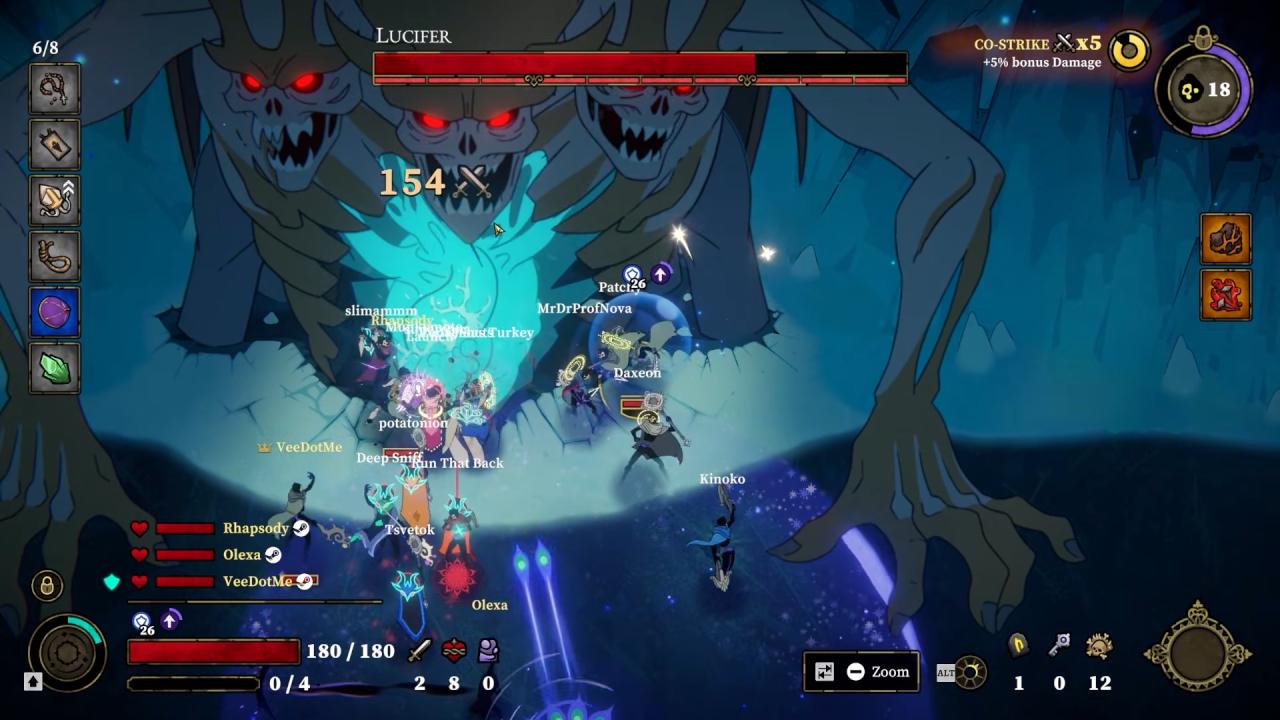
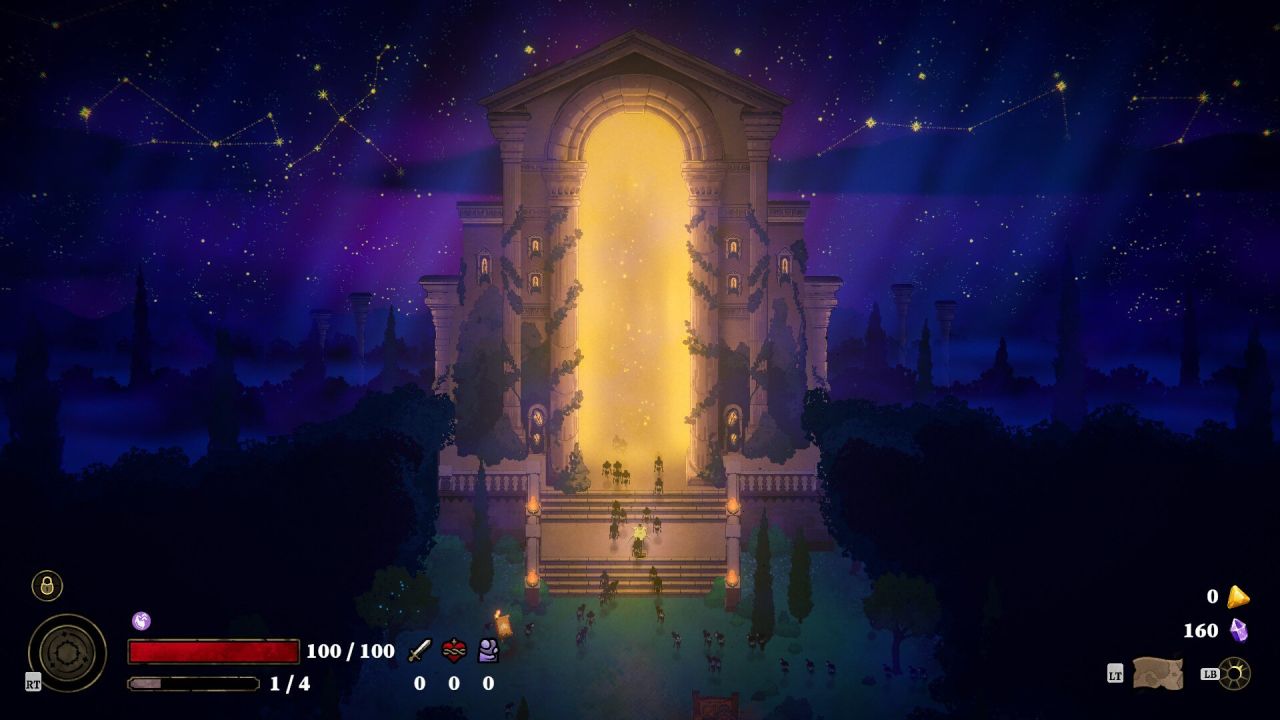
Visually, 33 Immortals has a clear 2.5D look that's recognizably Thunder Lotus, similar in tone to Spiritfarer but reworked for an afterlife setting. Given that there can be 33 players on screen at once, all using abilities simultaneously, the game does a surprisingly good job keeping things readable most of the time.
Character movement, skill effects, and the color-coding of different abilities all help you track what's going on even when the screen is busy. That said, it's not perfect. During the biggest fights, especially open-area clashes with a full lobby, the screen can turn into a genuinely chaotic mess where it's hard to tell what's happening.
Some of the group ability effects are also a bit unclear in terms of direction and placement, which can make it tricky to know exactly where an attack is going to land. None of this breaks the game, but it's a rough edge that's noticeable, especially during the bigger boss encounters.
The sound design in 33 Immortals is one of its strongest aspects.
The score leans heavily on choral and organ-based music, composed by Max LL, who's also worked on Spiritfarer and Jotun. That choice fits the Divine Comedy setting perfectly, giving runs through Hell and beyond a genuinely majestic, almost religious atmosphere. It's the kind of soundtrack that elevates the whole experience, and it stands out as one of the better indie game scores.
33 Immortals is at its best when everything clicks. Those moments of 33 players synchronously dodging a massive boss attack, or a chaotic scramble turning into a clean team wipe on a tough enemy, are hard to find in other games. It captures a specific feeling, that big chaotic raid energy from MMOs, but compresses it into a 30-to-60 minute session with zero prep, no lobbies, and no coordination required beyond emotes.
At the same time, the game has real issues. The combat is repetitive, especially in Inferno, where the variety of enemies is limited. The portal and chamber systems often split players up, leaving people standing around with nothing to do. Movement feels stiff, particularly early on. And because the game is entirely online with no real offline mode, your experience is tied to player population, which becomes a bigger concern the closer you get to Paradiso's already-small 11-player cap.
Even with all that, there's a strong, genuinely fun core loop buried in the game. The three-world structure based on the Divine Comedy, the relic and perk systems, and those genuinely great boss fights with proper phases and mechanics all add up to something that feels like a real raid experience without the usual MMO baggage. It's rough in places, but the foundation 33 Immortals is built on is solid, and it's the kind of game that could turn into something special with more content and some balance passes down the line.
Editor, NoobFeed
Verdict
33 Immortals delivers chaotic, rewarding co-op raids with great bosses, music, and promising potential for future improvement.
80
Related News
No Data.