
Dystopicon Review
PC
A dystopian life sim that turns watching TV into a fight for survival.
Reviewed by Adeela Tas on Aug 08, 2026
Dystopicon comes from Palitroque, a small independent studio that built this whole unsettling world without any big-publisher backing. There's no long-running series behind Dystopicon and no sequel baggage to worry about; this is a single, focused idea taken all the way to a full release.
Earlier builds of the game made their way around before launch, and plenty of people got their first look at this world through those early passes, watching streamers poke around a cramped apartment or get startled by a knock at the door.
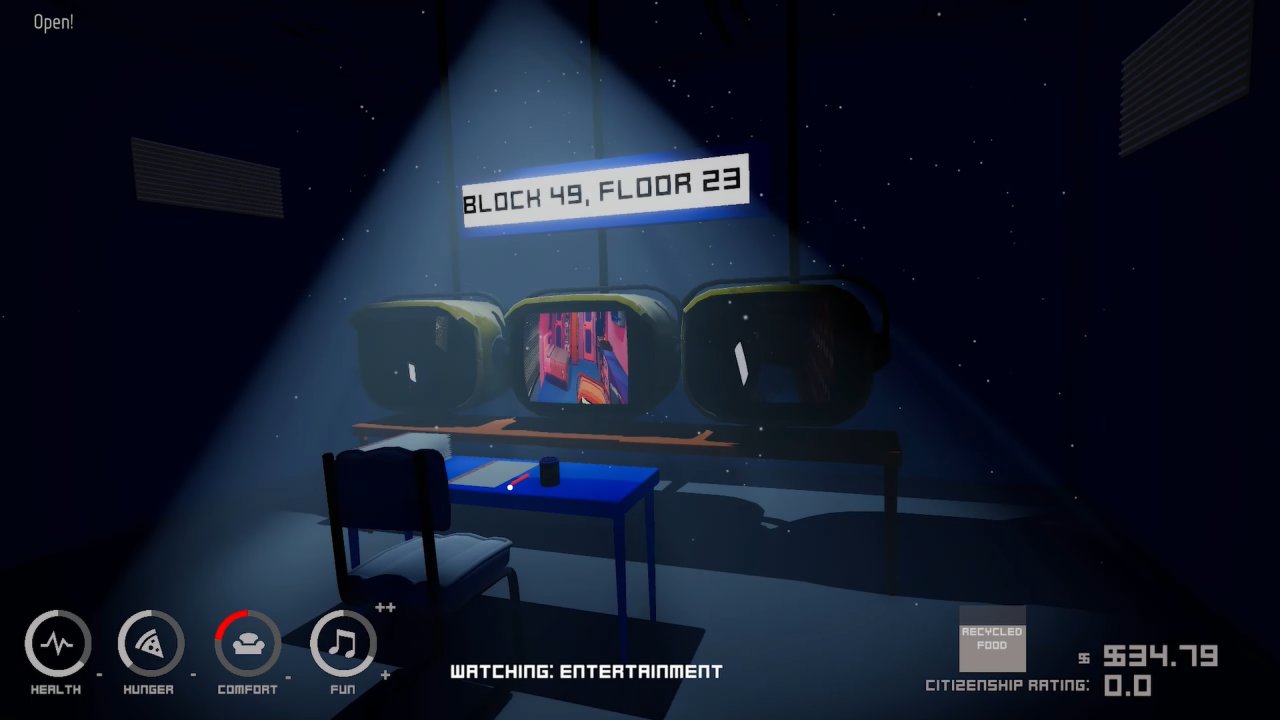
Dystopicon's real strength lies in the tightly focused premise driving the full game.
Whatever version you first bumped into, the finished release keeps that same hook intact and pushes it further, adding more story beats, more consequences for your choices, and more ways for an ordinary afternoon in front of the television to spiral out of control.
Palitroque clearly built Dystopicon around a single central premise rather than trying to stretch itself thin, and for a game confined almost entirely to one room, that premise carries surprising weight. You're not stepping into the shoes of some pre-written hero here. Dystopicon puts you in as yourself, dropped into a version of the world that isn't quite your own but sits close enough to be uncomfortable.
Robots have taken over the workforce, and instead of freeing anyone up, that shift has made ordinary people functionally useless to the economy. Your new job, handed down by a ruling body called The Trinity, is simple: sit in your apartment and watch television for money.
You start out as a lower second-class citizen fresh out of a civics camp, and if you keep your numbers up, you can work your way toward nicer housing with nicer amenities, at a correspondingly higher price. Every bit of information you get is filtered through printed bulletins, daily "truth" broadcasts, and a constant stream of reassurance insisting everything is fine, even as your own apartment tells you otherwise.
That routine is just the setup, though; what follows is a much messier web of consequences.
As the days stack up, you start running into other threads pulling at that surface: a neighbor spiraling into despair behind a thin wall, a resistance cell called New Dawn asking you to hide a package for them, police showing up to ask pointed questions, and diary entries left behind by whoever lived in your apartment before you.
Depending on how you play, you can end up an obedient, well-rated citizen, a re-educated failure, a member of the resistance, or someone who simply can't take it anymore and chooses to end things through the euthanasia machine tucked into the apartment.
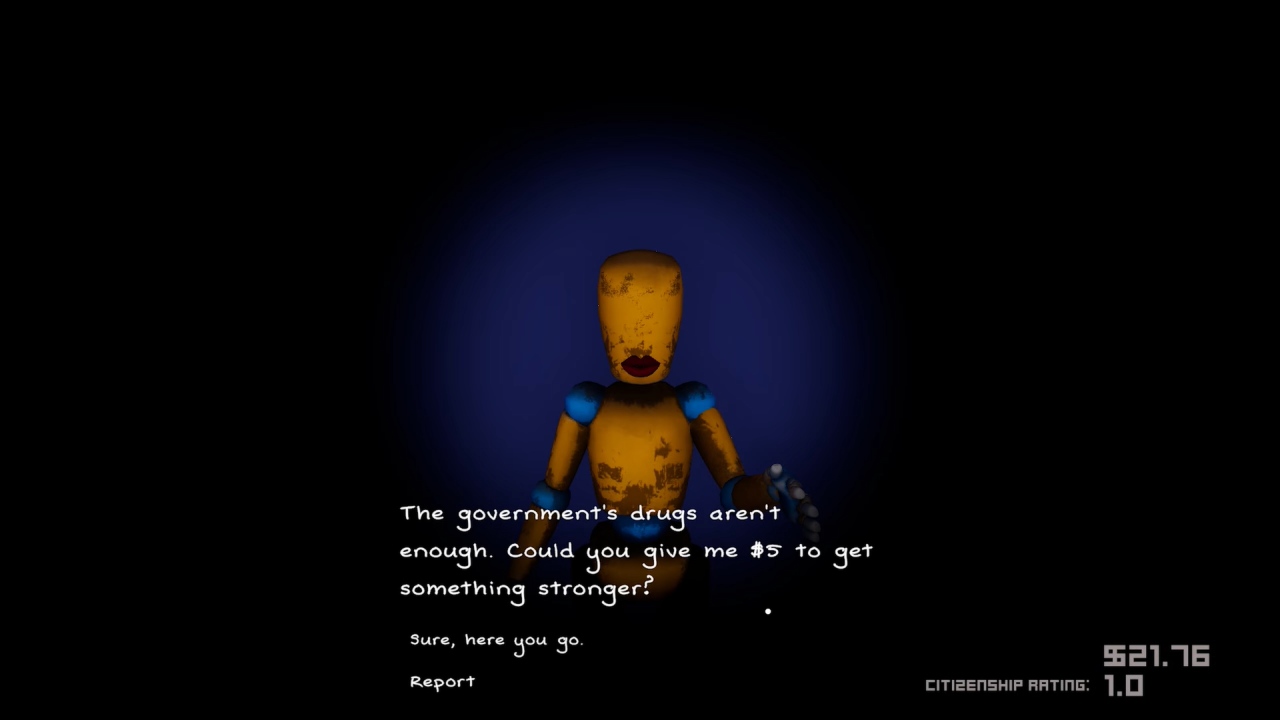
There's even a storyline that can pull you into planning an actual assassination attempt against a government official, which, depending on how it plays out, can land you in a re-education facility instead of freedom. Dystopicon never spells any of this out directly; it wants you assembling the picture yourself, one bulletin, one knock at the door, and one hidden note at a time.
Mechanically, the game boils down to one central loop: turn on the television, pick a channel, and let the money start coming in. That's the surface layer, though. While the TV runs, you're also managing four separate meters sitting at the bottom of the screen: health, hunger, comfort, and fun- and all four drain steadily over time. Let any one of them hit zero, and it's game over, sending you back to your last story checkpoint.
That balancing act between apartment upkeep, money, and time is where the game's real texture lives.
Every basic need costs money in Dystopicon, right down to using the bathroom or taking a shower, so your earnings from the television get eaten up fast if you're not careful. Some appliances only function while the television stays on, while others force you to shut it off completely, so you're constantly weighing trade-offs about what to deal with in any given moment.
Beyond your vitals, you've got the apartment itself to maintain: trash piles up from the food you eat, rats show up and need catching (which pays out a small bounty), the power occasionally cuts out and needs fixing, and unexpected knocks at the door mean you'll have to decide how to answer whoever's on the other side, whether that's a police officer, a building manager, or someone from the resistance.
A screwdriver you can pick up lets you unscrew a vent cover, opening up a path into your neighbors' apartments if you're willing to risk your vitals dropping while you're away from your own space. Along the way, you'll also stumble into a lottery machine for a shot at quick cash, government-approved drugs offered as a "safer" alternative to anything illegal, and a hotline for arranging companionship since the state doesn't assign partners to everyone.
As well as a citizen database where you can look up your own registration number and current standing. It's a lot of small systems running at once, and once new ones start layering on top of each other, keeping everything balanced becomes the actual challenge the whole thing is built around.
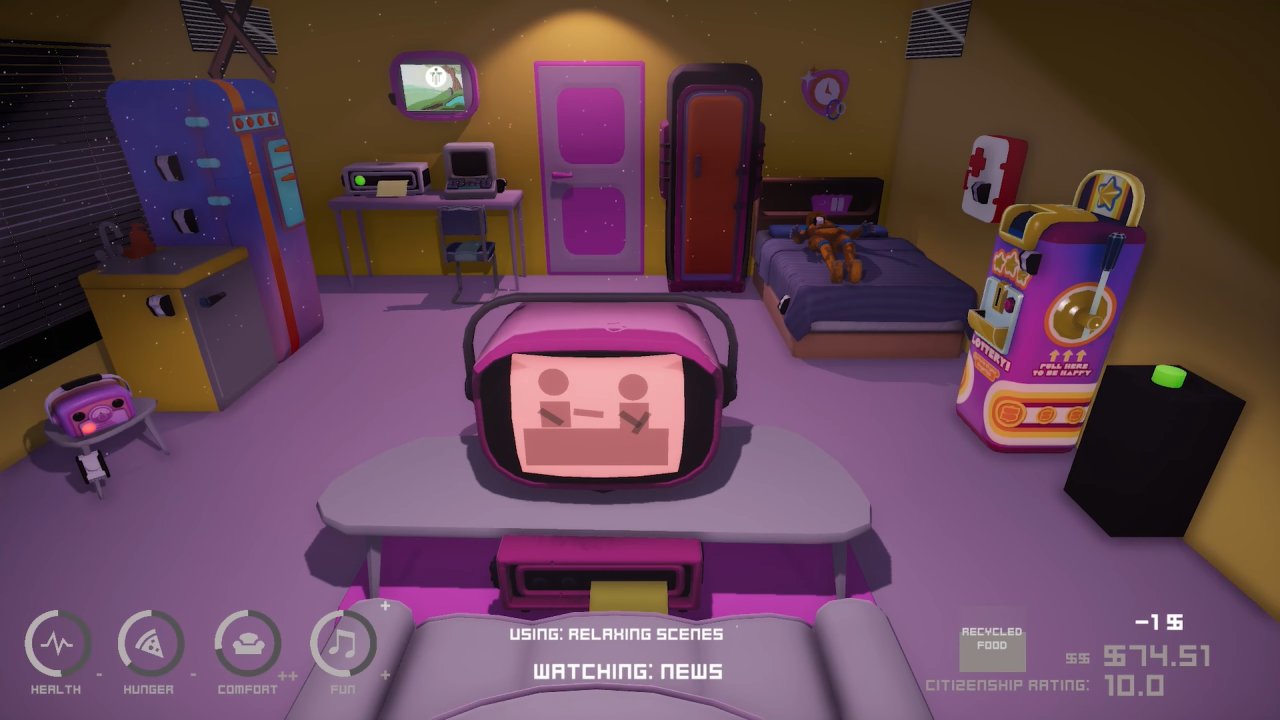
Several smaller systems layer on top of the core loop to maintain constant pressure.
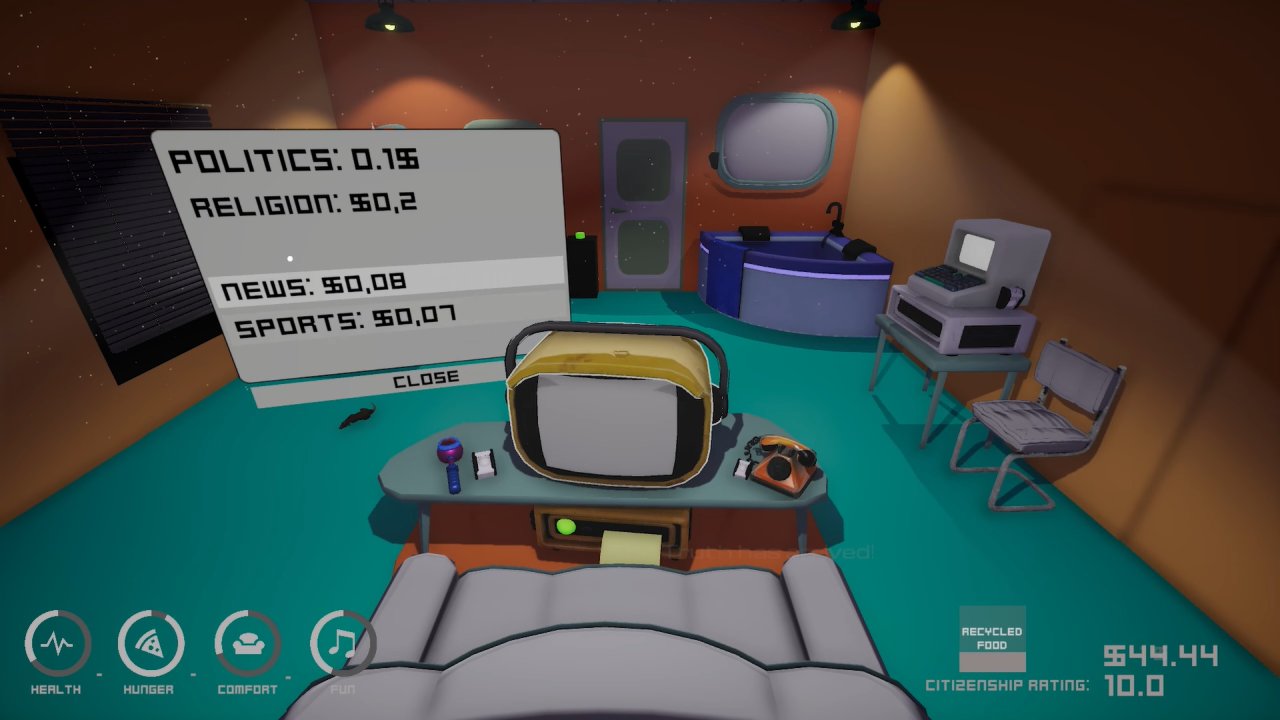
Since there's no traditional puzzle-solving or combat here, the closest equivalent is how you manage your channels and your visitors. Every channel behaves differently; religious programming usually pays the best but drains your fun meter fast, sports and general entertainment pay less but keep your other stats steadier, and political broadcasts boost your standing with the government instead of your wallet directly.
Deciding what to leave on and when to switch works a lot like solving a puzzle: you're constantly trading short-term survival against long-term progress, and every choice ripples outward into your other stats. The same logic applies to visitors; you can cooperate, lie, stay quiet, or push back against whatever they're asking, and each option nudges your citizen rating and your storyline down a different path.
This system works best early on, when new mechanics and events keep appearing and forcing you to adjust on the fly. Once you land on a reliable rhythm, though, it starts to lose its edge fast. A lot of players figure out one dependable routine within the first hour or two, and once you know exactly which channel to leave running and which needs can be safely ignored, the tension baked into the system fades out almost completely.
Making things worse, some apartments here don't even bother offering every service, and certain needs can go unattended for surprisingly long stretches without penalty, which only encourages that same routine. There's also a practical annoyance worth mentioning.
Small as that is, it hints at a larger problem with how progress gets tracked here.
Nothing keeps your mouse locked inside the game window, so if you're running a dual-monitor setup and go to grab a rat quickly, there's a real chance you'll click straight out of Dystopicon by accident instead. It's a small thing on paper, but it interrupts the rhythm the game is otherwise trying so hard to build.
There are no experience points or leveling system in the traditional sense, but Dystopicon still runs on a form of progression tied to your citizen rating and how many days you manage to survive. Keep that rating high, and you unlock better housing, additional channels, and more of the story; let it slide, and you're looking at re-education or worse.
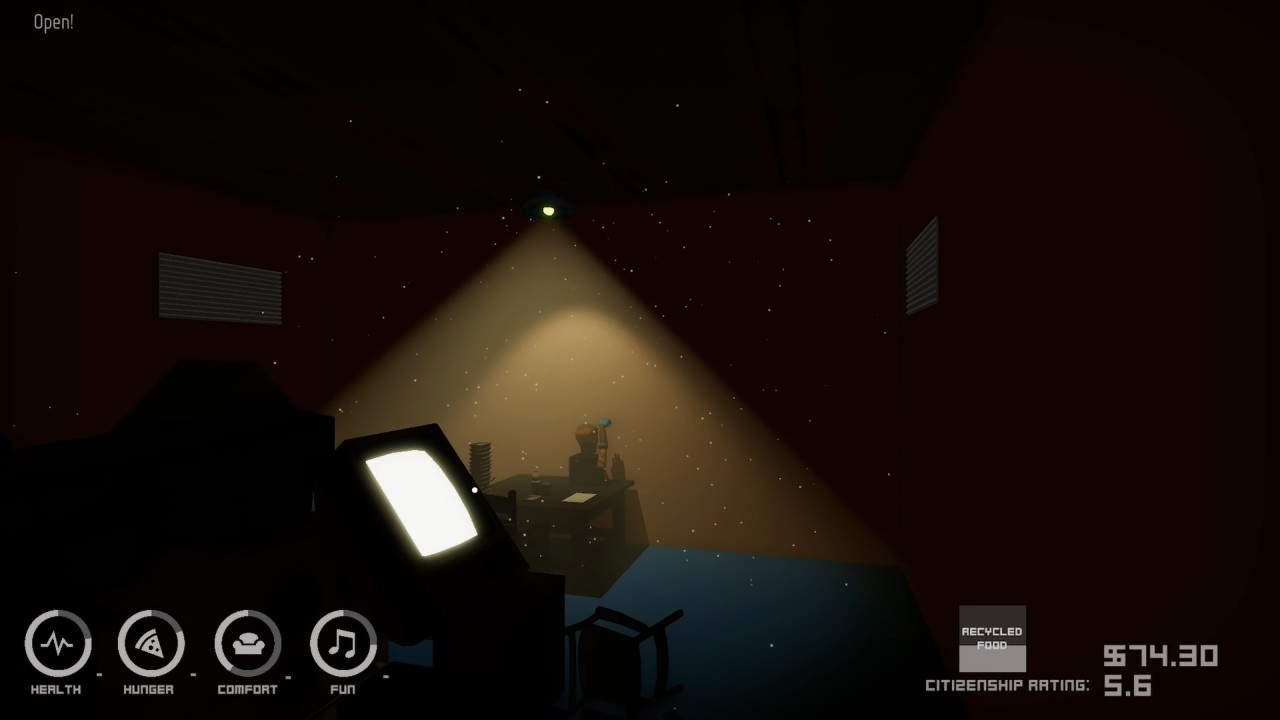
Each full run covers roughly a four-week stretch, and clearing one cleanly resets you into a slightly better position going forward, which functions a lot like a grind loop would in another kind of game. The frustrating part is that Dystopicon never gives you a clear read on exactly where you stand within that four-week window.
You're often guessing whether you're a few days from finishing or barely getting started, which makes planning your spending harder than it needs to be. Layered on top of the citizen rating is a wider unlock structure tied to the game's many endings, of which there are more than a dozen spread across different scenarios, plus at least one hidden ending that isn't explained anywhere in the game itself.
All of that feeds into a wide, sometimes obscure range of ways a run can end.
Some of those endings hinge on fairly obscure, unexplained actions - saving up a specific amount of money to buy your way out, for instance, and without digging through outside sources, it's easy to miss what actually triggers them.
On top of the main story, Dystopicon also includes a separate challenge mode that strips the narrative away entirely and just has you chasing that same savings goal under tighter conditions, which works well if you'd rather skip the story and focus purely on managing your stats.
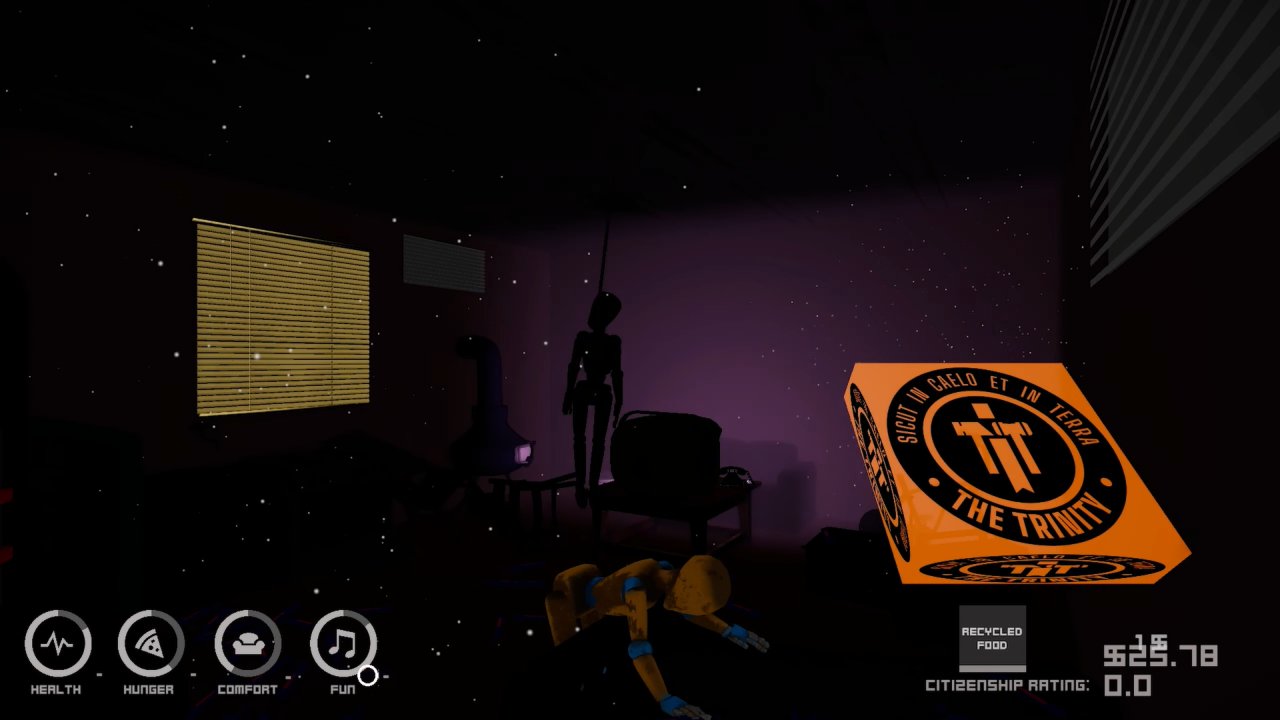
Visually, Dystopicon keeps things intentionally simple, and that restraint mostly pays off. The color palette leans muted and worn; the furniture and appliances have a retro-futuristic feel; and the people you run into are rendered as faceless, crudely shaped mannequins rather than anything more detailed.
None of it is technically impressive. But the apartment itself is well put together. Lighting, shadows, and the placement of small objects add up to a space that feels genuinely lived-in and slightly wrong at the same time. Even the other apartments you sneak into through the vents carry their own distinct look. They're not just reused copies of your own room.
Beyond that lived-in look, sound design does just as much to keep the apartment feeling alive.
That helps sell the idea that you're actually peeking into different lives, rather than palette-swapped versions of your own space. The cartoonish art style ends up making some of the darker moments land harder rather than softer, since the mismatch between the tone and the visuals adds to the general unease Dystopicon is going for throughout.
Sound plays a bigger role in Dystopicon than you'd expect from a game built almost entirely around sitting in one room. While you're reading a note or dealing with an on-screen notification, every background noise keeps running underneath it: a rat scurrying somewhere out of view, a knock at the door, a fax machine spitting out another bulletin.
You end up learning to recognize these cues almost instinctively over time, and they become just as important as anything on screen for figuring out what needs your attention next. It's a smart use of audio design that keeps tension present even during the slower stretches of a run, and it does a lot of the heavy lifting toward making the apartment feel alive despite how little actually happens inside it in a physical sense.
Taken as a whole, Dystopicon is a game built almost entirely around one strong idea, and for most of the experience, that idea carries it. The satire lands without being heavy-handed, poking at automation, media control, and manufactured obedience through a setup that's absurd on its surface but uncomfortably plausible underneath.
That idea comes through strongest in the writing, which carries most of Dystopicon's weight.
The writing does most of the heavy lifting here; bulletins, hidden notes, and visitor dialogue build out a world that feels much bigger than the single apartment you're stuck inside, and the constant gap between what The Trinity insists is true and what you're actually experiencing gives Dystopicon its bite. Where it stumbles is in how quickly that core loop turns predictable.
Once you've worked out an efficient way to keep your vitals up and your rating steady, there's not much stopping you from repeating that same sequence for long stretches while you wait for the next story beat to show up, and that gap between meaningful moments can drag more than it should.
Add in the lack of any clear progress tracking, a mouse that refuses to stay locked to the window, and a handful of endings that are borderline impossible to stumble into without outside help, and you're left with a game whose ideas are consistently stronger than the systems carrying them.
Even with those rough edges, there's something genuinely compelling about watching this small, controlled world slowly reveal how much it's been hiding from you, and that alone makes Dystopicon worth spending several runs with, especially if you don't mind repeating a few familiar sequences to see where they eventually lead.
Editor, NoobFeed
Verdict
Dystopicon backs a sharp, unsettling premise with real satire, though a repetitive core loop and murky progress tracking hold back an otherwise memorable dystopian experience.
76
Related News
No Data.