
Resonance: A Plague Tale Legacy Review
PlayStation 5 Pro
A pirate's hunt for treasure, myth, and a monster that hunts in the dark.
Reviewed by Adeela Tas on Aug 27, 2026
Having established themselves through their carefully crafted, story-driven experiences of Innocence and Requiem, Asobo Studio could have continued using their successful approach without much trouble. This fifteen-year-old prequel, as a spin-off game, takes a completely different route.
No longer will there be any rodent tides or the initial characters such as Amicia and Hugo; now, there is Sophia, a character from Requiem who is given an opportunity to have her own origin story, and she abandons the stealth approach in favor of direct combat mechanics.
This decision is quite risky for the franchise in general. Whether or not this risky move will pay off will depend solely on which aspects of the game attract you. Despite all the major changes to the mechanics, the essence of the franchise is still easily recognizable beneath the surface.
Setting and story details reveal how deeply those old bones still show.
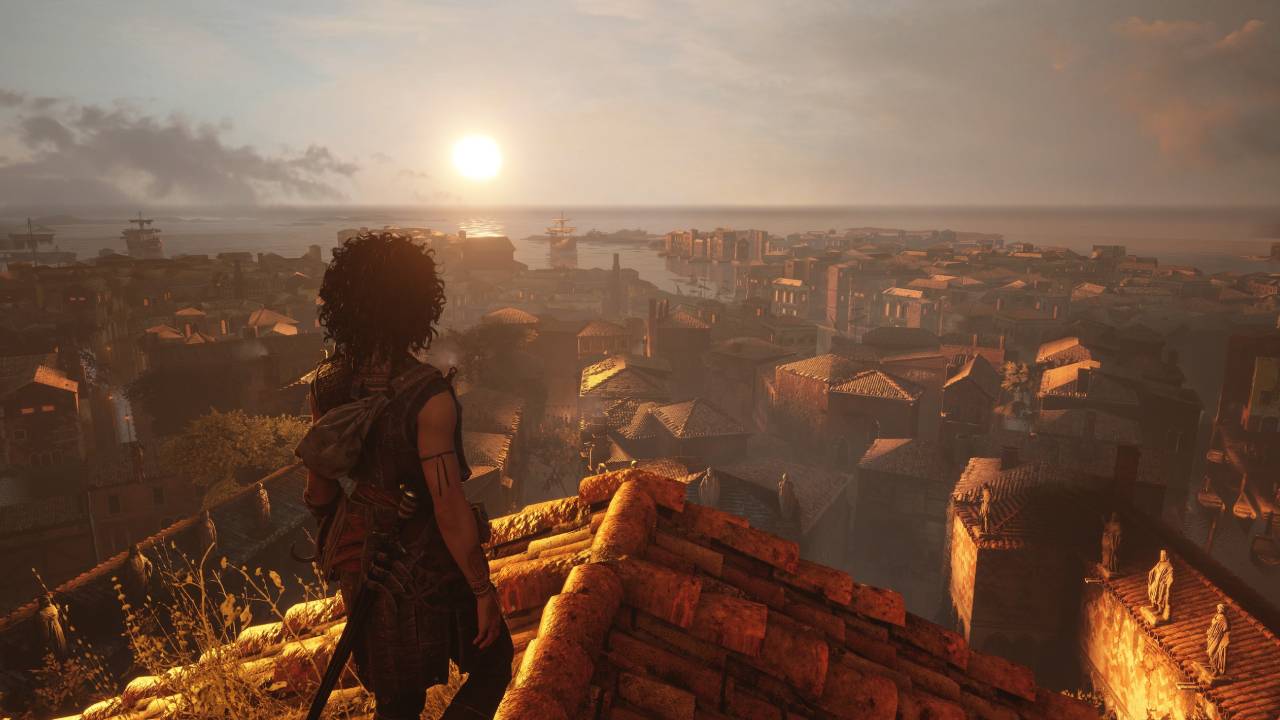
The shift from the gloomy, disease-ridden valleys of medieval France to a bright, Mediterranean setting completely changes the aesthetics, but instead of swarms of animals chasing you, you now feel psychological horror.
However, the rhythm, beats, and delivery of the story are all still clearly recognizable. Experienced players will easily recognize the family genes underneath all of the superficial changes. The essence of the quest lies in the themes of broken youth, loss, and betrayal. It masterfully camouflages itself under the guise of a treasure hunt and a horror experience, all while dodging an unseen pursuer.
By putting myself in the shoes of the young Sophia, I see the plot begin in a strict convent, where the guardians watch over her prophetic visions. These chilling visions hint at a forgotten Mediterranean region ruled by an unknown empire and an ancient story about a horned creature.
Her salvation comes from her foster father, Pharaoh, who plans a daring escape mission, taking her under his protection as part of a group of rebels and smugglers. Growing up amongst them, she gains her fighting skills and uses her prophetic visions to locate a way to their holy place, thanks to Pharaoh’s help.
Plans unravel in Venice, splitting the story into present and ancient threads.
Once they reach the gates of that mysterious place, they stop there due to a failed mission to steal artifacts in Venice, leaving Sophia alone with her loyal friend Leni. In doing so, they have to outstrip vicious opponents who do not really care much about the forces that might be unleashed by them in the process.

Alongside all these occurrences, the historical flashbacks feature the renowned hero Theseus, who documents the fall of the ancients while dealing with the contemporary conflicts. The key to this storyline lies in the personal conflicts that arise from the growing tension between Pharaoh – whose grief turns his protective nature into exploitation – and Sophia, as opposed to her consistent yet challenged relationship with Leni.
The two relationships arise due to a shared loss that affected both individuals in different ways. The writing isn't flawless throughout. Some of the banter between characters can feel a little stiff, and Sophia occasionally narrates her thoughts aloud in a way that feels more like a video-game habit than natural behavior.
The side characters around her, while likable enough, don't always get the same depth as Sophia herself, and a couple of them lean on a single defining trait rather than growing much across the story. Even so, the overall cast holds together, and the way the ancient Theseus storyline connects to Sophia's own arc gives Resonance: A Plague Tale Legacy a sense of scale that a simpler treasure hunt couldn't achieve on its own.
Story structure gives way to how the game actually plays out.
If you've played the earlier Plague Tale games, there are also quieter threads here tying back into the series' broader lore, revealed gradually enough that they add texture without needing you to have played anything else first. Structurally, Resonance: A Plague Tale Legacy follows the same general shape as most story-driven action-adventure games.
You move through a chain of small combat arenas and puzzle chambers with a companion nearby, trading dialogue as the plot unspools around you. The pacing stays mostly linear chapter to chapter, though a handful of sections open up into wider spaces where you're tracking landmarks or tackling a set of optional challenges in whatever order you like.
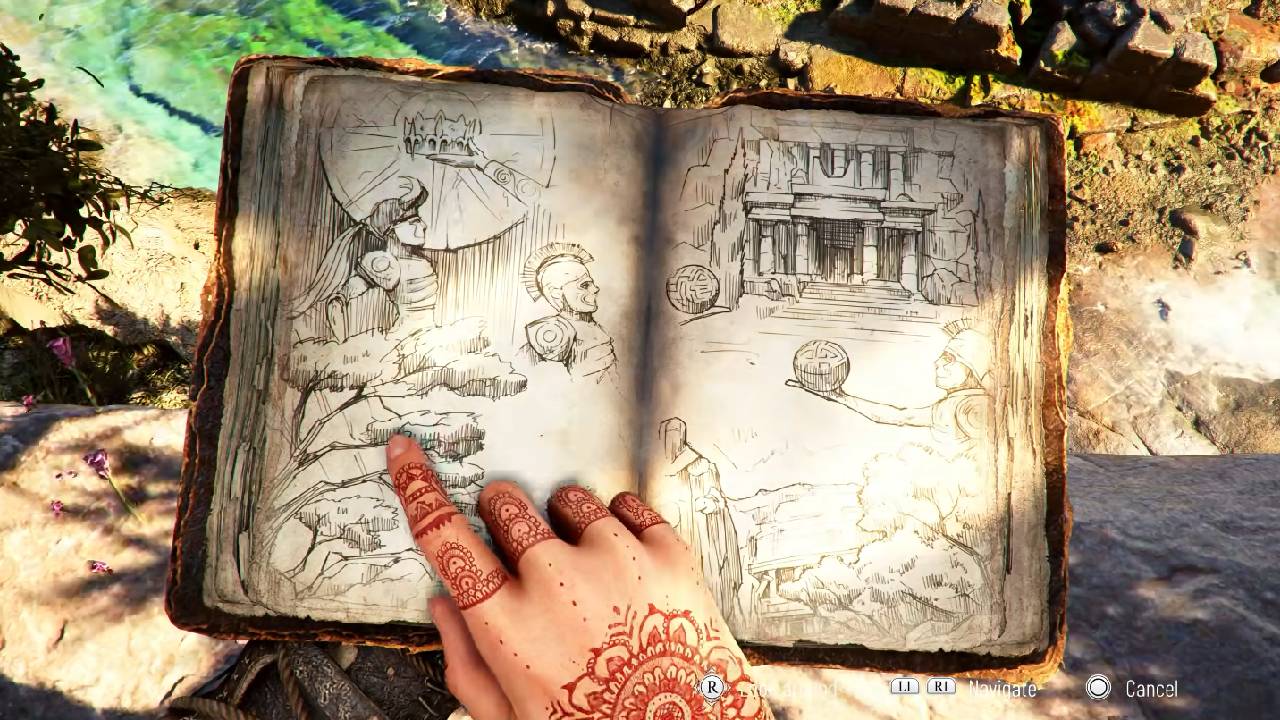
Sophia carries a dream journal that doubles as her father's expedition notes, so you can flip it open to reference clues on the puzzles you're working through, jot down new discoveries, or lean on an escalating hint system if you get stuck.
None of it is forced on you, so you can just as easily ignore the assists if you want to work things out yourself. Scattered through the island are tombs and hidden nooks holding collectible swords and charms, giving you a reason to wander off the main path even in a fairly focused game.
Sophia herself moves with much more speed and confidence than Amicia ever did in the earlier games, which fits, given that she's meant to already be a capable fighter rather than a frightened kid learning to survive.
Movement and pacing set up the puzzle mechanics built around light.
That extra pace carries into how you traverse the island too, with jumps, grapples, slides, and tight squeezes through gaps letting you move through ruined environments quickly, even if the platforming itself never asks for much precision.
Every so often the game breaks from its usual rhythm for a bigger set-piece moment, the kind of scripted, high-energy sequence that action-adventure games in this vein lean on to punctuate quieter stretches of exploring and puzzling.
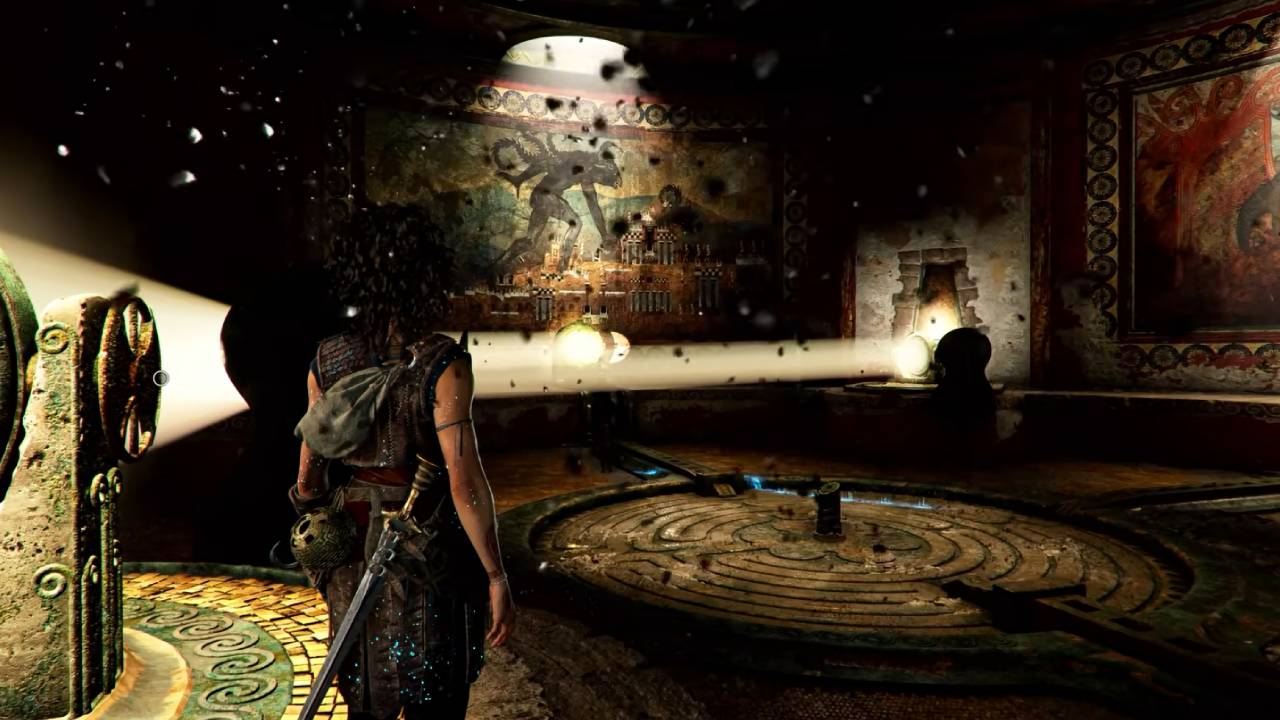
The puzzle side of Resonance: A Plague Tale Legacy leans almost entirely on light manipulation. A lot of it comes down to repositioning mirrors so a beam lands where it needs to, which is familiar territory if you've played anything like this before. Sophia also carries a sphere tied to the island's old trials, and it works in a few different ways.
One setting acts like a black light that exposes hidden symbols and trails you'd otherwise miss, and another splits a beam of white light into red, green, and blue strands that you then need to line up with matching crystals scattered around each chamber. The sphere only works near an existing light source, so it's useless if you wander into total darkness without a plan.
Puzzle tools soon double as survival gear before combat takes over.
Later in the game, this same light-based toolkit gets repurposed for something far more tense, using illumination to hold back a creature that hunts you through the island's underground passages. That shift, from simple beam-and-mirror logic to using light as a survival tool against something you can't fight, ends up being one of the strongest additions Resonance: A Plague Tale Legacy makes to the formula.
There's a clear Uncharted influence running through all of this, right down to how Sophia's journal functions as her own version of Nathan Drake's notebook, letting you tap through pages for extra detail on runes or clues you've picked up. It doesn't reinvent that idea much, but having it in hand makes a real difference.
Going back to earlier Plague Tale games without anything like it, the puzzle-solving feels noticeably less satisfying by comparison, which says a lot about how much this small addition adds to Resonance: A Plague Tale Legacy. Combat is the bigger departure, and it centers on a parry system that clearly takes cues from stance-breaking, Sekiro-style action games.
You've got light and heavy attacks, a kick that breaks an opponent's guard, a grappling hook you can use to yank enemies off balance, and the option to grab a dropped weapon or piece of debris and throw it to stun someone at range. Sophia only has three health pips at any time, but finishing off an enemy restores one, which pushes you toward staying aggressive instead of turtling.
Enemy variety and one late upgrade shape how tough fights feel.
The enemy roster covers regular sword-carrying soldiers, quicker knife users, archers who'll shoot from range, spearmen who can knock your grapple hook aside, and heavier brutes who take a while to bring down but can just as easily clip their own allies with wild swings.
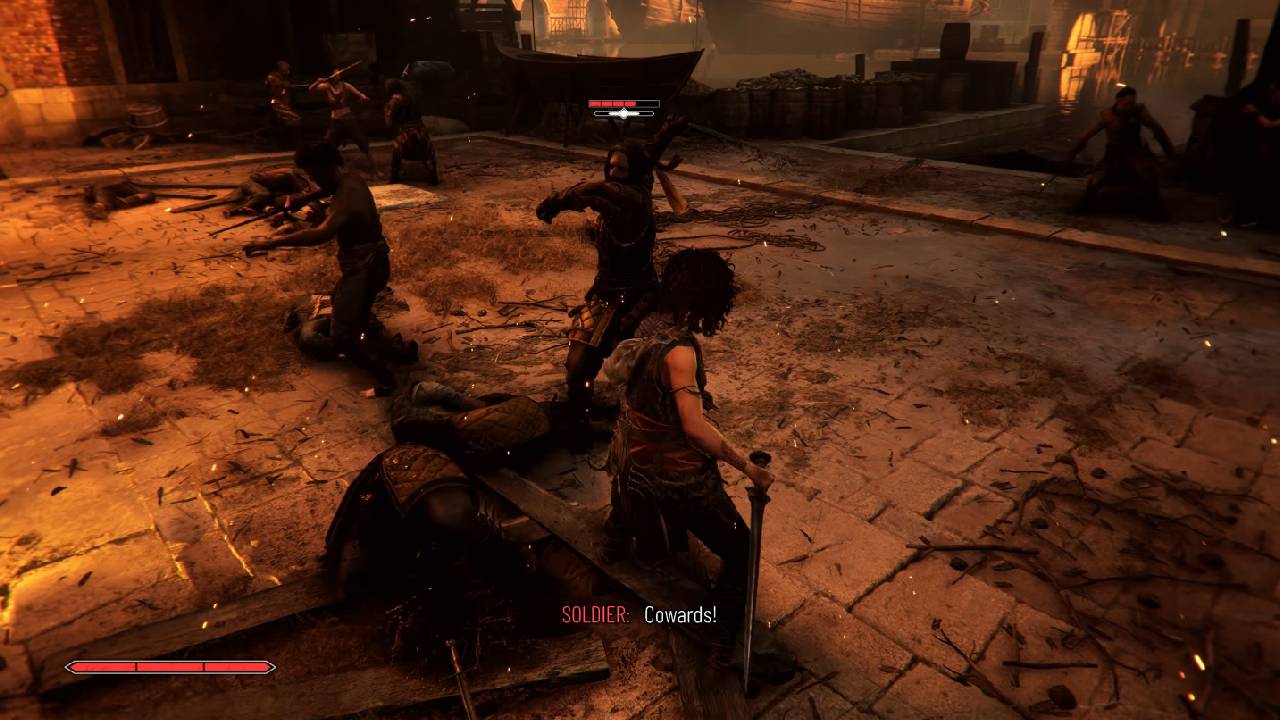
Later fights introduce unblockable attacks marked by a red glow that you have to dodge instead of parry, which adds a useful wrinkle to the rhythm of a fight, though it's a little undercut once the skill tree hands you an upgrade that lets you parry those same red attacks anyway, quietly removing the challenge it just introduced.
On the whole, the combat in Resonance: A Plague Tale Legacy is straightforward and can wear thin over repeated encounters in cramped little arenas, especially in the earlier stretches, but it stays functional and occasionally satisfying once you get a feel for its rhythm, and it clears the bar without ever really pushing past it.
Sophia's low health pool keeps every fight feeling a little dangerous even against basic enemies, but the fact that a kill instantly tops you back up means momentum matters more than caution, and stringing together clean finishing moves is genuinely satisfying once it clicks.
Combat momentum carries over into a progression system that feels thin.
It also helps that a well-timed kick can send almost any enemy, no matter how tough, tumbling into one of the many pits and holes scattered around the island, which never really stops being funny even after you've done it a dozen times. The arenas themselves are fairly static and don't ask much of you positionally, so the bulk of the challenge comes down to reading attack patterns rather than using the environment in any clever way.
Progression in Resonance: A Plague Tale Legacy runs through resonance points, which you pick up by exploring the island and by winning fights, then spend on a fairly small skill tree offering things like a stronger kick or brief protection after a kill. You can also swap between a handful of swords found in hidden tombs and stack charms that grant passive bonuses tied to different categories.
None of this gets in the way, mostly because the base combat kit already works fine without much extra investment, but the system itself feels thin. The points themselves are just small glowing pickups scattered around, with no real weight to finding them, and the tree they feed into doesn't offer much room to build a distinct playstyle. It's the part of Resonance: A Plague Tale Legacy that feels least developed compared to everything else going on around it.

That said, it never actively hurts the experience, since the core moveset you start with already carries you through most fights just fine, and the upgrades on offer are more about smoothing out combat than reinventing it. If you're the type who likes squeezing every optional system for value, you might come away wishing the tree had more branching choices.
Progression gripes fade once the game's stunning visuals take over.
You might also wish the swords felt more distinct from one another. But if you'd rather just fight and move on, you won't feel like you're missing much. Ignoring most of it costs you very little. Visually, Resonance: A Plague Tale Legacy trades the muddy, plague-ridden French countryside of the earlier games for sun-drenched Mediterranean coastlines and the ruins of an ancient Greek-inspired civilization, and the shift suits it well.
Weathered stone up close has real texture, lighting spills convincingly across outdoor scenes and into shaded corners, and interior spaces benefit from dust hanging in the air and volumetric light pouring through gaps in old architecture.
Character work stands out in particular, with strong facial animation and motion capture carrying a lot of the storytelling weight during close-up conversations. There are a few rough patches here and there, like occasional camera clipping during fights or animations that snap between poses rather than blending smoothly, and a rare crash isn't out of the question, but none of it seriously gets in the way of enjoying how the game looks.
The audio side pulls its weight too. The score leans on Greek-influenced instrumentation along with vocal-only passages that show up at exactly the right moments, especially during the tense stretches where you're trying to avoid being caught by the island's monster.
The cast's performances match the score's ambition.
Voice work across the cast holds up well, with Sophia, Leni, and Pharaoh all coming through as distinct people whose relationships feel lived-in rather than just functional plot devices, even when the dialogue occasionally leans a bit flat in quieter moments.

Taken as a whole, Resonance: A Plague Tale Legacy is a mixed but mostly rewarding detour for the A Plague Tale series. The treasure-hunting plot and its parallel ancient storyline carry the experience further than either the combat or the skill tree ever manage to. Sophia herself comes across as a stronger, more fleshed-out character than she was in her original appearance.
Even so, her personal arc doesn't always land as cleanly as the mystery surrounding the island itself. The puzzle design won't surprise anyone who's played this kind of game before, but pairing it with the later monster-hunt sections gives it a jolt of tension the earlier hours don't have.
Combat is serviceable rather than a highlight, and the progression system feels like an afterthought bolted onto a game that didn't strictly need one. None of that stops Resonance: A Plague Tale Legacy from being an enjoyable, good-looking adventure that's worth spending time with, particularly if you're already invested in where this series has been and curious to see where Asobo Studio can still take it.
Editor, NoobFeed
Verdict
Resonance: A Plague Tale Legacy swaps rats for swords and myth, and the trade pays off. The story and setting carry real weight, while combat and progression do their job without stealing the spotlight.
84
Related News
No Data.