
Underkeep Review
PC
A tight little dungeon crawler that drops you into a party with a map, then leaves you to work out the rest.
Reviewed by Adeela Tas on Nov 06, 2026
Underkeep comes from the studio Rake in Grass and is a first-person, party-based dungeon crawler with grid movement and turn-based fights, drawing on the 1990s games that shaped the style. Eye of the Beholder, Wizardry, and Lands of Lore are the obvious reference points.
If you spent time with Legend of Grimrock, you already know the feeling it is chasing, and you also know how seldom this genre gets a new release. A demo went out ahead of launch so that you could try the opening stretch early, and a Switch version is planned for the first quarter of 2027. The PC build already supports a full controller layout, with the D-pad handling turns and the left stick handling strafing.
Underkeep is small in scope, and that suits it.
The developers set a limit for themselves and never push past it, so what you get is tight instead of sprawling. Plan on roughly fifteen to twenty hours from start to finish, with a level cap of fifteen. Since you gain a level about once an hour, the sense of growth never really stalls.
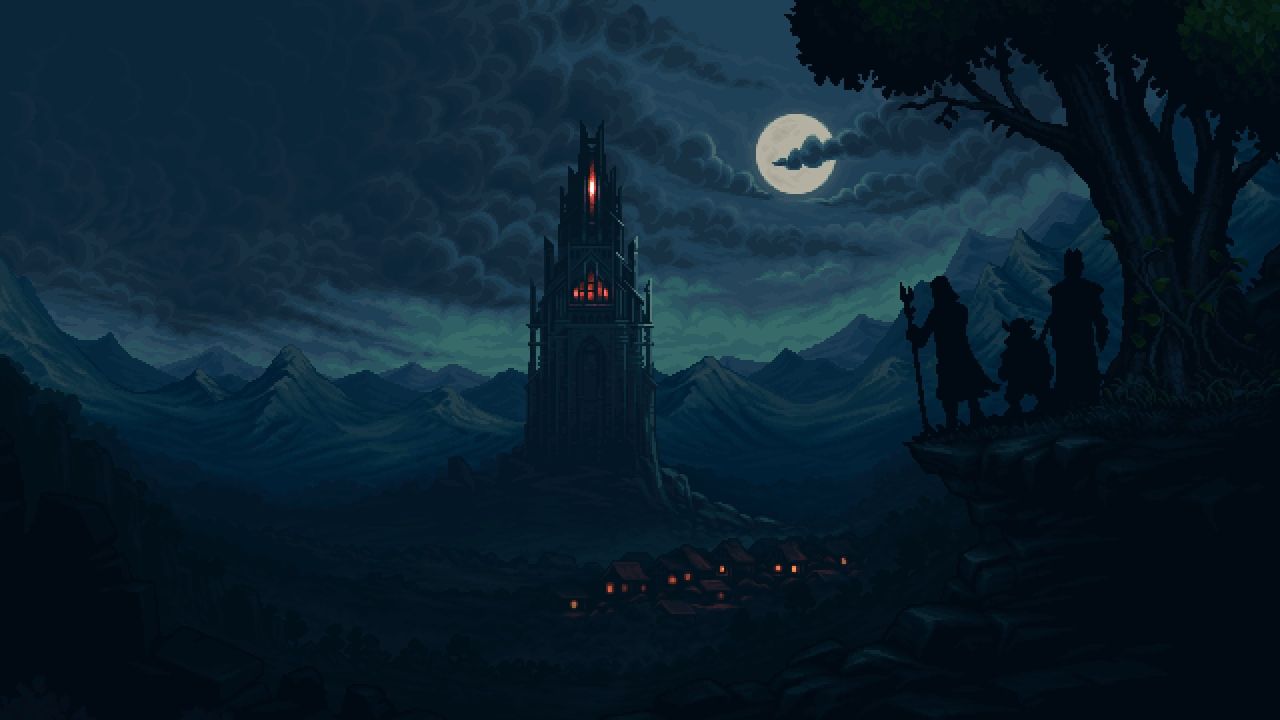
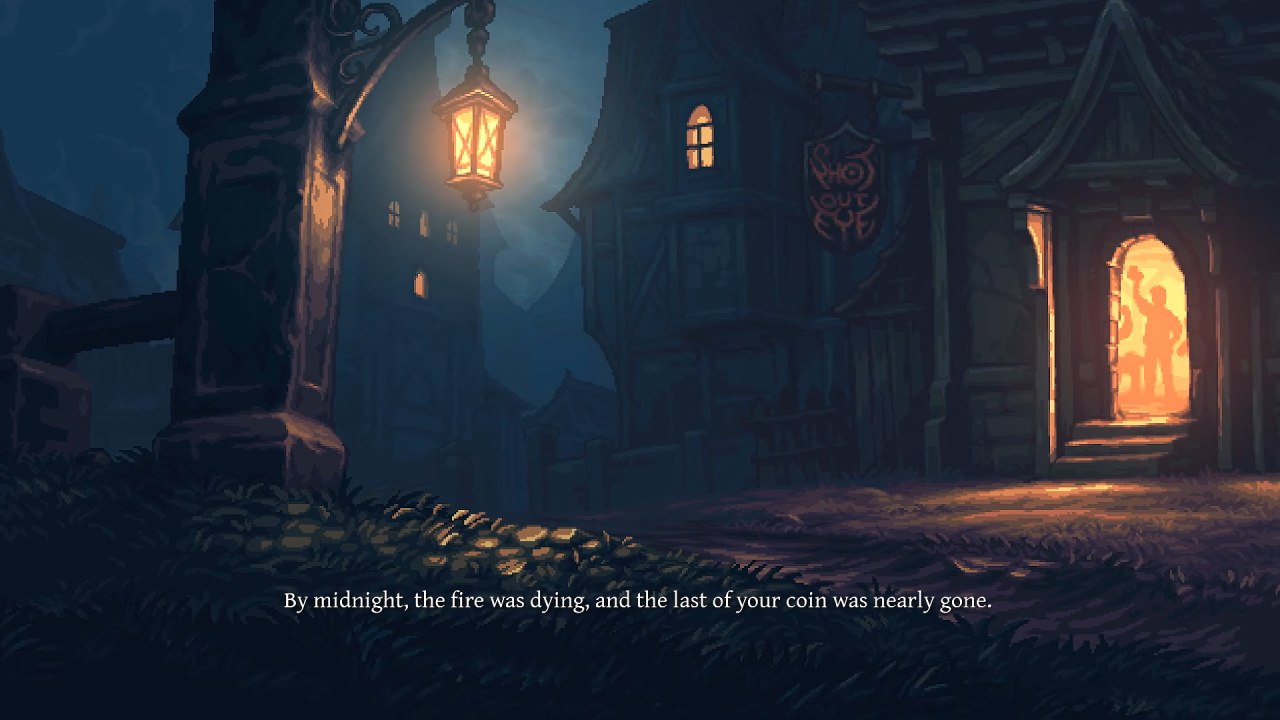
The setup is simple. Your four characters begin as drifters with little glory and less money, moving from one muddy town to the next. One night in a smoky tavern, a letter appears on your table, unsealed, crestless, and nameless. It asks you to travel to a remote village called Underkeep and promises payment worth the trip.
You leave at dawn, take the western road, and walk into a forest, where the first quest, Whispers of Underkeep, begins. The wider backstory involves a tower far to the east, past the last mountain roads. Rumor says untouched vaults lie beneath it, and dwarves once dug into the hills to reach them.
Somewhere deep below, something ancient woke up. A dwarven expedition has gone missing; treasure hunters have not come back, and your party is the next group to show up and find out why. The main story is not the draw in Underkeep, and the game seems to know it.
It follows the familiar pattern of evil waiting inside a sinister tower.
Your heroes never speak; there is no banter between them, and nobody is voice-acted, so you have to invent why your party cares. The side material is stronger. Quests are well written, and the NPCs you meet carry small stories that make the region feel larger than the map suggests.
The short narration blocks are good too. Early on, you reach a graveyard and find a dying monk in tattered crimson robes who asks for help. You get to choose how to respond, and the options depend on your party. A paladin can look into the man's soul and find nothing but malice, which leads you to refuse him.
He then pulls a skeleton warrior out of the ground with his last breath, and you fight it. A voidcaller can offer to guide his spirit instead, and the monk dies with his shadow drawn away like smoke. Moments like this are where your class choices shape what you see, and a mixed party sees more of them than a lopsided one.
Everything in Underkeep starts with building that party. You create four characters at the outset, picking a class, a race, a name,e and a portrait. The classes are warrior, thief, paladin, ranger, voidcaller, wizard, and blood mage. The voidcaller works as a cleric, and the blood mage casts with bones and falls back on its own health when the bones run out.
The races are human, dwarf, elk, stoneborn, raven, and slugman.
Each has a perk. Humans earn 10% more experience, dwarves gain a small elemental resistance and can see in the dark, and elk are the elf equivalent, gaining an armor bonus against animals. Stoneborn cannot wear body armor but gain armor at levels 1, 5, and 9. Ravens start with one random helpful mutation and one random harmful one. Slugmen cannot be critically hit, though fire hurts them twice as much.
You do not set stats by hand. You roll them, and the ranges depend on your class and race. The class sets the main stat, so paladins and warriors lean on strength while blood mages lean on endurance, and the race nudges the numbers further. You can reroll as many times as you want until the spread looks right. Strength affects melee damage, health growth, and which gear you can use.
Dexterity covers ranged accuracy, evasion, and critical hits, and doubles your dexterity, capped at 60%. Endurance drives health growth and stamina regeneration. Wisdom adds mana per level and elemental resistance. A dwarf wizard is possible but will run short on mana, so it's better to put the casting classes in races that suit them. After that, you pick one starting skill and a portrait.
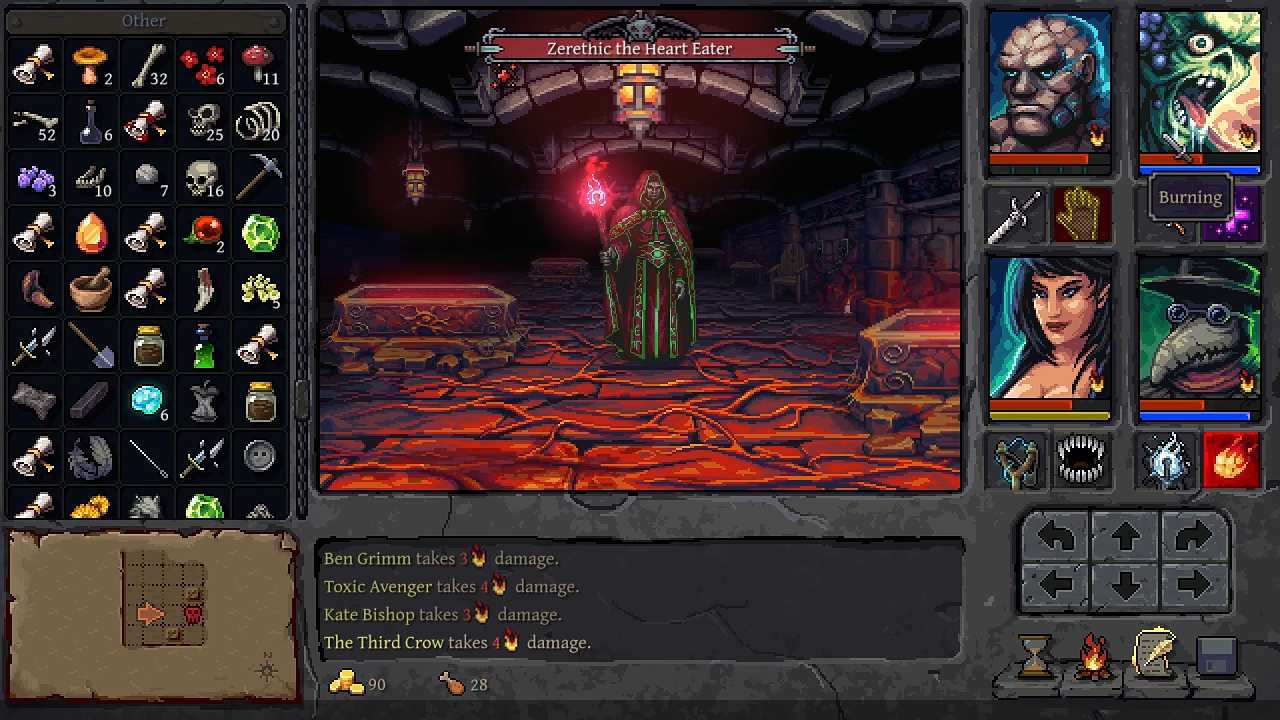
The portraits are colorful and detailed, and they blink now and then and close their eyes when the party rests. Day to day in Underkeep, you walk the grid with WASD, turn with Q and E, and open the map with M. The inventory is shared and sits on the left side of the screen, while each hero has a separate equipment sheet.
Resting costs food, and the amount you need climbs as you level, so keeping the pack stocked becomes a constant background chore.
Gold and food are both limited. Shrines bring fallen heroes back for a fee, but they are rare, and the revived character returns with little health, so you rest right afterward. The game saves automatically at checkpoints, but saving often is still smart, because a single mistake can leave you stuck. You can leave notes on the map, and they work well as reminders for chests you couldn't open or paths you couldn't cross.
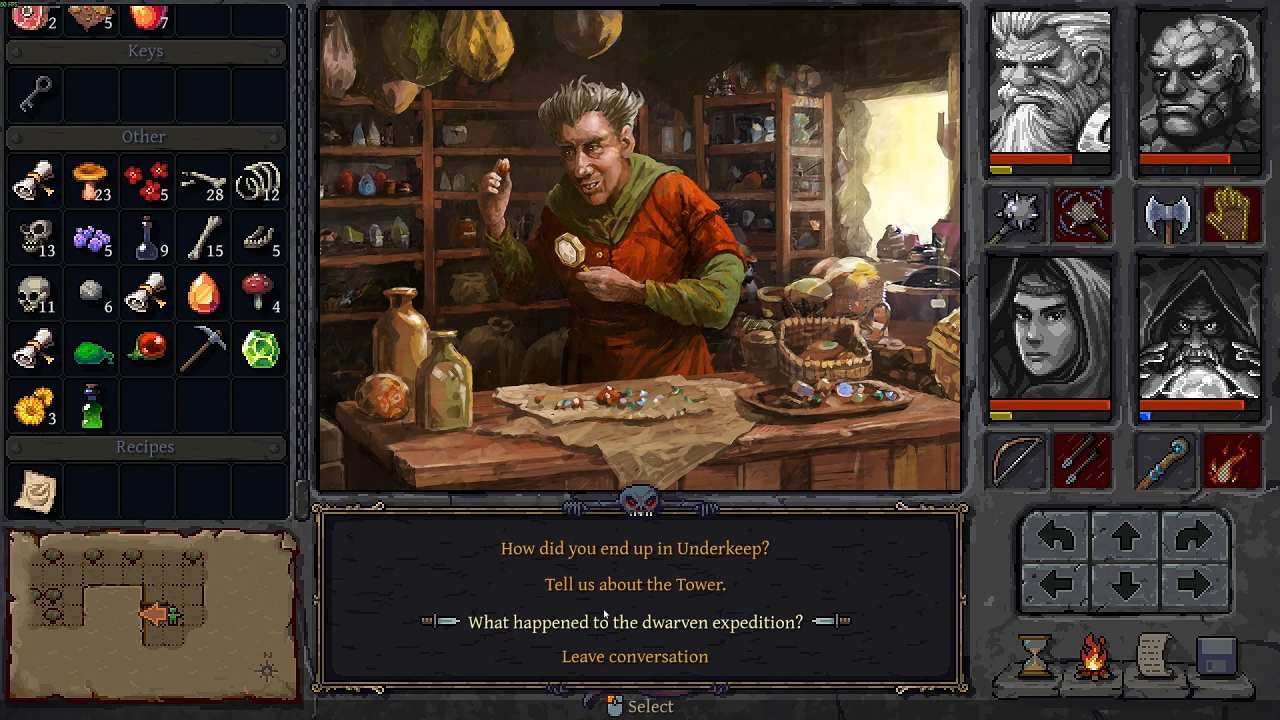
Underkeep is full of things to poke at. You pick flowers and berries, smash crates, open chests, and throw items at the screen. A thrown rock can land on a pressure plate across the room, the sort of simple physics puzzle you would expect. Fragile objects can be broken, and you can clear rubble with a pickaxe or dig it out with a shovel.
Gold veins require knowledge you don't have yet, and moonstone ore needs someone to teach you first. Lockpicks are single-use, and special keys fit specific chests, though the chest never tells you which key it wants. Secrets hide in tree lines and behind walls, so walking into anything that looks suspicious pays off. You also craft food and potions from the ingredients you gather, so you keep picking up everything you see.
Gear finds are worth the effort, from a cloak that heals two health when its wearer drops to one to a dagger with a 40% bleed chance, and they keep you opening every chest. The loot itself is generous, with plenty of potions, apples, and bread.
Combat in Underkeep is turn-based and played from the first-person view, and positioning matters a great deal.
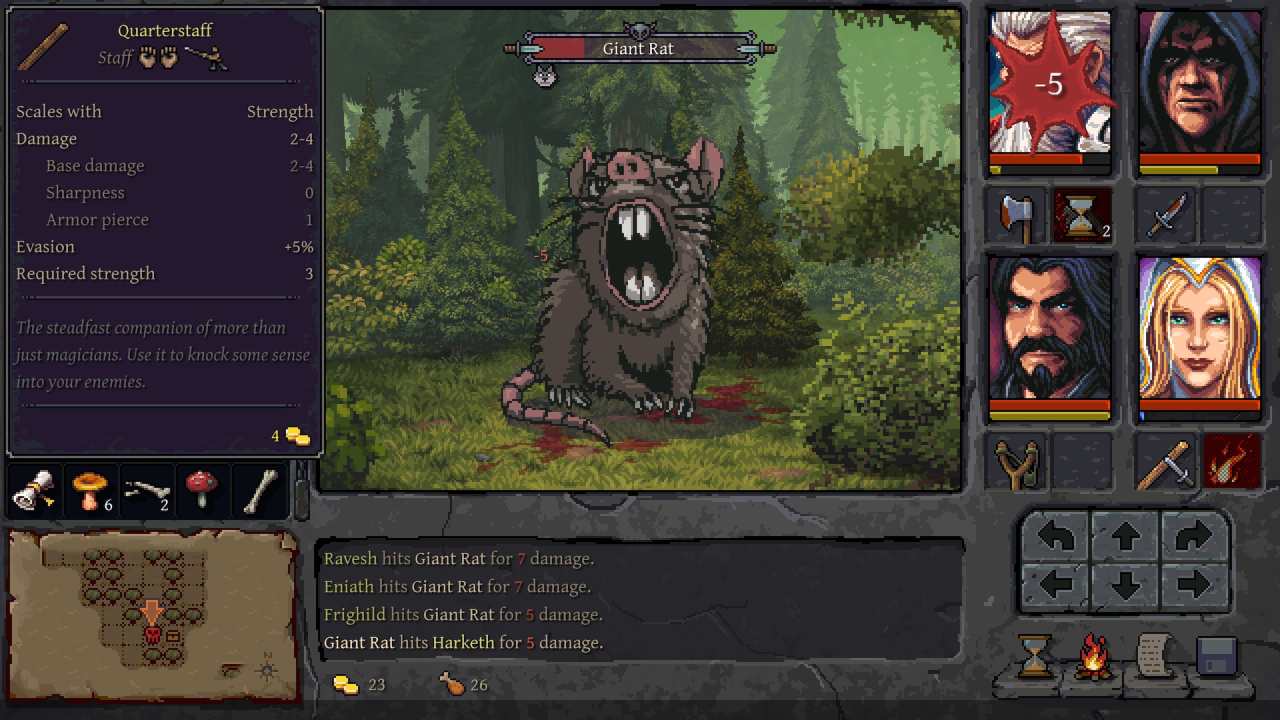
Your four heroes stand in a two-by-two formation. The front pair take most of the melee hits and can use melee weapons. The back pair need a reach weapon, such as a staff or spear, to hit anything up close, or they can use ranged gear like a slingshot or bow. If you try to attack something out of range, the game tells you to move a hero forward, use a reach weapon,n or shoot instead.
Facing matters as well, because enemies that arrive on your flank or behind you can pick at the back row, and a wizard can lose health without you noticing. Bosses and elites sometimes hit several heroes at once, or the whole group. Early fights teach this fast.
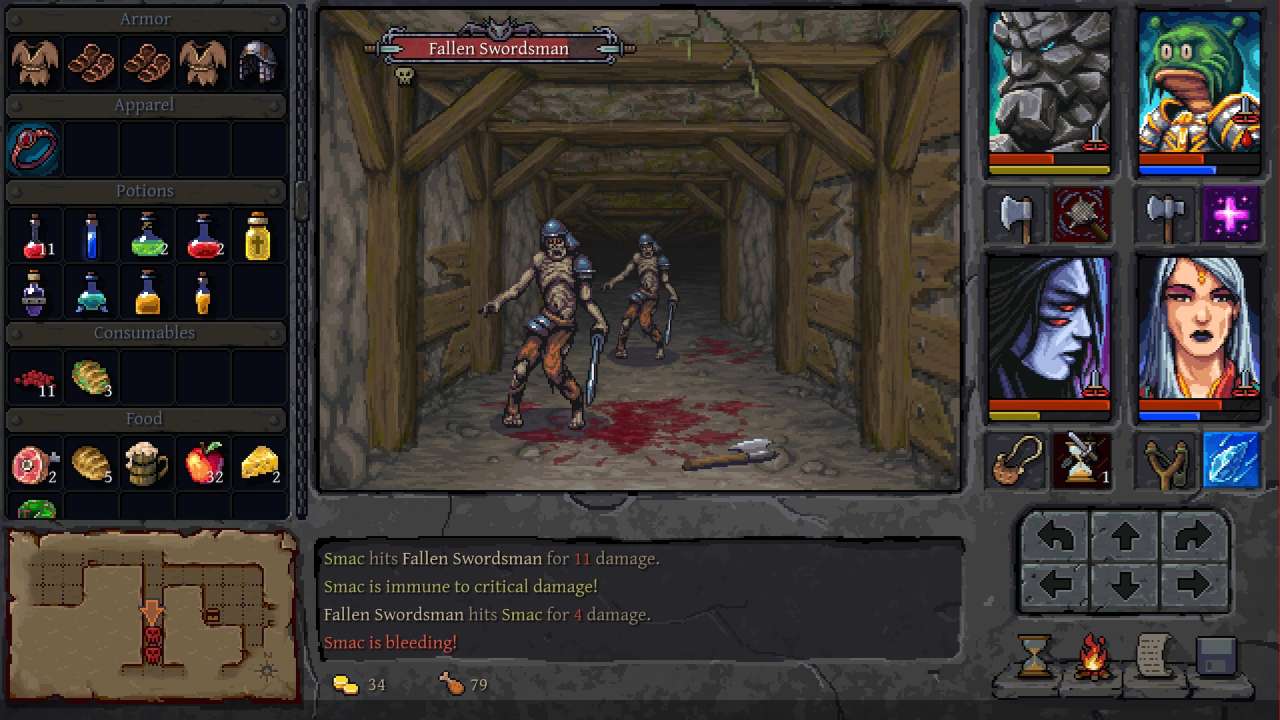
The skeleton from the monk scene is immune to bleed and hits for about 10 damage so that a front-row thief can drop quickly; once she falls, the next hero in line becomes the target. Giant rats come in groups and can leave a hero diseased. The paladin also needs basic attacks to land before he earns any zeal, so missing hurts him more than most.
Each hero gets one attack or one skill per round. Using a potion from your inventory costs no action, and you can end the round early, skipping anyone who hasn't acted. Once a hero has acted, the party cannot move that round, so the best time to attack is while an enemy is still walking toward you.
Skills run on cooldowns and on separate resources.
Casters use mana, thief and warrior types use stamina, and the paladin builds zeal by landing basic attacks, up to 5 points, which fades when the fight ends. You can only have one active skill equipped per hero at a time, and you swap it with a right-click. That means you pick the right tool before a fight, like Stun Undead before a crypt, or Lay on Hands, which heals 3 health per zeal spent, when the party needs sustain.
Each class plays differently. The thief's Bleeding Dash applies bleed; Backstab the Weak raises critical chance against afflicted targets. Nightshade Mastery gives swords and daggers a chance to inflict a random negative effect. The voidcaller has Void Mend for healing, a barrier spell, a debuff on the closest enemy, and auras that boost party melee, absorb damage, or reflect a share of melee hits back.
The blood mage has marks, a ranged lance, a root that also bleeds, life steal, and a sacrifice heal. Status effects appear constantly, including bleed, burn, poison, freeze, and disease, and disease stops all recovery during a rest. Enemies have weaknesses and immunities too.
Skeletons shrug off bleed, zombies suffer from cold, and some things cannot be blinded. Enemies are placed by hand, so there are no random encounters. Each fight is deliberately set up, and many are designed to catch you off guard.
There is a lot to like about how Underkeep handles all this.
Positioning, facing, and reach all carry real weight, and the way classes combine is satisfying. A voidcaller weakening a target, a thief stacking bleed, and a blood mage extending it fit together neatly. Fights stay tense even on Normal, where every battle matters and careless play gets punished.
Hard turns the game into an endurance test, where the real question is whether your potions and food last. Enemies vary, with giant rats, apple-headed goblins, skeletons, undead miners, a spider boss, orcs, snakes, worms, ogres, and demons, and each type demands a different approach. The puzzles are good as well. They are logical and tough enough to feel earned, and several send you off to other areas for the answer.
Some parts frustrate. Tooltips don't explain what bleed or burn does, even when you are choosing skills at character creation, and the crafting menu doesn't say what a potion will do. Quests give only general direction, and a few can fail without explaining why. A password at a wizard stronghold, for example, ended one quest on the spot, and no hint explained the right move.
A couple of puzzles produced nothing after you did everything asked, and the puzzle that unlocks fast travel depends on finding a hidden wall, which feels too cute for something so basic. Backtracking is built into the design. Blocked paths, locked chests, and rubble send you back to old areas later, and some rewards only appear after you hand in a quest.
Backtracking pays off with better loot and tougher fights.
It pays off with better loot and tougher fights, but you may still wish those fights happened in a late-game zone instead. Smaller annoyances add up too. Zeal burns out fast, Lay on Hands cannot be used outside combat, and the loot-all and rest keys sit next to each other, so a slip wastes food.
Experience in Underkeep comes from fights, and each hero levels at a different pace, probably tied to how much they contribute. Each level gives one skill point, and the cap is fifteen, so you can fully max roughly three skills. Most skills top out at five ranks, and each class has up to eight active and four passive options, so builds are limited and some skills are locked behind levels.
Stats don't increase with level, so gear matters more, since weapons and armor have strength and dexterity requirements. You can wear boosts like a hat or a ring for a little evasion, which works well for a fragile thief. There is no grinding in the usual sense, because encounters are fixed and experience comes from exploration. You also cannot swap your party members at a tavern, so the choices you make at the start stay with you.
Underkeep's art is clean retro pixel work, and it does its job well. The interface tells you what you need, and everything is easy to read. A short how-to-play section in the menu covers the basics, including a reminder to save often and which key rests the party.
Portraits are lively, and the monsters and environments make the forests, caves, and tunnels feel distinct.
Objects you approach grow larger on screen, as if you were zooming in with an eye, which looks odd at first and then works fine. The options menu offers plenty of accessibility choices, including move-and-turn animation, camera shake, floating combat text, and wall-hit sounds. The one weak spot is that you cannot stretch the screen to remove the borders, so windowed or borderless modes are the workaround.
The music in Underkeep shifts with location and switches to a combat theme when a fight starts, and the tracks feel pleasantly ethereal. At first, sound effects were far louder than everything else, but the audio options let you bring them down. With no voice acting, you spend most of your time exploring in quiet, so the soundtrack fills the space well.
Underkeep is not trying to reinvent anything, and you can tell. It takes what these games have always done and executes it cleanly. The grid movement, reach rules, hidden walls, and shared inventory feel familiar if you know the genre, and easy to pick up if you don't.
The resource pressure, fixed encounters, and generous loot make it feel like a good tabletop campaign. The weaker points are the lack of guidance and the amount of backtracking, and both will bother some players more than others. For many, hours will vanish without notice. It works well as a break between bigger games, and Underkeep leaves you wanting a second run with a different party.
Editor, NoobFeed
Verdict
Underkeep keeps its scope small and its design sharp. Fun party-building and tense fights carry it, even if vague quests and backtracking get tiring, making it a strong pick for classic RPG fans.
75
Related News
No Data.