
DirectX Raytracing Gets Biggest Upgrade Since 2018 as Clustered Geometry Cuts Memory by 90%
Microsoft's latest DirectX Raytracing upgrade could reshape how future PC games handle complex geometry, dynamic environments, and path-traced lighting.
Hardware by Masaru Hoshino on Oct 30, 2026
Since its introduction in 2018, DirectX Raytracing (DXR) has transformed how PC games handle realistic lighting, reflections, and shadows. However, despite major GPU improvements, one persistent problem has limited adoption: the enormous computational and memory overhead of maintaining Bounding Volume Hierarchies (BVHs) in dynamic game environments.
Microsoft is now addressing that problem at the API level. With the introduction of Agility SDK 1.722 Preview, the company has announced its most significant DXR architectural update since the technology debuted. Rather than introducing another visual feature, this update focuses on making the underlying ray-tracing infrastructure substantially more efficient.
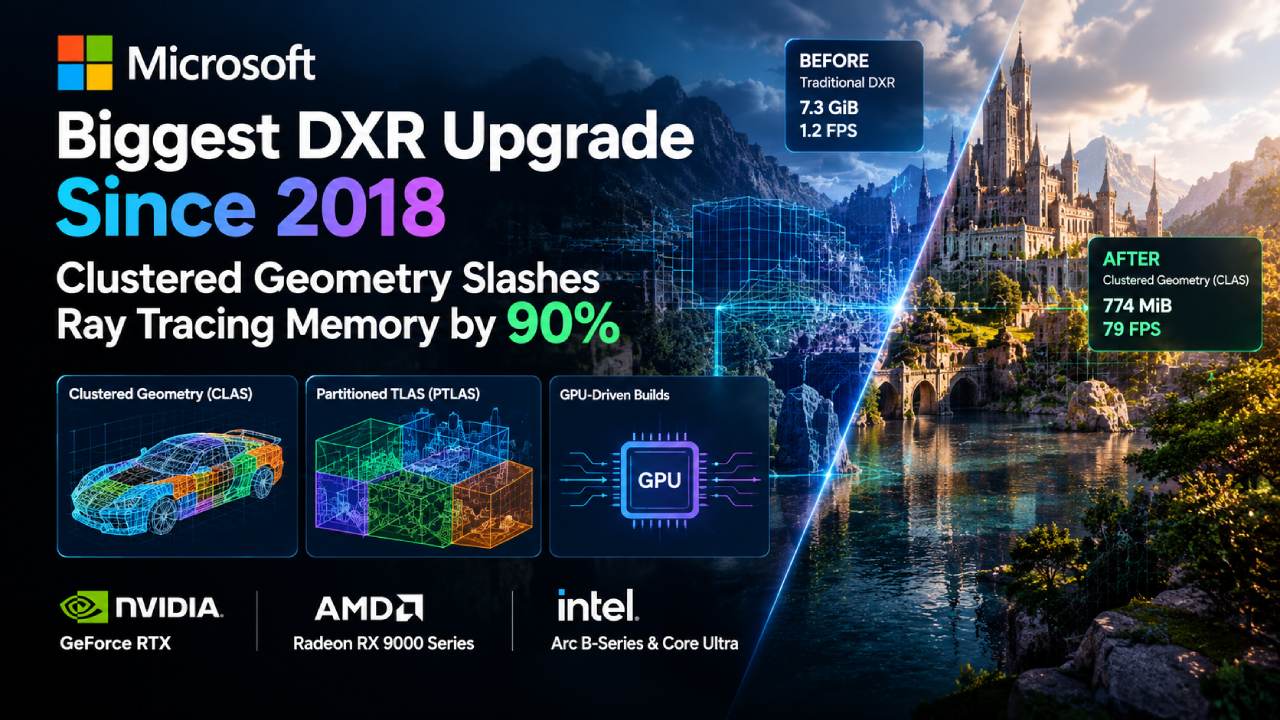
The new solution adds Clustered Geometry (CLAS), Partitioned Top-Level Acceleration Structures (PTLAS), and GPU-driven acceleration structure construction. Together, these methods reduce duplicate processing when gaming engines update complex scenes filled with animated actors, moving objects, and changing environments.
Clustered Geometry Reduces Rebuilding Overhead
The major addition is Clustered Geometry (CLAS), which changes how engines store geometry for ray tracing. Traditionally, engines construct Bottom-Level Acceleration Structures (BLAS) around individual objects. If the geometry changes, rebuilding these structures can be expensive in GPU processing time and memory bandwidth.
CLAS solves this problem by breaking the mesh into smaller groupings of triangles, termed clusters. Each cluster may store 256 triangles and 256 vertices. Instead of building a new mesh structure each time geometry changes, developers can reuse existing clusters and piece them together into Cluster BLAS structures.
This approach is especially beneficial for animated figures, generative environments, and level-of-detail systems. Engines can reuse the geometry information already there instead of repeatedly reprocessing complete objects. Microsoft also adds cluster templates, which allow animated geometry to regenerate using precomputed structural information.
This may potentially allow developers to ray trace more detailed geometry without depending as much on simpler proxy models to manage performance overhead.
Partitioned TLAS Prevents Unnecessary Scene Updates
CLAS solves problems with individual geometry. Partitioned TLAS (PTLAS) solves inefficiencies across large scenes. Traditional Top-Level Acceleration Structures manage object instances across a scene, but updating a small number of moving objects can still require unnecessary rebuilding.
PTLAS divides scene instances into persistent partitions. If anything changes, engines can update the impacted partitions while retaining the acceleration structure data for untouched regions. This is especially useful for open-world games with moving vehicles, destructible terrain, animated characters, and dense vegetation.
Microsoft also brings GPU-driven builds where compute shaders can generate acceleration structure operation data directly in GPU memory. This reduces CPU involvement and makes engines more flexible when handling complex scenarios.
66x Performance Improvement
A strong illustration of the potential improvement is a Microsoft demonstration on the AMD Radeon RX 9070. In its synthetic testing environment, the traditional acceleration structure build workload delivered just 1.2 FPS. Switching to Clustered Geometry raised that result to 79 FPS, about a 66x improvement.
Memory consumption also changed dramatically. Total acceleration structure memory dropped from about 7.3 GiB to 774 MiB, nearly a 90% reduction. However, these figures require context. The 90% saving applies to total acceleration structure memory, with animated geometry accounting for most of the improvement. Static acceleration structure memory also decreased, but by a considerably smaller amount.
Furthermore, a 66x improvement in acceleration structure construction does not mean games will suddenly run 66 times faster. Rendering performance depends on many other parameters such as ray traversal, shader execution, denoising, texture streaming, and CPU workloads.
But removing this cost could improve frame-time consistency and free up precious VRAM for higher-resolution textures, more complex modeling, and more ambitious lighting effects.
Editor, NoobFeed
Gaming Hardware Updates
No Data.