
NVIDIA RTX Spark Combines Local AI, Gaming, and Content Creation
NVIDIA RTX Spark targets AI enthusiasts with up to 128GB of unified memory and dedicated Blackwell graphics capabilities.
Hardware by Tanvir Kabbo on Oct 13, 2026
NVIDIA has announced the RTX Spark platform, bringing local AI computation, professional content creation, and gaming into one device. The platform uses an ARM-based processor with Blackwell graphics and features a unified memory design with up to 128GB of RAM. Developed with MediaTek and supported by Microsoft's Windows optimizations, RTX Spark could offer an alternative to traditional workstations and high-performance laptops.
NVIDIA RTX Spark Introduces a New Hardware Platform
At the center of RTX Spark is NVIDIA's N1X system-on-chip, which integrates the CPU and GPU around a unified memory architecture. MediaTek contributed CPU and cache technology, the memory controller, power management, and other platform components.
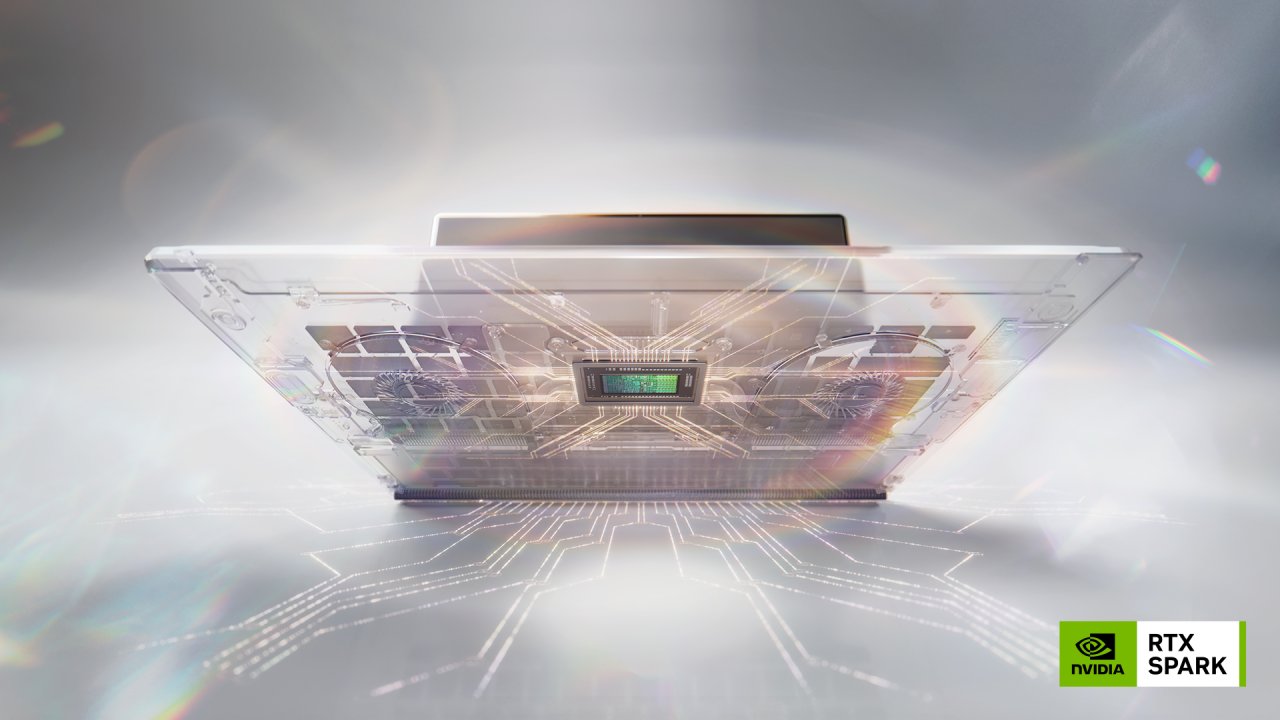
The higher-end configuration features a 20-core CPU and a Blackwell GPU with up to 6,144 CUDA cores, fifth-generation Tensor Cores for AI acceleration, and fourth-generation ray-tracing cores. A smaller configuration offers 18 CPU cores and 5,120 CUDA cores. The larger model supports up to 128GB of memory, while the smaller version supports up to 64GB.
The 20-core processor uses two clusters, each containing five Cortex-X925 performance cores and five Cortex-A725 efficiency cores. NVIDIA also lists a 256-bit memory interface with 300GB/s of bandwidth. Laptop configurations operate within a 45W to 80W power range, while desktop implementations can reach 140W.
Unified Memory Could Transform Local AI Workloads
The headline feature is up to 128GB of unified memory. However, unified memory is not equivalent to 128GB of dedicated VRAM. The CPU and GPU share the same physical memory, and Windows controls how it allocates memory to the GPU, CPU, and other applications.
As a result, the memory available for AI models depends on Windows, background applications, model size, context length, and cache settings. Running a large language model alongside demanding creative software could put considerable pressure on the available resources.
For local AI enthusiasts, the real test is whether RTX Spark can run a model and its associated agent while keeping applications such as DaVinci Resolve responsive. Longer texts and larger codebases will also help determine how memory bandwidth and system performance affect practical workloads.
Windows on ARM Receives Further Optimization
Microsoft is changing CPU scheduling, power and thermal management, and how Windows exposes shared memory to the GPU. Microsoft's translation system for Windows on ARM, Prism, is getting new features that will let x86 and x64 apps run on the platform. Application compatibility remains a consideration. Beyond launching creative software, users will need to verify that their plugins, drivers, peripherals, and other essential features work as expected.
NVIDIA advertises support for language models with up to 120 billion parameters, though performance depends on model precision, software configuration, and runtime support. Mixture-of-experts models can minimize the number of activated parameters during inference, but the full model still consumes memory.
Local AI Agents and Creative Workflows
RTX Spark can do much more than run a chatbot. Video editors can use local AI agents to sort footage, transcribe recordings, tag media files, and summarize projects. This may reduce dependence on cloud services and their charges when these processes run on the same device.
Other applications include automating 3D-printing workflows, from locating STL files and configuring slicing settings to preparing models for printing. However, genuinely local operation requires the model, agent, and supporting tools to avoid unnecessary cloud calls.
NVIDIA also advertises up to 1 petaflop of AI performance under specific FP4 sparsity conditions. This theoretical figure does not directly measure everyday performance or token generation speed. Testing NVFP4 and FP8 workloads separately will help establish how different precision formats affect inference.
Content Creation and Video Editing Performance
Content creation is another major focus, with native ARM support identified for applications including DaVinci Resolve, Blender, Photoshop, and Premiere Pro. Adobe is also working on platform-specific enhancements for Premiere Pro's video pipeline and Photoshop's GPU compositing.
NVIDIA also touts hardware acceleration for 4:2:2 video encoding and decoding, which could help editors working with 10-bit 4:2:2 HEVC material. Performance in DaVinci Resolve will matter, especially for intensive editing workflows that combine video processing with local AI assistance.
Gaming Performance Remains an Important Question
While RTX Spark isn't really aimed at gaming, its Blackwell visuals are worth checking out from a gaming performance standpoint. To see how the platform handles heavy workloads at multiple resolutions, try titles like Cyberpunk 2077 with DLSS and frame generation turned on.
RTX Spark is planned for several hardware combinations, but its success will ultimately depend on more than specs. It remains to be seen whether its unified memory architecture, Windows optimizations, and Blackwell graphics can deliver a practical all-in-one solution for AI users, content creators, and gamers in real-world testing.
Senior Editor, NoobFeed
Gaming Hardware Updates
No Data.