
CES Revealed About AMD's Zen6 and Intel's Comeback Play
AMD’s Zen6 Venice demonstrates significant core and per-core performance improvements, establishing a major advancement over the previous Zen5 generation.
News by Tanvir Kabbo on Jan 07, 2026
This year's CES had a strange feel to it. There were a lot of strange AI-related events, such as when Jensen Wang flirted with a server rack too much, and Lisa Su kept saying "yada flop" over and over again. Some companies even bragged about being able to remap AMD's office to look Egyptian or whatever, yet their AI still failed to render the AMD logo correctly.
Even though there are a lot of AI announcements, the focus here is on the really amazing ones and the ones that were left out, including AMD's new X3D CPUs and Intel's shockingly strong Panther Lake chips.
The MI455X part of the AMD press presentation was one of the best parts. For anyone who cares about AI compute, AMD genuinely looked like it is continuing to close the gap with Nvidia, even if it is still not quite at Nvidia's level. In that section, Lisa Su confirmed earlier leaks about Zen 6 Venice, including not only the core count but also the die-level configuration.
Zen6 Venice has two IO dies, each about 375 mm² in size, and eight 32-core CCDs, for a total of 256 cores. AMD's released information shows that increasing from 192 cores in Turin to 256 cores in Venice, and claiming a 70% performance boost, means each core gets about 30% more power. While that is not exhaustive detail, it strongly supports earlier claims that Zen6 represents a dramatic jump over Zen5.
Once fully realized, Zen6 is expected to deliver very large per-core improvements, a potential doubling of multi-threaded performance, and significantly higher gaming performance, especially with the desktop AM5 core count rising from 16 to 24.
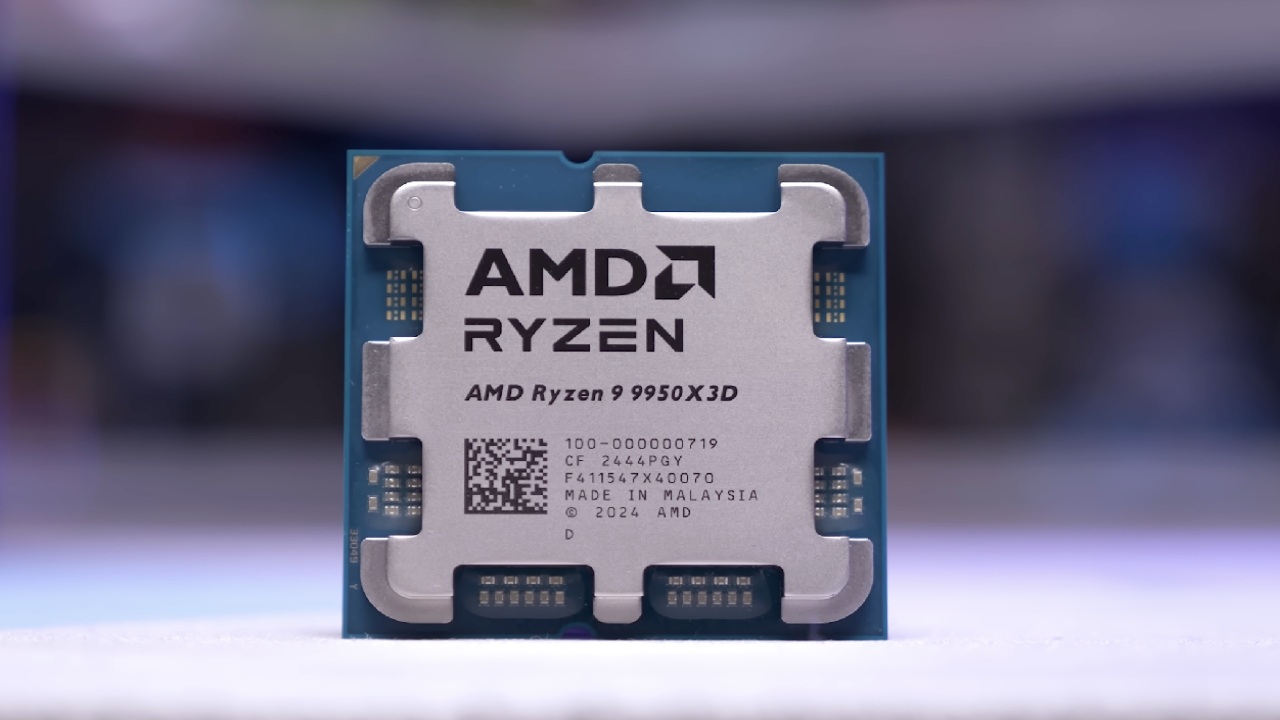
Lisa Su also showcased the 9850X3D, which seems to land somewhere around mid-range expectations.
Behind the scenes, there are whispers of impressive performance using very fast memory, but since no one can buy such memory yet, AMD does not seem focused on that angle for now.
The real deciding factor will be price. If the chip lands around $480–$500, it will simply be a slightly faster but slightly more expensive option. If it costs $550–$600 and cannot run faster RAM, then that is a different conversation entirely. For now, all we can say is that AMD already holds the gaming crown by a large margin, and the 9850X3D only expands that lead.
As for the 9950X3D2, AMD quietly did not announce it. Multiple presentations about it reportedly happened behind the scenes, so its absence raises eyebrows. If AMD canceled or delayed it, the reasoning is likely strategic. Arrow Lake refresh poses little threat, and AMD may believe that the 9850X3D alone can trade blows with or come close enough to Intel's upcoming Nova Lake at a far lower cost—similar to how the 5800X3D sustained AM4 sales against Alder Lake.
Sales data reinforces this logic: most gamers buy 8-core CPUs, occasionally 6-core chips, and rarely the flagship models. It might not make sense to release a dual-V-Cache flagship that consumes more chiplets when the market shows that few people want more than 8 cores.
.jpg)
Intel CPUs barely make it into the top 20 on Amazon's best-selling CPU list. Even AM5 brackets sell better than Intel processors. Intel's popularity among fans has declined significantly, setting the stage for the Panther Lake dispute.
This year's Intel presentation at CES was very different from last year's disappointing one. Intel didn't waste time with small talk; they came right to the point. The main event this month was the debut of Panther Lake.
Even though many people were rude about it, Panther Lake seems to be Intel's best CPU launch since Alder Lake. The statements about efficiency fit with what people thought would happen: Intel would bring flagship laptop-level performance inside Lunar Lake power envelopes. This is especially true since AMD is employing cheaper, less sophisticated nodes for its chiplet solutions.
Intel's strong boasts about graphics are what really jump out.
Panther Lake is positioned as competing with the RTX 4050 in integrated performance and being 73% faster on average than Strix Point.
Intel also implicitly acknowledged that Strix Point was faster than Lunar Lake by showing a larger performance jump relative to Lunar Lake than to Strix—something Intel previously avoided.
However, some red flags exist. One slide showed that Intel was giving its own CPU more power while using a weaker 10-core/12CU AMD model instead of the full 16CU flagship. This must have had an effect on the results. There were also differences in memory rates. Intel used DDR5-9600. Strix Point, on the other hand, utilized DDR5-7500, and Lunar Lake used DDR5-8533. Bandwidth is very important for integrated graphics performance. This could inflate Intel's advantage by around 10%.
Even accounting for possible "cooked" numbers, Panther Lake still looks to significantly outperform Strix Point, likely by double digits or more, and probably beat AMD's Gorgon Point by 30% or higher. Even adjusted downward, Panther Lake seems to offer genuine gains rather than marketing exaggerations.
That being said, Panther Lake needs to win by a large margin because its complex packaging and pricey nodes make it much more expensive to make than Gorgon Point. A 10–20% lead wouldn't be enough. Panther Lake may not win in gaming against Strix Halo, its real cost-equivalent competition. Still, its efficiency and next-gen features could offer it a strong niche.
Overall, Panther Lake made one of the strongest hardware impressions at CES, surprising many people who had already given up on Intel.
Battle Mage is still missing. The revelation of the missing B770 is another bad sign. While the product appears to remain in development, Intel's unwillingness to announce it on CES's opening day suggests poor readiness or lack of confidence. Launching a flagship GPU years after initial teasing is reminiscent of hypothetical delays that would render a 7900 XTX launching today irrelevant. For now, Battle Mage is not worth close attention until Intel demonstrates otherwise.
DLSS 4.5 adds dynamic frame insertion, letting you stay flexible without always running at lower framerates. This is an upgrade that was needed for a long time. But we need additional information before we can draw any useful conclusions.
Senior Editor, NoobFeed
Related News
No Data.