
AMD 9850X3D Delidding Guide with 13°C Cooling Improvement and Stability Testing
Delidding the Ryzen 9 9850X3D delivers a consistent 13°C to 15°C temperature reduction under full load.
Hardware by Masaru Hoshino on Feb 21, 2026
The 9850X3D was recently reviewed, and the intention was always to delid the CPU during the launch coverage, but time constraints prevented it. Physically, the 9800X3D and the 9850X3D should be identical.
However, with AMD, there is always the possibility of small changes, such as different glue or minor material adjustments. The expectation is that the 9850X3D is essentially a binned 9800X3D, potentially offering slightly better overclocking margins. It has also simply been a while since a CPU was delidded.
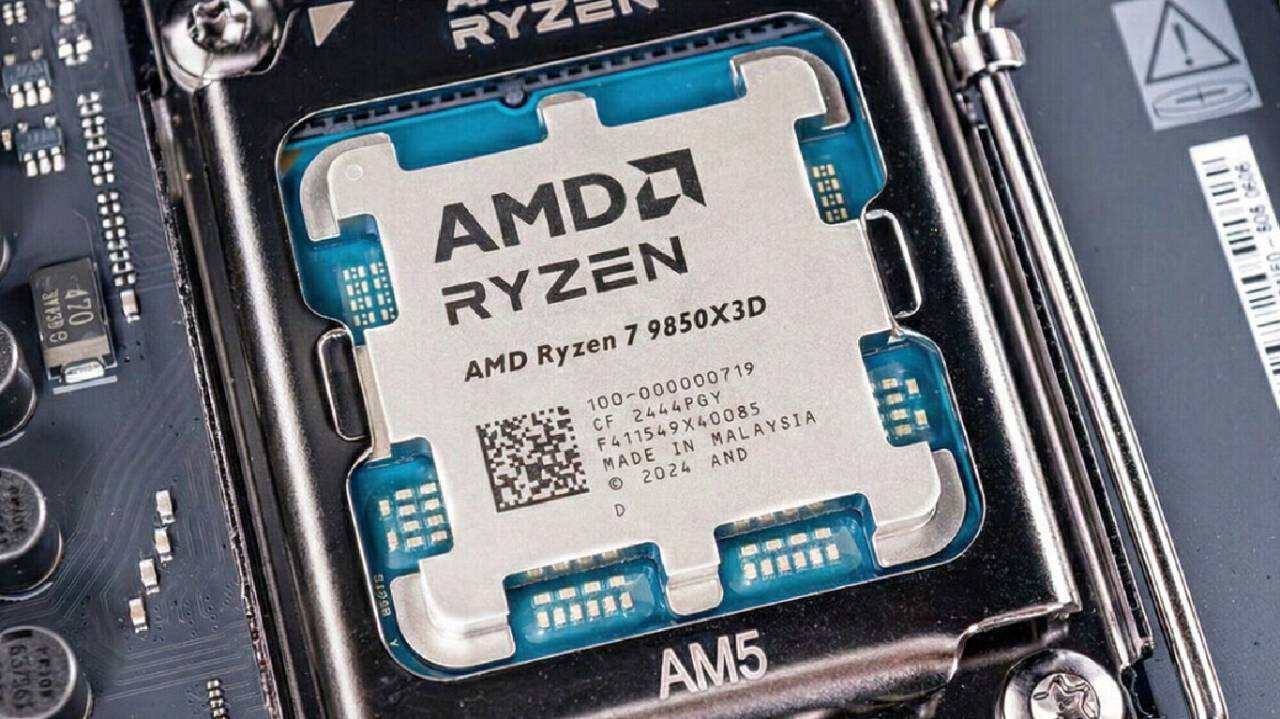
Before starting the delidding process, baseline temperature numbers were collected. The test setup consists of the ASUS X870 Hero BTF motherboard, the 9850X3D cooled by a Micro Pro water block (a non-direct-die block not yet released), paired with the MOA cooling solution and an RTX 5090.
The CPU was manually overclocked to 5.4GHz across all cores at approximately 1.27V. After running 10minutes of Cinebench R23, the maximum temperature reached 90.2°C, with CPU package power draw between 170W and 175W. Average load temperatures ranged from 72°C to 85°C.
During previous 9800X3D delidding tests, similar voltages around 1.27V to 1.28V were used. Even after delidding, scaling further with voltage was not possible. Going higher without delidding was impractical, as temperatures had already peaked around 90°C.
Freezing vs Heating Before Delidding
A method long considered but never tested involved cooling the CPU before delidding. Previously, heating the delidder and CPU to around 60°C was attempted to ease the process. However, this made removal more difficult. The indium solder likely softened at higher temperatures, requiring more than 100 movements to release the IHS. Heating indium below its melting point did not prove helpful.
The opposite approach was tested by placing the CPU and delidder in a freezer at approximately 0°C for 30minutes. The idea was that colder temperatures might make the indium harder and more brittle, increasing susceptibility to metal fatigue and easing separation.
There was concern that other materials, such as solder joints between the chip and the PCB, might also become more brittle, but testing was necessary to confirm.
After cooling, the CPU was carefully removed. People wore gloves to keep things from getting too hot too quickly. The glue started to feel loose after two moves. The IHS came apart quite rapidly when they used a drill to hasten things up. It felt like it was going faster than the last few times we tried to heat it up. To avoid damaging the CPU right away, the IHS was shifted to the side instead of being pushed straight up.
The result appeared identical to previously delidded 9800X3D samples, with no surprises.
Cleaning and Surface Observations
Most of the indium solder was taken out by hand. Liquid metal was used to remove any residual material, and it was left for a few minutes. The upper layers of the CPU are very complicated. They are made up of indium, gold, titanium, and nickel, among other things. These coatings form a complex structure that needs further investigation in future tests.
After cleaning, liquid metal was applied to both surfaces before reinstalling the CPU in the system.
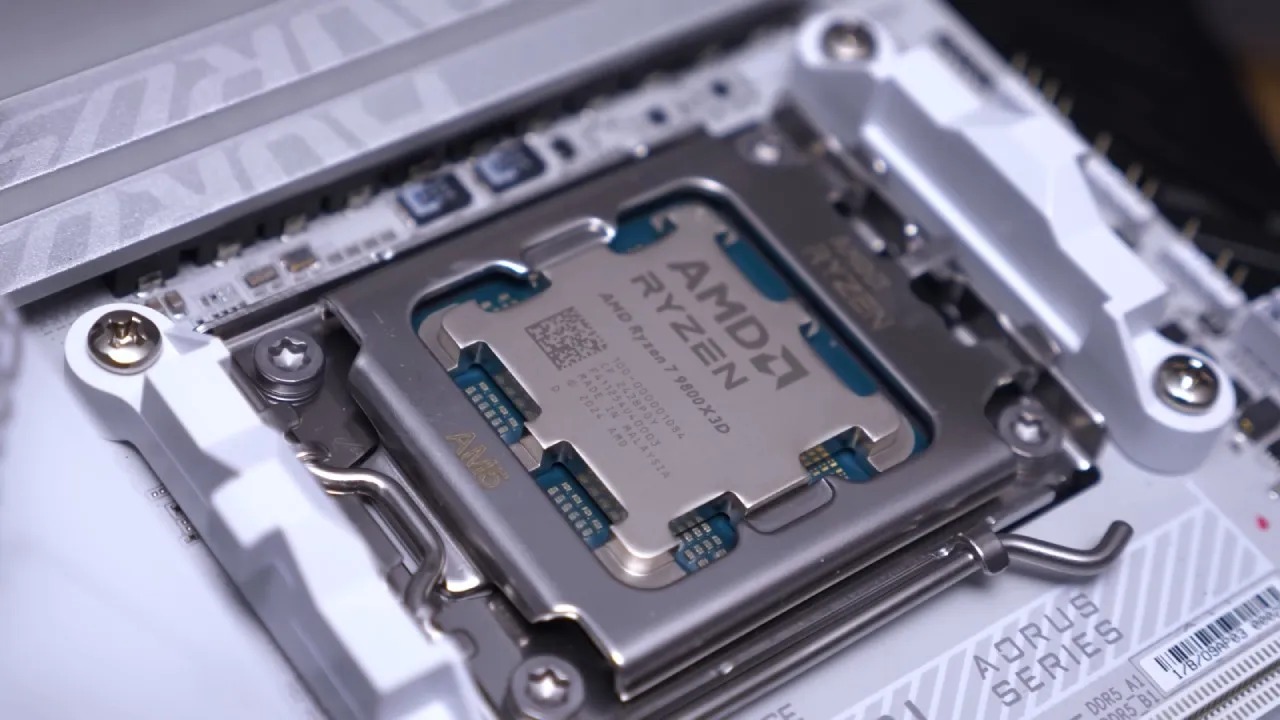
Post-Delid Temperature Results
A quick check of the BIOS showed that everything was working OK. The settings were reapplied, and the idle temperatures seemed stable. We ran Cinebench R23 again for 10 minutes.
The highest temperature was 77.4°C, which is 13°C lower than before delidding. Core behavior showed that the temperature dropped by about 15°C while the load was on. These results are in line with what has been seen before with delidding Ryzen chips, where the gains are usually between 13°C and 15°C.
It was determined that the mounting pressure was good and that the cooling performance was stable.
Overclocking Comparison
Next, overclocking capability was tested and compared with a personal 9800X3D sample that previously achieved 5.6GHz at similar voltage levels. However, comparing two individual CPUs does not represent the entire product series. A meaningful conclusion would require testing 100samples of each model, which is not available.
Testing began at 5.5GHz, which the 9850X3D handled without issue. Temperatures and benchmark scores remained stable. Increasing to 5.6GHz resulted in an instant freeze. A retry at 5.575GHz also froze immediately. Even increasing the voltage by 30mV to 1.30V did not allow 5.575GHz to pass stability testing.
In this limited comparison of two samples, the 9800X3D performed better. But this doesn't mean that there is a bigger trend, because silicon variation is a big part of it. The 9800X3D sample that was used before was known to be very powerful.
Final Thoughts
If you currently have a 9800X3D, there is no real reason to upgrade to the 9850X3D. The 9850X3D can still be a good choice for people who are upgrading from an older platform because the price difference isn't that big.
Delidding lowers the temperature by about 13°C to 15°C every time; the exact amount depends on the CPU. ThermoGrizzly Shop has pre-delidded CPUs with warranties for people who want them.
The 9850X3D works exactly as expected in terms of thermal and overclocking performance. This shows that delidding is still a good way to lower temperatures significantly, but the gains from overclocking depend on the quality of the silicon.
Also, check our other hardware articles:
- AMD Ryzen 9 9950X3D Review: Setting The Standard For 2025 Gaming CPU
- Amazon Luna 2025 Review: Is Prime Gaming's Cloud Service Your Go-To For Casual Fun?
- AMD RX 9070 XT Review: AMD's RDNA 4 Champion for 1440p Gaming
- GeForce Now Ultimate: Ditching Your Gaming PC For Cloud RTX 4080 Power?
- NVIDIA GeForce RTX 5080 Review (2025): Still A 4K Gaming Powerhouse?
- Intel Core Ultra 9 285K Review And Performance Breakdown (2025)
- AMD Ryzen 7 9800X3D Review: 3D V-Cache Goes God Mode with Stunning Gaming Performance
- Intel Core Ultra 9 285K vs AMD Ryzen 7 9800X3D: In-Depth Gaming Performance and Benchmark Comparison
- NVIDIA GeForce RTX 5080 Super Performance In Cyberpunk 2077: Path Tracing & DLSS 4.0 Tested
- AMD Radeon RX 9070 XT In Cyberpunk 2077: Ray Tracing & FSR 4.0 Tested
- Intel Arc B580 Review: The $250 GPU Revolutionizing 1440p Gaming
- Intel Arc B570 Vs. B580: Value, Specs, And Real-World Gaming Performance
- RTX 5090 Laptop Vs. M4 Max MacBook Pro: Ultimate Raw Performance Vs. Battery Endurance
- Intel Arc b580 Vs. RTX 4060: Game Performance And Value Analysis
- RTX5090 Hell Is Us Demo 4K Ultra Benchmark: DLSS Vs. Native Performance Guide
- NVIDIA RTX 5070 Review: Mid-Range Muscle or Marketing Hype?
- Nintendo Switch 2 Review: Handheld Performance, Features & Value Breakdown
- RTX 5070 Ti Review: Performance, Thermals & Power Efficiency Tested
- Samsung Odyssey OLED G81SF Review 2025: Ultimate 32-Inch QD-OLED Gaming Monitor
- AMD RX 9070 Performance Review: Thermals, Clocks, and Real-World FPS
- AMD Ryzen 5 7600 Review: Best Budget Gaming CPU of 2025?
- AMD Radeon RX 7800 XT Review: RDNA 3 Power For Midrange Gaming
- Asus ROG RTX 5090 Astral OC Vs. Founders Edition: The 4K Gaming Benchmark
Editor, NoobFeed
Gaming Hardware Updates
No Data.