
Intel XeSS Multi-Frame Generation Performance on MSI Claw 8 AI
XeSS multi-frame generation enables desktop-class gaming performance on MSI Claw 8 AI handheld hardware.
Hardware by Nahe Yan on Feb 05, 2026
Intel XeSS multi-frame generation is currently working on the MSI Claw 8 AI, which is a handheld gaming device that can run games at high frame rates. The rig shown runs Cyberpunk 2077 at 1200p with the Ultra preset, achieving performance levels not usually seen with this type of hardware. Intel Arc140VIG GPU, based on Xc2 architecture, lets you use the feature locally on the device, without streaming.
Intel Panther Lake CPUs and Xc3 GPUs officially support XeSS multi-frame generation. Still, it can already be enabled on systems with Xc2 chips. The technique uses official Intel drivers and data, which are applied manually. The approach works as it should, but it is not official yet. Intel may add it directly in the future.
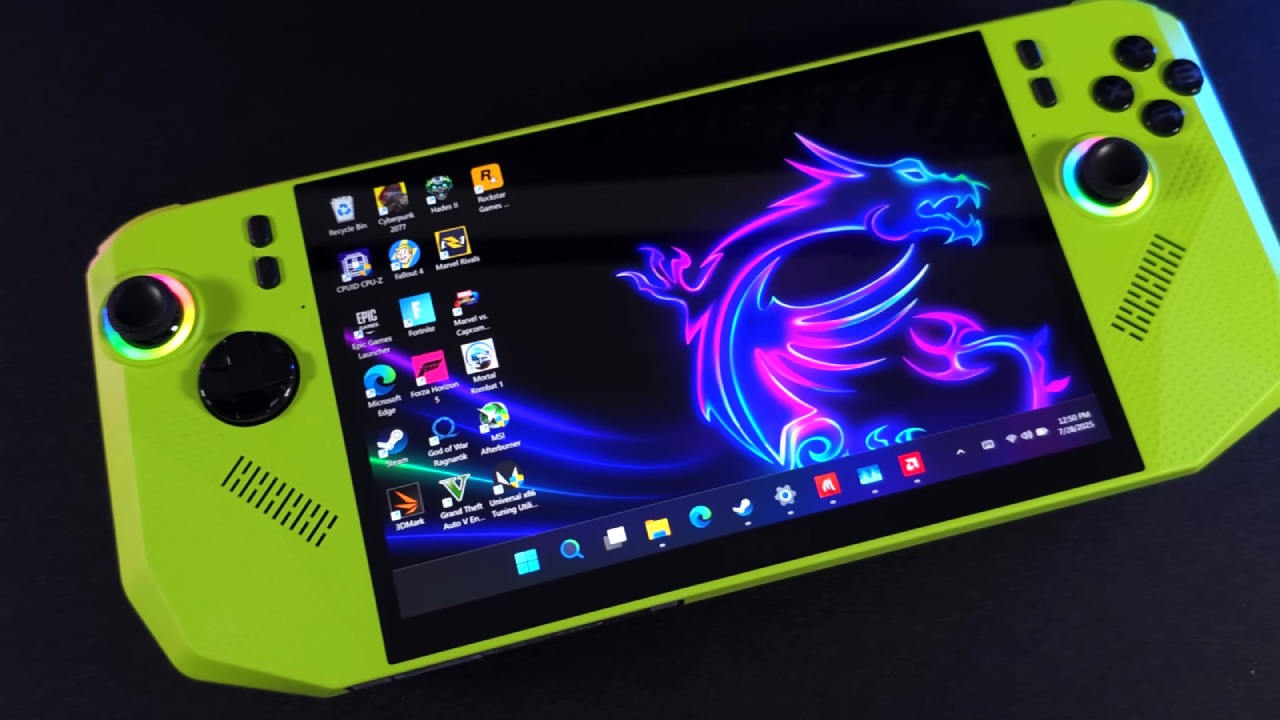
Setting up hardware and software
MSI Claw 8 AI uses an Intel Core Ultra7258V and an Intel Arc140VIG GPU. When the override is enabled, Intel Graphics Software displays a new XeSS multi-frame generation section with options for 2x, 3x, and 4x. The main emphasis of the tests was the 4x setting, which was used with Intel XeSS's low-latency mode to keep input delay under control.
How to Install Drivers
Two parts are required for XeSS multi-frame generation to work. The first is the most recent Intel Arc graphics driver, and the second is a utility that removes all drivers to ensure a clean installation. After the driver package is extracted, two files from the newer Xc3 driver folder are moved to the older Xc2 installation path. Once the old driver is completely gone and the new installer is run, the system installs support for XeSS multi-frame generation.
Testing Cyberpunk 2077's Performance
The game Cyberpunk 2077 was played at 1200p. with the highest and ultra settings. Standard XeSS frame generation doubled the frame rate, and XeSS multi-frame generation took performance to a whole new level. When the 4x setting was enabled, the average frame rate exceeded 100 fps. Power draw went up a little, to around 30W TDP, but performance stayed the same.
With ultra settings, XeSS multi-frame generation set to 4x, and no XeSS scaling, the system averaged 157 fps at 800p on the built-in 8in120hz VRR display. At this resolution, the picture stayed clear.
Results for Black Myth Wukong
Black Myth Wukong was run at 1200p, with high settings and 80% internal scaling. Because of the obvious input lag at 4x, XeSS reduced multi-frame generation to 3x, which fixed most responsiveness issues. Even after these changes, the game still ran at frame rates handheld hardware can't usually handle.
More Game Testing
We tested Japanese Drift Master to see how well it worked in a racing situation. The title worked as planned, as long as native XeSS frame creation was supported. We also tested Hogwarts Legacy at 1200p, high settings with XeSS multi-frame generation set to 4x, and the results were solid. In most cases, the 3x setting was a good middle ground between speed, power use, and latency.
We tried Marvel Rivals at 1200p, high settings with 4x multi-frame generation. Frame generation is usually not used in multiplayer games. Still, Intel XCSS's low-latency option enabled online play with little trouble.
Notes on Compatibility
XeSS multi-frame generation only works in games that already support Intel XeSS frame generation. At the time of testing, about 43 to 45 games met this criterion. One game that didn't work was Borderlands 4, where neither XeSS nor other frame-generation methods worked properly.
.jpg)
Things to think about when it comes to power and efficiency
We conducted all testing at 30 wTDP to achieve the best performance. Lower-wattage setups still work with lower resolutions, and performance scaling remains the same across all tested titles. You can make your battery last longer by reducing XeSS multi-frame generation from 4x to 3x without losing much frame rate.
Final Thoughts
Since its release, driver updates have gradually improved the MSI Claw 8 AI's performance. Adding XeSS multi-frame generation makes it much more powerful. Intel has said it will make a Panther Lake processor in the future, specifically for portable devices. This chip is believed to be better than the ones currently available. Until then, XeSS multi-frame generation enables a lot more with Intel-based handhelds.
Also, check our other Intel chips Articles below:
- Intel Core Ultra 9 285K Review And Performance Breakdown (2025)
- Intel Core Ultra 9 285K vs AMD Ryzen 7 9800X3D: In-Depth Gaming Performance and Benchmark Comparison
- Intel Core i5-13400F Gaming Performance: Still Worth It in 2025?
- Intel Core i9‑14900K vs. AMD Ryzen 7 7800X3D: Power Profiles & Gaming Benchmarks
- Intel Core i9 14900K: Specs, Benchmarks, and Competitor Comparison
- Intel Core Ultra 5 245K Review: Gaming, Productivity & Power Efficiency Tested
- Intel Core Ultra 9 285 K's iGPU Gaming: In-Depth Benchmarks & Analysis
- Intel vs. AMD Gaming Laptop: Performance, Thermals & Battery Life Compared
- AMD Ryzen 7 9800X3D vs.7800X3D vs. Intel Core Ultra 7 265K: Gaming, Thermals & Price Analysis
Editor, NoobFeed
Gaming Hardware Updates
No Data.