
NVIDIA DLSS 5 Sparks Debate Over AI Rendering
DLSS evolved from AI upscaling into neural rendering that now reshapes entire game visuals in real time.
Hardware by Shinji Okazaki on Jun 13, 2026
Nvidia's DLSS has long been known for using AI-based rendering methods to enhance gaming performance. The technology has developed from image upscaling to frame generation since 2018, and more recently to neural rendering. The unveiling of DLSS 5 in early 2026, however, has drawn the wrath of gamers and developers alike because of its potential to alter a game's visual appearance.
Nvidia's DLSS technology has been improving game performance for 8 years with hardly any loss. Let's be honest: the company did receive some criticism for adding AI-generated fake frame-rate numbers, but overall, DLSS has had a positive reputation.

The Evolution of DLSS
RTX 2080 was the first graphics card to feature Nvidia's original Deep Learning Super Sampling. This is a gross oversimplification, but basically it would process smaller images and then use machine learning to re-scale them to a higher resolution without the significant performance penalty. Later releases improved this image enhancement process, including an enhanced anti-aliasing and denoising algorithm.
In DLSS 3, the technology advances with the addition of frame generation, which boosts frame rates through the use of AI to create what many gamers referred to as "fake frames. The new version, DLSS 4.5, can produce up to 6 fake frames per real frame. A real frame is still generated using the traditional graphics rendering method, though it is modified during the process.
The New Way to Do DLSS 5
DLSS 5 may push the concept of faux frames even further, replacing real frames. NVIDIA says DLSS 5 takes a real-time neural rendering model to add photoreal lighting and materials to pixels. This ultimately results in a skin that shines from within, fabric with some sheen, and hair that is more detailed than on a hard surface. Nvidia's Zora environment demo showed dense forest growth with complex lighting effects that would be very difficult to simulate with traditional methods.
One interesting thing about DLSS 5 is that, for now, it doesn't seem particularly concerned with boosting performance. Rather, it is about the picture's quality. But those images are either attractive or not – the tech is real. That is the bigger question: how it does that. The facts are distinctly different from Nvidia's explanation. The facts differ significantly from Nvidia's explanation.
Nvidia CEO Jensen Huang said that DLSS 5 works at the geometry level and that developers would have the freedom to control the model's output. The description implied a tight coupling with game engines and direct access to developer-made assets. But more information about the technology's operation was provided later. Nvidia's Jacob Freeman confirms the details of DLSS 5, which will accept a 2D frame and motion vectors. Information about the direction of objects moving is recorded in motion vectors.
In addition, this model is unaware of the game's actual geometry, texture files, and other assets. Instead, it infers details from the completed image. It basically takes a 2D screenshot and applies generative AI algorithms to produce a modified output. The scenes were highly realistic in some of Nvidia's demos, especially the environments rather than the characters. Meanwhile, the process raised concerns about the level of creative control artists and developers have.
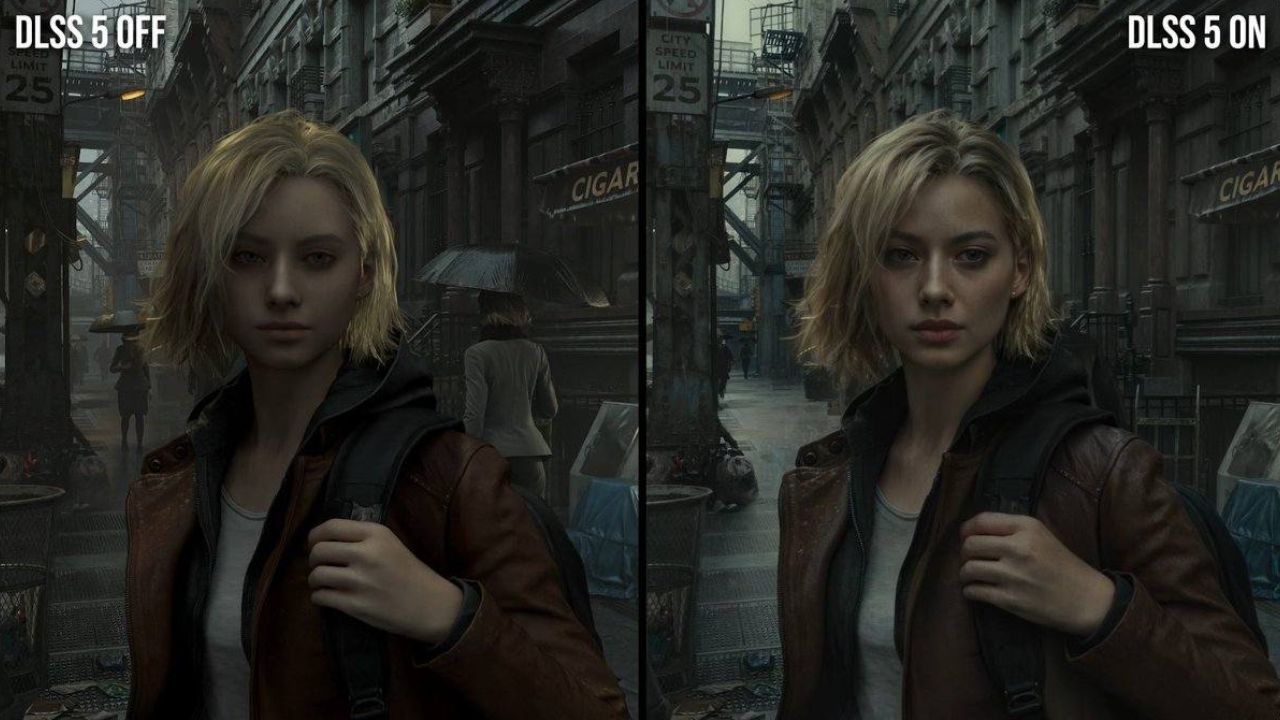
Why did gamers resist it?
DLSS 5 came under heavy criticism for affecting character appearances. Character faces were noticeably different in the Resident Evil Requiem, Starfield, and Hogwarts Legacy demos. The cast of Resident Evil's Grace Ashcroft came in with makeup that was not done as before. One character in the game Starfield appeared to grow some more hair.
Faces were sometimes much smoother and airbrushed more than before. The changes were discussed online, and the term "yassified" began to be used to describe them. Former Red Dead Redemption 2 developer Mike York said the technology was more of an AI rerender than a lighting pass. That characterization is consistent with what is known about the system's inputs and outputs and how the technology is currently being used.
For many players, it's not just about better lighting or better quality images. Rather, it could be that an AI model is making artistic choices that are changing how characters and environments are originally designed. Developers have not completely lost control over the rendering process, NVIDIA tells us in its FAQ. They can change the blending, contrast, saturation, and gamma settings.
They can also specify which elements to mask so the AI does not change them. These controls are, in essence, similar to image editing controls. The AI still decides how to change most of the scene, and that's based on a 2D image, without direct access to the game assets. As a result, many developers and gamers remain wary of the power artists wield over the final product's visuals. Some titles, such as Assassin's Creed Shadows, Resident Evil Requiem, and Oblivion Remastered, are set to arrive in the Fall, along with DLSS 5.
That will give NVIDIA opportunities to iron out the bugs and offer developers more flexibility.
The initial launch of DLSS was also a difficult time in 2018; at the time, it was the standard in AI upscaling, but since then it has improved significantly. Given that history, it's conceivable that attitudes toward DLSS 5 could shift as this technology develops. But whether that will occur will hinge on Nvidia's willingness to have an honest conversation about issues of artistic control and the changes AI algorithms make, rather than simply dismissing them.
Even if neural rendering were to improve, the screen will always be the last step between the created content and viewers. These visual enhancements will appear different during gameplay depending on the panel's quality. Due to its image quality, OLED technology has gained widespread adoption among gamers. No matter how graphics are created with AI, display technology remains a crucial part of the final products viewed on screens.
Editor, NoobFeed
Gaming Hardware Updates
No Data.