
Four AMD RX 470 With 32GB GDDR5 on a Massive PCIe Board Prototype Discovered
Four Radeon RX 470 processors share a massive PCB, creating one of the strangest graphics hardware discoveries in recent years.
Hardware by Tanvir Kabbo on Nov 04, 2026
The history of graphics technology is full of bold engineering experiments that never reached consumers. But every so often, an obscure development board pops up that makes even seasoned hardware fans wonder what GPU makers were working with behind closed doors. The new one might be one of the most ridiculous ever, a massive AMD-branded PCIe graphics board with four Radeon RX 470 GPUs on a single PCB.
Hardware leaker GOK (@GOKForFree) has shared online photos of a giant red development board that houses four Polaris GPUs in a 2x2 layout. The board is so big it makes the motherboard pictured next to it look small. What's even more striking is its claimed 32GB of GDDR5 RAM, its enormous power consumption, and its odd PCIe interface.
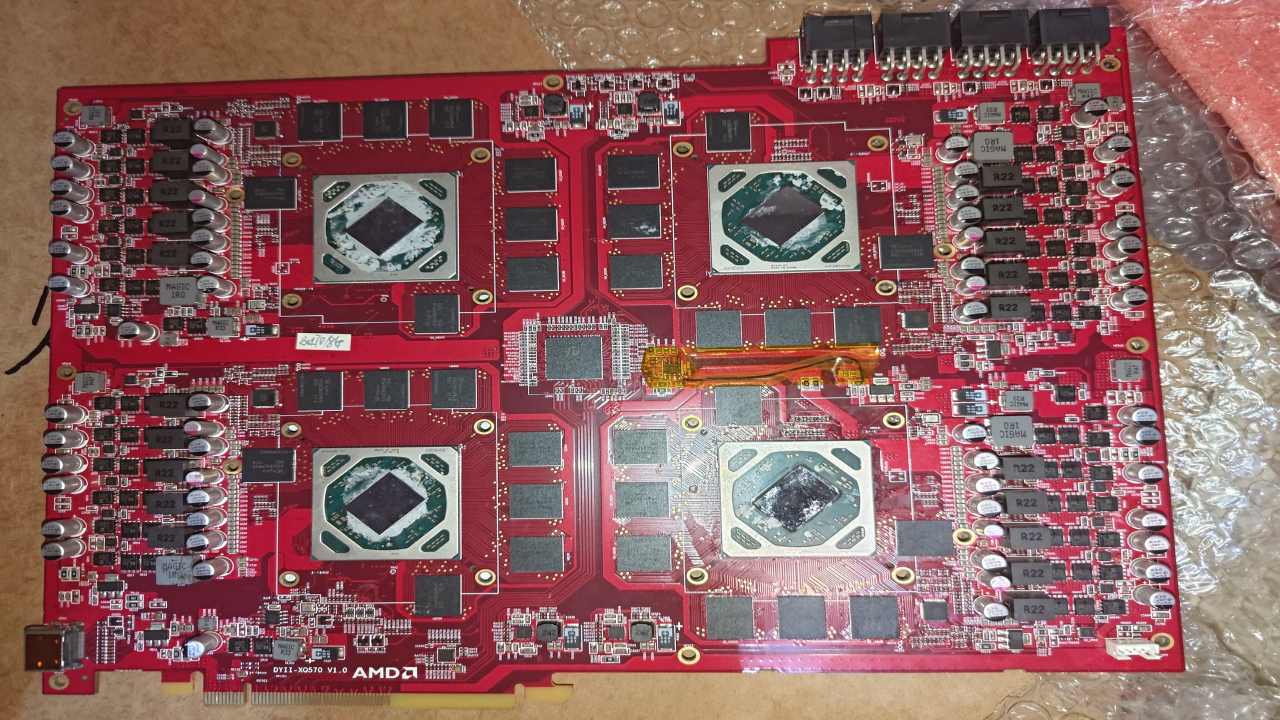
AMD has not officially launched such a product, but this find offers an interesting look at experimental hardware ideas around the bitcoin mining surge.
Under the Hood: Four Polaris GPUs on One PCB
The most impressive thing about this find is how much silicon it can cram onto a single expansion card. According to GOK, the four GPUs are Radeon RX 470 GPUs built on AMD's 14nm Polaris architecture, first unveiled in 2016.
Each GPU occupies its own section of the oversized PCB, surrounded by enough GDDR5 memory chips to provide 8GB per GPU. That brings the combined memory capacity to an impressive 32GB of GDDR5.
However, this isn't equivalent to a conventional graphics card with 32GB of unified VRAM. Each GPU maintains its own dedicated memory allocation, meaning software would need to distribute workloads across the four processors rather than access the entire capacity as one shared memory pool.
For perspective, a standard Radeon RX 470 features 2,048 stream processors and 32 compute units. If all four processors operate as expected, the prototype theoretically combines 8,192 stream processors across its four GPU sections. That is an extraordinary amount of Polaris silicon for a single PCIe expansion card.
Power delivery presents another engineering challenge. The board features four 8-pin PCIe power connectors, providing substantial electrical capacity for the densely packed processors. The design also incorporates a PCIe 2.0 switch, allowing multiple GPUs to communicate through a shared host connection. However, its relatively limited bandwidth would limit applications that require frequent communication between processors.
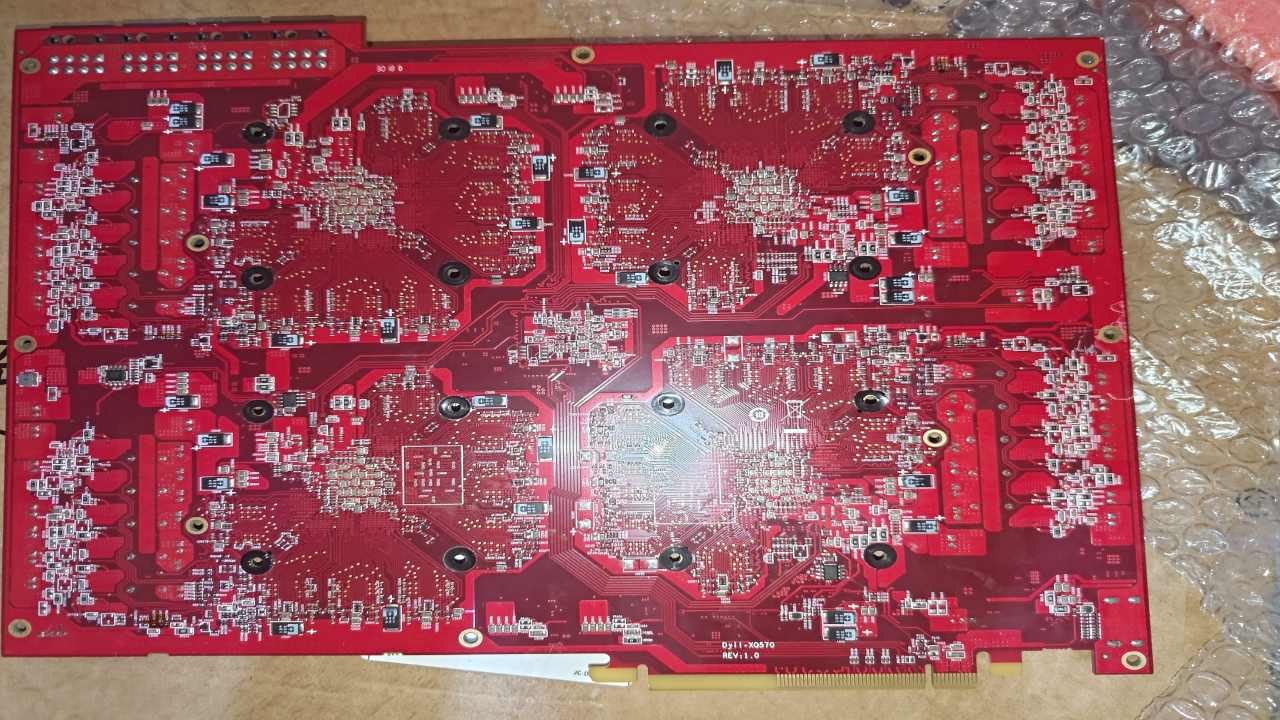
A Relic of the Mining Boom: Four GPUs Built for Cryptocurrency
Despite its impressive specifications, the board's physical layout provides important clues about its intended purpose. The most revealing detail is arguably its display connectivity.
The entire four-GPU configuration features just one HDMI output. That would be an unusual decision for a gaming graphics card, where multiple display outputs are generally expected. A workstation product would also benefit from considerably more flexible display connectivity. Cryptocurrency mining, however, presents entirely different requirements.
During the Ethereum mining boom, AMD's Polaris GPUs became particularly attractive because of their performance in memory-intensive workloads. Miners cared less about traditional gaming and more about maximizing computational performance while keeping deployment costs reasonable.
A specialized board combining four RX 470 GPUs could theoretically consolidate several individual graphics cards into one expansion device. A mining operator might be able to run four processors using a single PCIe link, rather than four GPUs.
The PCIe 2.0 transition also makes much more sense from this perspective. Mining workloads often require far less communication between the GPUs and the host processor than heavy gaming activities. So limited PCIe bandwidth would matter less. Ethereum mining is therefore a particularly plausible explanation, although the board's actual purpose remains unconfirmed.
AMD Mystery: Secret Engineering Sample or Overseas Frankenstein?
The board's origin is arguably more interesting than its specifications. An AMD logo is clearly visible on the PCB, suggesting some connection to the company. However, the board reportedly carries the DYII-XQ570 V1.0 marking rather than a conventional AMD board identification number. It also lacks an official board OPN and standard AMD formatting.
This leaves two particularly interesting possibilities. The first theory is that the board originated as an internal AMD engineering experiment. During the crypto mining boom, the business could have explored putting multiple Polaris GPUs onto one expansion card, perhaps even developing a reference design for dedicated computing. AMD may have abandoned it before reaching commercial production.
Alternatively, this could be a custom creation assembled by an overseas manufacturing facility for large mining operations. Specialized factories might have experimented with non-standard PCB layouts, packing available GPU components in exceptionally dense ways.
Just because it says AMD on it doesn't mean AMD created or built the board. Without any more evidence or confirmation from AMD, its true origin is unknown.
FAQ
Q. How many GPUs does the mysterious AMD RX 470 prototype feature?
A. The prototype features four AMD Radeon RX 470 GPUs arranged in a 2x2 configuration on a single oversized PCB, combining four Polaris processors into one PCIe expansion card.
Q. How much memory does the quad-GPU RX 470 prototype have?
A. The board reportedly features 32GB of GDDR5 memory, with 8GB allocated to each of its four Radeon RX 470 GPUs.
Q. Was the quad-GPU RX 470 prototype designed for cryptocurrency mining?
A. Its single HDMI output, extreme compute density, and four 8-pin power connectors strongly suggest a specialized mining design, potentially intended for Ethereum mining during the cryptocurrency boom. However, its original purpose remains unconfirmed.
Q. Did AMD officially release the four-GPU RX 470 graphics card?
A. No. AMD has not officially announced or released the board. Its origins remain uncertain, with possibilities including an abandoned AMD engineering sample or a custom mining-focused creation from an overseas manufacturer.
Senior Editor, NoobFeed
Gaming Hardware Updates
No Data.